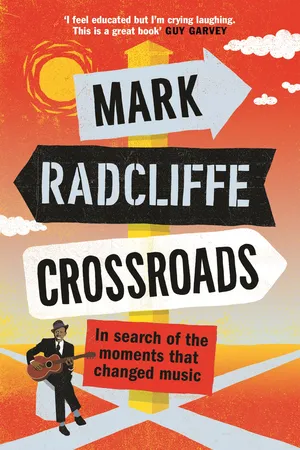
Standing at the crossroads – the Mississippi crossroads of Robert Johnson and the devil's infamous meeting – Mark Radcliffe found himself facing his own personal juncture. Aged sixty, he had just mourned the death of his father, only to be diagnosed with mouth and throat cancer. Together these events led Radcliffe to think about pivotal tracks in music and how the musicians who wrote and performed them had reached the crossroads that led to such epoch-changing music.
Crossroads is a warm, intimate account of music and its power to transform our lives, as Radcliffe takes a personal journey through these key tracks.
- 304 pages
- English
- ePUB (mobile friendly)
- Available on iOS & Android
eBook - ePub
About this book
Information
Subtopic
Music1
I Went Down to the Crossroads
‘So, have you guys been laid?’
We’ve all had interesting conversations with taxi drivers in our time but as an opening gambit this still came as a something of a surprise. The cabbie in question was a generously proportioned African American gentleman, memorably kitted out in a white and gold velour track suit, oversized and unlaced Timberland boots and a leather fedora. It’s not often you feel under-dressed when being picked up in a minicab, but this was certainly one of those rare occasions.
On the morning in question this voluble, lavishly attired roué was collecting me and my travelling companions Jamie and Phil from a hotel in downtown Memphis, where North Front Street crosses Jefferson Avenue, to take us out to Graceland as per the itinerary for our collective sixtieth birthday road trip. I checked the schedule again just to confirm that ‘getting laid’ hadn’t been slipped in there as an optional extra by our travel agent Shannon. It seemed unlikely even though they do always tell you to read through all documentation, but there didn’t appear to be any brothel vouchers in our travel pack.
It was rainy that day in Memphis. The Mississippi river, which in my mind was going to be a glistening mile-wide ribbon peppered with chugging paddle steamers from the decks of which distant straw-hatted relations of Tom Sawyer dispensed cheery waves, was a Lowry-esque Salfordian smudge of turgid grey traversed by weary goods locomotives hauling their endless chains of rusting containers all the way to Arkansas.
Being practical souls, the three of us had dressed for the weather and were sitting in the taxi in our firmly zipped and poppered cagoules, while our charmer of a chauffeur indulged in several minutes of sexually infused badinage and innuendo with the ample receptionist. Once he took the wheel you would have thought that one look at us would have told him that the answer to his question was only ever going to be in the negative. People in Memphis to ‘get laid’ probably don’t pack cagoules, do they? On reflection it occurred to me that his enquiry wasn’t actually restricted to the immediate locale. Perhaps he glanced at us and wondered whether we’d been laid ever. Again, the way we looked that day, a response in the affirmative was by no means a foregone conclusion.
As longtime buddies since university days, and music nuts our whole lives, Phil, Jamie and I had always planned a trip to some of the key historical sights of the birth of rock and roll and R&B. Memphis has not only Graceland, but also the Sun and Stax studios and the blues joints of Beale Street with their neon hoardings and promise of honest sweaty bands and cheap liquor. Nashville has a similar strip for the cream of country bar bands on Broadway, the Grand Ole Opry and the Country Music Hall of Fame. For the journey between the two cities we’d opted to take a scenic route called the Natchez Trace Parkway which rolls through endless miles of woodland, dipping into Tennessee, Alabama and Mississippi and stopping amongst other places at Elvis’s birthplace in Tupelo where the shotgun shack he was born in still stands on its original footings.
Before heading on the parkway to Tupelo, though, we detoured to Clarksdale, Mississippi. In many ways it is such a classic American ‘small town’ that at first you wonder if you haven’t strayed onto a film set. Naturally the streets are on a grid pattern and none of the buildings are above two or three storeys high. Cars park diagonally into the curb, every store and house has a bench on the stoop and puffs of dancing dust swirl with every rare breath of breeze. The walls are painted in bright oranges, pinks and turquoises, or at least they are colours that were bright once. Chipped, faded and heat ravaged, it looks like there hasn’t been a reliable painter and decorator in town since the mid-Sixties.
But there is history here. There are clues in some of the shops. In a settlement this size in the UK you might expect to find a mini-mart, a pub, a grocer’s or butcher’s, maybe a newsagent’s, a scented candle and mindfulness parlour, artisan beard waxer and, if you’re very lucky, a Post Office. You wouldn’t happen upon a saxophone outlet very often. But there’s one in Clarksdale. It’s painted puce with various bluesmen caricatured on the frontage and is called Deak’s Mississippi Saxophones and Blues Emporium. The sign on the pavement outside advertises ‘harmonica lessons, sales and service, live music, folk art, open harp surgery and cold beer’. Top man Deak. Which shopping experience isn’t enriched by the offer of cold beer except for perhaps test-driving a new sports car or motorbike? Or buying a gun perhaps. None of these items seemed to be readily available in Clarksdale although there were two other musical instrument suppliers, several more purveyors of folk art and cold beer and a heroically graffiti-infested fairy-lit blues club and soul food café co-owned by Morgan Freeman called Ground Zero for reasons that evade me. Dining in places named after memorials to major terrorist incidents is not something that it’s easy to do but I had catfish nevertheless. It just seemed the right thing to do somehow. It was nothing to write home about although I suppose that’s exactly what I’m doing now.
So why is there such a musical presence in a one-horse town like Clarksdale? Well, it’s because it can make a convincing case for being the very place where the blues itself began, or at least the Delta blues as opposed to the Chicago blues (the birthplace of which you can probably guess at). The Delta blues came first. It is the folk music of that landscape. These are primal screams of poverty and pain featuring, for the most part, voice, acoustic guitar and harmonica, and even a few hours in hundred-degree temperatures traversing that flattened, sweating topography is enough for you to begin to understand how that music came about. Chicago blues came a bit later and developed when many of the dab hands of Delta migrated to Illinois and discovered the electric guitar. Ironically the generally acknowledged first Delta blues recording, Freddie Spruell’s ‘Milk Cow Blues’, was recorded in 1926 in … Chicago. So although the birth of the blues happened on the Delta not Chicago, recorded Delta blues was born in the Windy City. Of course pinning down the actual birthplace of the genre to one point on a map is well nigh impossible. There are many locations, notably the Dockery Cotton Plantation which stakes a claim, but at the heart of Clarksdale’s bid is one of the greatest legends in all of rock and roll.
You come into Clarksdale on Highway 61. As this was my first time there, it felt inappropriate to soundtrack the drive with Bob Dylan’s ‘Highway 61 Revisited’ but next time I’ll be sure to put that right. Just before you hit town there’s an intersection with Highway 49. It’s a wide but nondescript junction with a Sonic petrol station and various stores offering hot food and tobacco. Traffic lights hang from scrawny electric cables above a central grass island. It’s not particularly well tended, though there is a flower bed, and a utilitarian grey wiring box is mounted on a telegraph pole. It’s a junction like hundreds of thousands of others in the USA. Except that it isn’t.
Also rising from the turf is a post with three semi-acoustic guitars clinging to it and a sign under each of them that says ‘The Crossroads’. For this is not a crossroads. It is the Crossroads. And, at that moment, having been experiencing major life changes myself it felt like a significant place to be. The whole trip was planned to celebrate our landmark birthdays, but it also served as a welcome escape from dealing with stuff back home, and standing on this spot seemed to bring all those feelings together. So what was it about this spot that made it such a symbol of change and transformation and one that altered the course of popular music?
Robert Johnson, or possibly Spencer, or one of around eight other surnames he adopted at various times, was born in Hazlehurst, Mississippi, in 1911. He was, like most black people in the States, from impoverished stock and raised in a town that was a real powerhouse for the growing of tomatoes and cabbages but had little else going for it, bearing in mind this was at least a century before the lilies were gilded and cabbage was labelled a superfood and tomatoes a fruit. Even had he known all of that, it seems unlikely that young Robert would have found the information fascinating enough to make him want to stick around. It’s on the Delta. The soil is fertile. Stuff grows. So what? And so he became an itinerant musician and agricultural labourer, at one time ending up at the famed Dockery Cotton Plantation where the workforce at one time or another also included Delta blues legends Charley Patton and Howlin’ Wolf.
Over the years that followed there were various recorded sightings of Johnson all over the region as he scraped a living singing in juke joints or on street corners. In Beauregard, Mississippi, he hooked up with Ike Zimmerman who famously practised his guitar-playing and singing in graveyards at night. In Robinsonville he spent some time with another giant of the scene Son House who seemed to take quite a shine to Robert and liked his harmonica playing (perhaps he’d had lessons at Deak’s), but considered him a very poor guitarist and average singer.
It’s clear that, not unlike our taxi driver, the young Robert Johnson was a dude with some presence. He was evidently a charismatic performer, if prone to wandering off when he got bored, and was effortlessly persuasive with the ladies. That Robert Johnson got laid, and regularly, is not in doubt. The cagoule wasn’t launched until the early Sixties in the UK when former Royal Marine Noel Bibby registered the Peter Storm trademark. However, even if they had been available in Mississippi in the Thirties it seems unlikely that Robert would have bought one because he was a dapper guy. Nomadic he may well have been but in the only photos we have of him he was what blues aficionados ZZ Top might call a ‘Sharp Dressed Man’. There are really only two portrait images that are generally seen. In one he has a cigarette hanging nonchalantly from his lip at a louche angle, as he shapes a barre chord in braces and a white shirt. In the other more famous picture, which is reproduced in a peeling mural on a Clarksdale gable end, he is resplendent in a pristine chalk-striped suit with pocket handkerchief, shirt, tie and a rakishly cocked trilby. His spindly fingers once again bestride the neck of the guitar he is most associated with, a Gibson L-1 archtop, the instrument which by rights should sit on The Crossroads marker post. He looks every inch the superstar, the Prince of his day, even though he would actually go higher up the ranks of the nobility by being dubbed ‘The King of the Delta Blues’.
But hang on. If Son House was right and Johnson was a journeyman in terms of his guitar-playing abilities, then how did he reach these exalted heights?
Roughly four centuries before Robert Johnson’s lifetime, in what is now Stuttgart, lived, legend has it, a scholar, magician and alchemist called Johann Georg Faust. A restless soul, he found himself as dissatisfied with the incantations and inculcations of the town of Knittlingen as Robert Johnson would come to be with the dubious fruits and over-hyped superfoods of Hazlehurst, and began to wonder if there was a way of deriving greater rewards and excitement from this earthly drudgery. This is a thought many of us have had and have sought to confront by buying a new sports car or motorbike, experimenting with an inadvisable wardrobe makeover, returning in late middle age to a foam party in a cavernous Ibizan discotheque or getting laid by a younger consort. In fact, Faust did go down this latter route with a fragrant Fräulein by the name of Gretchen who would later be arrested for murder after drowning their son. So that went well. However, the key part of Faust’s plan to negotiate the midlife crisis was to recruit a bit of help from the Devil.
Summarily summoning Mephistopheles, Faust made a pact to enjoy a bounteous and luxurious life on earth in return for letting his soul head off to Hell when it was all over. Given this came in his sixtieth year, this might not seem like a grand old age but remember this was Württemberg in the fifteenth century and so the equivalent today would be living until you were seven hundred and fifty. Probably.
Now, you might be wondering why Faust had need of Satanic assistance, being as he was already an alchemist and therefore presumably able to transmute base metal into gold. One would have thought that colossal material riches would automatically ensue from having that ability just as it does from being able to play football to Premiership standard nowadays. So why would he throw his soul onto the table as a bargaining chip? Perhaps he took a gamble that the Devil might not come back to collect his debt. This seems foolish, though to be fair we’re still a couple of hundred years off the Brothers Grimm collecting the story of Rumpelstiltskin. If this cautionary, and indeed Germanic, tale had been available to Faust perhaps he would have thought again. These gargoyles of the underworld always come back to close the deal. Rumpelstiltskin was absolutely clear that if the miller’s daughter wanted to marry the king then he would use his alchemical artistry to spin straw into gold as required, but he would be nipping back in the future to collect her first-born sprog as payment in full. Even then, he gave her a get-out clause. If she could guess his name then he would cancel said debt. And here it was that the imperious imp made his crucial error. After two nights of name guessing (it’s not Keith or Darren or Son House or Howlin’ Wolf), he camps out in the woods and dances round his own campfire singing:
Tonight, tonight, my plans I make
Tomorrow, tomorrow, the baby I take
The queen will never win the game
For Rumpelstiltskin is my name.
Didn’t he know he was in a fairy tale and there was bound to be a woodsman or hunter lurking nearby? Why if feeling the urge to sing didn’t he choose one of many songs appropriate to a woodland setting such as ‘A Forest’ by The Cure, Hank Williams’ ‘Settin’ the Woods on Fire’ or ‘I Talk to the Trees’ as performed on the soundtrack to Paint Your Wagon by Clint Eastwood? And so of course he was overheard and the message relayed back to Her Majesty who promptly proclaimed his name and sent him on his way, making me think that he might not have been an incarnation of Lucifer but just a really gobby goblin, albeit with a handy sideline in precious metal transmogrification. And another thing, if you can already spin straw into gold then why not just do that and buy all the sports cars and motorbikes you like without getting into a tangle at the palace?
I digress (often) and what, you may ask, does any of this have to do with Robert Johnson? Well, here’s the thing. Though his precise movements are hard to track we do know he was married to a woman called Caletta Craft and in 1932 they were living in Clarksdale and approaching Robert’s date with destiny. In a Faustian pact he is supposed to have encountered a massive, mesmerising black man at the Crossroads who agreed to show him lots of brilliant licks on the guitar and educate him in the art of killer songwriting in exchange, like our friend in Stuttgart, for his soul in perpetuity when the time came. You can understand the temptation: it is often said that the Devil has all the best tunes although I don’t think he had ‘Dancing Queen’ or ‘Get Lucky’ so that might not be entirely accurate.
What’s clear is that after this encounter, an alchemical reaction took place transmuting Johnson’s base skills into blues gold (if that’s not oxymoronic, colour-wise). Within a very short space of time, our itinerant harmonica-toting busker had made his classic recordings in 1936 and 1937, which include tellingly ‘Me and the Devil Blues’, and had become the Jimi Hendrix of his day. In fact Eric Clapton would later proclaim Robert Johnson as a prime influence. Unfortunately the deal went sour as I suppose a deal with the Devil is wont to do. Johnson died aged twenty-seven, perhaps the first legend to check out at that number on a list that also includes Hendrix, Amy Winehouse, Brian Jones, Jim Morrison, Kurt Cobain and Janis Joplin. Not only that but his recordings were unsuccessful during his short lifetime and only celebrated posthumously.
Yet those recordings did change things for ever. It’s not just that they influenced so many other artists but they have also cemented rock and roll’s association with the dark side. In Robert Johnson’s time just singing secular songs was enough to find yourself accused of selling your soul to the Devil. You had strayed from the heavenly light into the cesspit of the shadows. Black is the colour of rock and roll. The night is the time of rock and roll. Godlessness, misbehaviour, overindulgence and debauchery are the pulse of rock and roll. Robert Johnson was the first man alive to realise that.
Now, there may be some of you who think that a lot of this is supposition and hearsay and in any case hinges on the existence of God and Satan. Fair enough, but look at the cast iron facts behind the myth. There was definitely a Robert Johnson. Or maybe Spencer. Or maybe another surname. He definitely died when he was twenty-seven in 1938, shot by the jealous husband of a ladyfriend he was escorting. Or possibly by drinking poisoned whiskey. Or by contracting incurable syphilis. No matter, he is buried at Mount Zion Missionary Baptist Church in Morgan City, Mississippi. Unless you prefer to visit his nearby gravestone at Payne Chapel, Quito. Tell you what, why not dip down to his headstone at Little Zion Church just north of Greenwood, then you’ve seen all three. Then again you might think, as some do, that he lies unmarked in a pauper’s grave somewhere. What’s beyond doubt though is that Robert Johnson met an extravagantly modish, darkly persuasive and mysterious figure at the Crossroads where Highways 61 and 49 cross. Unless you prefer the intersections of 1 and 8 at Rosedale, or 28 and 51 at Hazlehurst. Clearer than that I cannot be.
Unlike Robert Johnson, Phil, Jamie and I did not get laid in Clarksdale, Memphis, or anywhere else on that trip. Not that our enthusiastic taxi driver didn’t tantalisingly hint that the knowledge at his disposal would certainly extend to the full range of personal services available in town.
‘So, you guys been laid?’
‘Errmm, no, we haven’t.’
A beat.
‘D’you guys wanna get laid?’
‘Errmm, that’s very kind, but no, thank you very much. How long does it take to get to Graceland?’
It only came to me months later. A charismatic black man in lavish attire had beckoned us towards a portal to an underworld of temptation and debauchery. Had we, like Robert Johnson, encountered the Devil at a crossroads? What, at that stage in my life, would be the ramifications if I had chosen to go a different way?
2
The Gates of Hell Opening
A thunderstorm rages. A solitary, solemn church bell echoes from across the marshlands. In front of a gently decaying water mill is a tendrilous and bedraggled autumnal garden where a ...
Table of contents
- Introduction
- 1. I Went Down to the Crossroads
- 2. The Gates of Hell Opening
- 3. Disco Sucks!
- 4. I Hear a New World
- 5. The Writing on the Wall
- 6. An Original Soundtrack
- 7. Talking Real Fast
- 8. Against Your Better Judgement
- 9. House Party
- 10. To the Manor Born
- 11. The Single Life
- 12. The Time of Your Life
- 13. Culture Clash
- 14. Ride That Train
- 15. From the Laboratory to the Dancefloor
- 16. Trouble in Motor City
- 17. The Voice of Protest
- 18. It’s Got to Be Perfect
- 19. The Concept
- 20. Lady of the Canyon
- 21. Hail! Hail! Rock and Roll!
- 22. The Open Road
- 23. Background Music
- 24. The Red, White and Blue
- 25. The Beginning is the End
- Acknowledgements
- Footnotes
Trusted by 375,005 students
Access to over 1.5 million titles for a fair monthly price.
Study more efficiently using our study tools.
Frequently asked questions
Yes, you can cancel anytime from the Subscription tab in your account settings on the Perlego website. Your subscription will stay active until the end of your current billing period. Learn how to cancel your subscription
No, books cannot be downloaded as external files, such as PDFs, for use outside of Perlego. However, you can download books within the Perlego app for offline reading on mobile or tablet. Learn how to download books offline
Perlego offers two plans: Essential and Complete
- Essential is ideal for learners and professionals who enjoy exploring a wide range of subjects. Access the Essential Library with 800,000+ trusted titles and best-sellers across business, personal growth, and the humanities. Includes unlimited reading time and Standard Read Aloud voice.
- Complete: Perfect for advanced learners and researchers needing full, unrestricted access. Unlock 1.5M+ books across hundreds of subjects, including academic and specialized titles. The Complete Plan also includes advanced features like Premium Read Aloud and Research Assistant.
We are an online textbook subscription service, where you can get access to an entire online library for less than the price of a single book per month. With over 1.5 million books across 990+ topics, we’ve got you covered! Learn about our mission
Look out for the read-aloud symbol on your next book to see if you can listen to it. The read-aloud tool reads text aloud for you, highlighting the text as it is being read. You can pause it, speed it up and slow it down. Learn more about Read Aloud
Yes! You can use the Perlego app on both iOS and Android devices to read anytime, anywhere — even offline. Perfect for commutes or when you’re on the go.
Please note we cannot support devices running on iOS 13 and Android 7 or earlier. Learn more about using the app
Please note we cannot support devices running on iOS 13 and Android 7 or earlier. Learn more about using the app
Yes, you can access Crossroads by Mark Radcliffe in PDF and/or ePUB format, as well as other popular books in Media & Performing Arts & Music. We have over 1.5 million books available in our catalogue for you to explore.