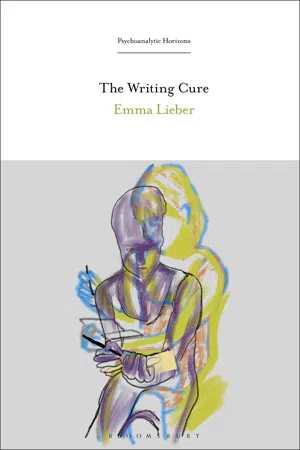
In The Writing Cure, Emma Lieber tells the story of her decade-long analysis, and her becoming a psychoanalyst, by tracing dreams, scenes, and signifiers that emerged from her analysis while also undertaking critical explorations of works of psychoanalytic theory and literary texts. The Writing Cure thus articulates what psychoanalysis does for its patients by writing the moment of its termination in real time, performing the convergence of theory and life on which psychoanalysis itself balances.
Throughout, Lieber considers what psychoanalysis--"the talking cure"--has to do with writing: the foundation of psychoanalysis on Freud's distinctive writing practice; what it means to write oneself as a psychoanalyst; the extent to which the cure involves a new kind of self-writing. Most broadly, The Writing Cure asks: What would it look like to write your way to the end of an analysis? Is it possible to write yourself into the position of psychoanalyst? Is it possible to write your cure?
- 160 pages
- English
- ePUB (mobile friendly)
- Available on iOS & Android
eBook - ePub
The Writing Cure
About this book
Information
Chapter 1
On Coming to Write, Or, Tell Me About Your Mother
I conceived this book on my birthday. My husband helped a little bit—just the slightest insemination, which seems to be what I ask of him. I told him some things I had been thinking for a long time and he said, “That could be a book.” Which only means, what my husband gave, what perhaps he has always essentially given, was an articulation of form. Form impregnates matter; “Wherefore that which is to receive all forms should have no form” (Plato). But what is, what has ever been, the relation between the two? (Bruce Fink) Anyway, there is something wrong with that metaphor. I think I am writing this book in order to correct, for myself, that something wrong—in order, no longer, to have to wait for that form-giving gesture, much as I am also grateful for it.
My psychoanalyst was involved in the conception too, albeit remotely, which is how she always acts. We were on our way to a party where I knew we would see her. From this strange threesome, a book was born.
If I conceive a book on my birthday, is it mine or my mother’s? Is it mine, or me? Am me mine? My logic gets twisted here, along with the grammar, subject or object, and the biology, conception or birth. The timing of the book’s conception was probably intended to continue twisting that logic—just enough to finally get out of it. Maybe you can twist and twist a knot so much that it just . . . falls away.
My aunt, a linguist, once told me about verbs that become nouns (I’m sure that’s not how she phrased it) by shifting the accent from the second to the first syllable. Somehow, I retained this teaching as pertaining primarily to words having to do with trash: compost, refuse, object. It has taken me a long time to see that my feeling of being excluded from the world’s interesting doings is the result of my own defenses, refusals, objections. In analysis once, speaking of this, I remember saying, the way you become the abject is by shifting the blame.
* * *
As with everything, I did my best to make the writing of this book impossible.
My favorite story about living in Russia is about when I had to renew my student visa. I went where I was told to go by the institute I was studying at—down a back alley, up the stairs of a ramshackle building, into a hovel of an office where an extremely bearded man sat ashing his cigar on a pile of papers. I said, I’m here to renew my student visa, and he said, you can’t renew your student visa until you get a migration card. What’s a migration card?—I asked. It’s a new document, a new regulation—foreigners need one when they’re walking around, to show to the police if they’re stopped—he said. How do you get a migration card?—I asked. You get one on the plane, when you’re entering the country. Are you leaving and coming back any time soon?—he asked. Indeed, I was, on a brief trip to London before returning to St. Petersburg. Ok, he said—you’ll get a migration card when you return, and then you can come back here with it, and I’ll renew your visa. It wasn’t until I was halfway down the street that I realized: I can’t leave the country with an expired visa.
This, as I understand it, is the paradox of the parents’ bedroom in a nutshell: you can’t leave until you’ve entered; you can’t enter until you’ve already left.
The same structure pertained to my image of writing a book for quite a while. When I finally decided to put aside the book about the subject of my graduate degree—literature, especially Russian—in favor of writing something more personal, something attempting to give shape to the process of an analysis as I have been experiencing it for a very long time, I thought, maybe I’ll write on the idea of cure. But my plan established a neat futility, since how could I write on cure if I wasn’t already cured? I’d have to wait until I had finished my analysis to begin writing. What I couldn’t see was that the something “not right” in myself that I thought was motivating my analysis and preventing me from writing was simply my insistence that as yet I could “not write.” It didn’t occur to me that the writing was itself the righting, or something of the cure, which was what the question of writing a book always evoked for me.
Early in my analysis I dreamed of a book ostensibly written by my analyst: its cover was baroque, with a title that curved like the dome of a church. It was called Archangels and Demons, and it identified my analyst, after her name, as “woman psychoanalyst, and potential theologian.” All of the things that it was impossible to be, she somehow was, down to the movement of potentiality, and desire. Becoming a psychoanalyst is only an achievement insofar as it opens to elsewhere. That I identified these impossible positions as that which she either was or had was my neurotic deadlock. Of course, the book was mine. I had dreamed it. For crying out loud, everyone is a potential theologian. The end of analysis may well be a new way of writing oneself: an aesthetic event, it is not not-me. I made it myself but not alone; its making takes place in the space of address. The paradox of the process of analysis, which is the paradox of nachträglichkeit, is that with another you write yourself as the book that you will have been, but will no longer continue to be, once you have written it.
And yet, this does not mean, writing your autobiography; rather, an engagement with the unconscious puts to question the status of autobiography or self-writing (as though it wasn’t already). As Shoshana Felman writes, Freud’s theory of dreams—or more precisely, for her, the experience of the dream session—reveals the ways in which these unconscious productions “tell . . . us about our own autobiography another story than the one we knew or had believed to be our own.” The dream inheres in its own telling, and its theorizing makes for “a revolution in the very theory of autobiography.” Freud’s discovery of the “meaning” of dreams—wish-fulfillments—was made in the context of a dream (the dream of Irma’s injection) that itself inscribed Freud’s wish to discover the meaning of dreams, to theorize the unconscious, to say something about femininity, to birth psychoanalysis. The dream turns around this vortex where theory and autobiography meet, where autobiography gestures at a narration that happens elsewhere, despite us. Autobiographical accounts that imbricate stories of one’s analysis, as this book in part will be, function in this matrix, perhaps just barely closer to the edge of elsewhere.
To the extent that an analysis far exceeds what is said within it, or obtains as an effect of the accumulation of sayings that outlies both the content and the register of enunciation, the book of one’s analysis is hardly a rehearsal of that process. If the book lies in the direction of the cure, it can only do so as an effect of the analysis of which it is a residue, at the same time that it structures the possibility of an exit from the narrative that one tells, with its surplus of meanings. Thus the status of signification, at the end of an analysis, has started to shift—enough of the unlanguaged having been brought to language so as to change that unlanguaged field, and the pressure it exerts. One begins to see, dimly, the prospect of another relation to speech, to complaint, to responsibility, to love. And if the analyst represents the possibility of representation, then the book of an analysis must itself represent the possibility of replacing that position with something of one’s own, the remainder of the process. Once the signifiers are worked and reworked and linked and unlinked and relinked and drained and voided, fallen in exhaustion, flattened of their charge, having served their purpose, enough is enough, something else happens. Somehow, from within that ongoing telling where one still needs that object—the analyst—to structure that labor, one must begin to write.
When I first started analysis, when I needed analysis so badly and so quickly that the prospect of one day ending it struck me with utter horror, I thought, well, when I terminate, I will give my analyst a book. I wondered which one: The Brothers Karamazov? The Wind-Up Bird Chronicle? Housekeeping? It didn’t occur to me that I could be its author, or that by the time of its offering, its being for her could have, really, nothing very much, any longer, to do with her.
* * *
In a fit of self-reproach the other day—why haven’t I done more with my life? Why haven’t I written a book yet? Why isn’t the book I want to write already written?—I found myself googling myself. Maybe everyone does this every once a while, as a form of self-assurance. Look! When people look you up on the internet, this is what they see! Look at everything you’ve done! Look at all the articles you’ve written! Look at how competent you seem! That’s you! What a big girl you are! Google, which offers a self-reflection in letters; the internet, the mirror stage (Lacan) for literate grown-ups. It’s horribly embarrassing.
What was amazing to me in this shameful act of self-research was the discovery that I had, in fact, already written a book. It’s there on Amazon, and on Google Books: God’s Children by Emma Lieber, published in 1921. It seems to be part of a series of “lost classics”: old and underestimated books that have been rehabilitated and republished by a publishing house called Forgotten Books. Talk about the mirror stage in letters: your book is already written, it was underestimated once but now it’s seen for what it really is! But heed well: it was written by someone else. Your double, your old and future self—whole, capable, finished, adult—already exists, but you’re not it. And, it’s forgotten.
Evidently, God’s Children is an impassioned call for parents to talk to their children about sex, to include their kids in the scene of knowledge and desire. Evidently, it offers an implicit—or maybe explicit, I don’t know, I’ve only read a few pages online—association between sexuality and grace (even as it also includes some extremely distasteful moments about the suppression of carnal appetite and the achievement of racial purity). I don’t know if my dream book, Archangels and Demons, which itself presaged this present book, The Writing Cure, was a reference to that book, God’s Children, which I may very well have seen years ago during an earlier fit of google-despair. It seems plausible. In which case, The Writing Cure—an attempt, in part, to explain to my children, whether or not they will ever read it, something about the conditions of their becoming as it was bound up in my analysis, and also, about desire as a figuration of grace—will be the fulfillment of a dream book from the beginning of my analysis, itself the residue of a forgotten book written by a me who is also a past me or perhaps a future me but in any case a not-me.
* * *
The end of an analysis does indeed call for testimony.
For Lacan, and the school he established in Paris in the 1960s, the procedure that accounted for this call to testimony was called “the Pass.” Pass, as in, pass something along, like language. You think you’re coming to the end of your analysis, and you’re in a school to become an analyst, because that’s what you want to be, so you call upon two other analysts-in-formation to whom to give the account of your analysis. They then pass along what they assimilate of your telling to a committee, which decides on its basis whether you are in fact an analyst. Somehow, in that process of offering your testimony to traverse the mouths of others, you usher yourself to the position of analyst which the committee then affirms.
Invectives abound against this procedure of the Pass, which is quite beautiful in theory but probably terrible in practice. Perhaps it should be taken more as a provocation to theory than to practice—except that theory and practice in psychoanalysis are absolutely intertwined. And anyway, the putting to practice of theory in schools calls for regulation, and regulation then becomes the problem. There may be no way out of this loop.
At least, the Pass testifies to the extent to which becoming an analyst is a communal project. It is done with fellow travelers. The Pass further puts into play the status of testimony, or the ways in which one’s story takes on new property in the moment of its address. Felman emphasizes this necessary address in her work on testimony in law, literature, and psychoanalysis, and claims that no one can testify to your story, but you. You must address your story—to the courtroom, to the wider culture—and in so doing you must claim it, as yours alone. “There is only one specific person, one specific subject who can bear witness to what he/she has experienced, and no one else can report what this particular subject has lived and narrated.”
I don’t know that these two positions—only you can tell your story to the judge; only others can tell your story to the judge—are as opposed as they seem, especially to the extent that judgment isn’t really, in the end, what’s at stake. Rather, what is at stake is the effect of the act of testimony, and the complex place at which testimony lies in the linguistic passages between self and others. At least in theory, the structure of the Pass dances around the question of regulation only to belie it, the fact and form of address shifting entirely the status of plaintiff, witness, and judge. Probably, these positions are dialectical corollaries of each other: only I can tell my story, but I cannot tell it alone. The address itself encodes this truth; if you want to stick some others in there to mediate further—if you want to track the effects of the testimony on its way through one more round of address—so be it. But probably, the essence is the same.
I’m studying at a psychoanalytic institute that does not have the procedure of the Pass. That’s fine by me. I don’t think it will be up to a school to adjudicate. I suppose I am offering this bo ok at what feels to me to be the tail end of my analysis, as a form of address to anyone who will have it. I suppose that I am writing it as a way of posing a question to no one in particular, in the hopes that the book itself will provide the means of finding an answer which only I can find but which I cannot find alone. I suppose that in the end, the book will at least have posed the question: Am I an analyst?
* * *
Dan Gunn’s Wool-Gathering, or How I Ended Analysis is a book about ending a six-year analysis with a Lacanian analyst in Paris at the same time that transit strikes are overtaking the city. Gunn writes of a certain Lacanian formulation of the course of an analysis, that
the patient starts . . . by speaking to himself; goes on to speak to the analyst but about one who is not himsel...
Table of contents
- Cover
- Half-Title
- Series
- Dedication
- Title
- Epigraph
- Contents
- Preface
- Acknowledgments
- Chapter 1 On Coming to Write, Or, Tell Me About Your Mother
- Chapter 2 The Double
- Chapter 3 First Love
- Chapter 4 The Gift
- Epilogue
- Writings, in Order of Appearance
- Copyright
Trusted by 375,005 students
Access to over 1.5 million titles for a fair monthly price.
Study more efficiently using our study tools.
Frequently asked questions
Yes, you can cancel anytime from the Subscription tab in your account settings on the Perlego website. Your subscription will stay active until the end of your current billing period. Learn how to cancel your subscription
No, books cannot be downloaded as external files, such as PDFs, for use outside of Perlego. However, you can download books within the Perlego app for offline reading on mobile or tablet. Learn how to download books offline
Perlego offers two plans: Essential and Complete
- Essential is ideal for learners and professionals who enjoy exploring a wide range of subjects. Access the Essential Library with 800,000+ trusted titles and best-sellers across business, personal growth, and the humanities. Includes unlimited reading time and Standard Read Aloud voice.
- Complete: Perfect for advanced learners and researchers needing full, unrestricted access. Unlock 1.5M+ books across hundreds of subjects, including academic and specialized titles. The Complete Plan also includes advanced features like Premium Read Aloud and Research Assistant.
We are an online textbook subscription service, where you can get access to an entire online library for less than the price of a single book per month. With over 1.5 million books across 990+ topics, we’ve got you covered! Learn about our mission
Look out for the read-aloud symbol on your next book to see if you can listen to it. The read-aloud tool reads text aloud for you, highlighting the text as it is being read. You can pause it, speed it up and slow it down. Learn more about Read Aloud
Yes! You can use the Perlego app on both iOS and Android devices to read anytime, anywhere — even offline. Perfect for commutes or when you’re on the go.
Please note we cannot support devices running on iOS 13 and Android 7 or earlier. Learn more about using the app
Please note we cannot support devices running on iOS 13 and Android 7 or earlier. Learn more about using the app
Yes, you can access The Writing Cure by Emma Lieber in PDF and/or ePUB format, as well as other popular books in Literature & Literary Criticism for Comparative Literature. We have over 1.5 million books available in our catalogue for you to explore.