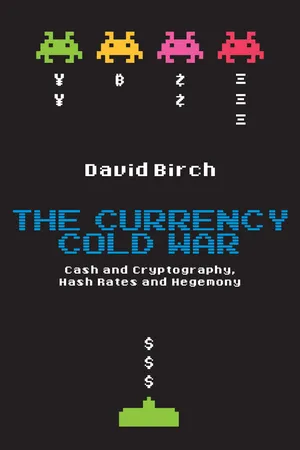
Money is changing and this may mean a new world order. David Birch sets out the economic and technological imperatives concerning digital money, and discusses its potential impact. Tensions will inevitably arise: between old and new, between public and private, and, most importantly, between East and West. This book contributes to the debate that we must have to shape the International Monetary and Financial System of the near future.
eBook - ePub
The Currency Cold War: Cash and Cryptography, Hash Rates and Hegemony
Cash and Cryptography, Hash Rates and Hegemony
- 256 pages
- English
- ePUB (mobile friendly)
- Available on iOS & Android
eBook - ePub
The Currency Cold War: Cash and Cryptography, Hash Rates and Hegemony
Cash and Cryptography, Hash Rates and Hegemony
About this book
Information
Publisher
London Publishing PartnershipYear
2020Print ISBN
9781913019075
Edition
1eBook ISBN
9781913019099
Part 1
Digital Currency
The US Government stands more to gain from digital currency than anyone else. Ironically, they don’t seem to have figured that out yet.
A digital currency is a currency that only exists in the virtual world of computers. It has no ‘mundane rump’, as sterling does. What I mean by this is that most pounds – around 96% of them, in fact – only exist in the virtual world of computers, with just 4% of them clinging to the physical world in pockets and purses and down the backs of sofas throughout the land. If I decided that I did not like pounds and wanted to create a new currency of my own, it would be a bit of a hassle to have to start minting coins, printing notes and persuading McDonalds to add another drawer to their cash registers. In the world of Apple, Angry Birds and Amazon, though, this is not a problem. I can just make up my digital currency and off I go. Although, as the economist Hyman Minsky famously observed, creating money is easy: getting it accepted is the hard part.
Why would someone accept new currency, such as my proposed Wessex e-Groats, instead of euros? Convenience, for one thing. Look at private currencies, such as Marks & Spencer vouchers or Amazon gift certificates, as a pointer. A friend of mine paid at a farmer’s market in Surrey using a Marks & Spencer voucher and got change. Although not sterling, they are a form of currency, in Surrey and no doubt in other parts of the United Kingdom. As I spend a fortune on Amazon, I would have no problem taking a tenner’s worth of Amazon gift certificates instead of the tenner you owe me down the pub. The revolutionary capabilities of the internet and, in particular, the mobile phone make this not only possible but inevitable. While it may be difficult to imagine popping to the shops with half a dozen kinds of banknote in my back pocket, it is not hard to picture an app on my smartphone managing these different currencies for me and choosing the best one for the purpose at hand.
It is not all about convenience and efficiency though. Some currencies, and Bitcoin is a current example, are really more ideological in nature. The people who champion Bitcoin are only partly concerned with transactions. They are more focused on removing governments’ hands from the monetary reins. You do not trust the government to run supermarkets, they might say, so why let it run money? The same goes for those who advocate electronic gold or some kind of world currency based on commodity prices and the like.
Others – myself included – think that the future of money is connected with the future of communities, both physical and online. In fact, I wrote a book about it: Before Babylon, Beyond Bitcoin. In places where monetary arrangements collapsed, such as Greece, we have already seen local groups developing their own currencies to replace the misfiring euro. We have also seen early experiments in the United Kingdom (the Brixton pound in London), in Germany (the Chiemgauer in Bavaria) and in many other places, all of which attracted some attention following the global financial crisis (Halton 2019). None of these have yet attained scale, but the new technologies of cryptocurrency lower the bar to entry, which means we can begin to think about new possibilities. For an obvious example, look at London. The economy of the capital is already distinct from that of the rest of the United Kingdom, so that would be a good place to start. If London started its own digital currency and Scotland started its own digital currency, then their utterly distinct economies could be freed from the mutual shackles of national monetary policy.
Insofar as governments (rather than international bond markets) control their monetary policy, you can see the possibility for some form of oversight or governance. But in a world of hundreds if not thousands of digital currencies, it will be the market that sets the values. Right now, we in the United Kingdom use one currency, sterling, for everything. But I suspect our children might find this as outdated as the Edwardian gold standard I so fondly remember by the nickname ‘half a dollar’, slang for the half-crown coin of my own childhood. They might use London pounds or World of Warcraft gold when they go shopping but amass Kilowatt cash and Mobility moolah in their pension funds.
So, we are going to see a new world of choice between digital currencies that embody different values, and that is a good thing. This is why it is time to take a look at what digital currencies are and how they might work.
Chapter 1
What is digital currency?
The history of digital cash can also show us a particularly vivid example of the use of money and technologies to tell us stories about the future.
So, what is digital currency? It is a kind of digital money that has become a unit of account as well as a store of value and a medium of exchange. So far, so good. But wait: what is digital money? It is a kind of electronic money (e-money) that can serve as a store of value and can be analogue or digital;2 either way, it lives inside chips and computers, not pockets and purses.
Digital money, then, is e-money. When people talk about digital currency, though, they generally mean something more than a form of e-money. After all, we already have e-money, and lots of it. In developed markets, almost all money is electronic, with only a small fraction being made up of notes and coins. When people talk about digital currency, what they are really talking about is going all the way and replacing those notes and coins. It is not simply a matter of replacing the store of value, either, but of replacing cash as a medium of exchange.
From the earliest days of the internet, people have wanted the kind of electronic cash (e-cash) that would replace physical cash. Here, for example, are Daniel Lynch (a founder of CyberCash, one of the earliest enterprises in this space) and Leslie Lundquist writing in the early days of the web (Lynch and Lundquist 1996):
What is digital money? Digital money is an electronic replacement for cash. It is storeable, transferable and unforgeable. It is the cuneiform of a new age. As it is written on the DigiCash home page, digital money is ‘numbers that are money’.
I rather liked their use of cuneiform as a metaphor, because Babylonian writing arose from the need for accounting and recording transactions.
They go on to describe a canonical set of use cases that define what I might label the Silicon Valley Standard (SVS) definition of e-cash:
Using digital money, lobbyist Alice can transfer money to Senator Bob so that newspaper reporter Eve cannot determine who contributed the funds.
Bob can deposit Alice’s money in his campaign account, even though the bank has no idea who Alice is.
But if Alice uses the same piece of digital money to bribe two different members of Congress, the bank can detect that. And if Congressman Bob tries to deposit Alice’s contribution into two different accounts, the banks can detect that, too.
The idea that anonymity was the key to creating a form of e-cash that was a ‘perfect’ cash replacement suffused the thinking (including mine) about digital money in those early days. Here are economist Robert Guttman’s thoughts on the matter from more than 15 years ago (Guttman 2003):
People and businesses will use cybercash if they see it as an untraceable money form, much like cash.
In other words, the desired form of e-cash is a perfect tool for crime. I think it is unrealistic to imagine that this standard will be allowed by the authorities, although whether they will be able to do anything about it is another matter – one that we will return to later when we think about what digital money should do for the new economy.
Let us continue with this line of thinking and say that digital money is a form of e-cash. The crucial distinction between e-money and e-cash is that, if I want to pay you for something, I can send e-money to your bank account, but that is it; I cannot use Pingit or Venmo to put money into your pocket, only into an account somewhere. However, e-cash is just like physical cash: if I send it to you, it is yours. You can stick it ...
Table of contents
- Cover
- Half title
- Series page
- Title page
- Copyright page
- Dedication
- Contents list
- Foreword by Michael J. Casey
- Preface
- Introduction
- Part 1: Digital Currency
- Chapter 1: What Is Digital Currency?
- Chapter 2: Technology as Catalyst
- Chapter 3: Anyone Can Make Money
- Part 2: Drivers for Change
- Chapter 4: What Problem Will Digital Currency Fix?
- Chapter 5: Rethinking Money
- Chapter 6: Creating Digital Fiat
- Part 3: The Currency Cold War
- Chapter 7: Private Digital Currency
- Chapter 8: Public Digital Currency
- Chapter 9: Red Versus Blue
- Coda: A Call to Action
- Glossary
- Bibliography
Trusted by 375,005 students
Access to over 1.5 million titles for a fair monthly price.
Study more efficiently using our study tools.
Frequently asked questions
Yes, you can cancel anytime from the Subscription tab in your account settings on the Perlego website. Your subscription will stay active until the end of your current billing period. Learn how to cancel your subscription
No, books cannot be downloaded as external files, such as PDFs, for use outside of Perlego. However, you can download books within the Perlego app for offline reading on mobile or tablet. Learn how to download books offline
Perlego offers two plans: Essential and Complete
- Essential is ideal for learners and professionals who enjoy exploring a wide range of subjects. Access the Essential Library with 800,000+ trusted titles and best-sellers across business, personal growth, and the humanities. Includes unlimited reading time and Standard Read Aloud voice.
- Complete: Perfect for advanced learners and researchers needing full, unrestricted access. Unlock 1.5M+ books across hundreds of subjects, including academic and specialized titles. The Complete Plan also includes advanced features like Premium Read Aloud and Research Assistant.
We are an online textbook subscription service, where you can get access to an entire online library for less than the price of a single book per month. With over 1.5 million books across 990+ topics, we’ve got you covered! Learn about our mission
Look out for the read-aloud symbol on your next book to see if you can listen to it. The read-aloud tool reads text aloud for you, highlighting the text as it is being read. You can pause it, speed it up and slow it down. Learn more about Read Aloud
Yes! You can use the Perlego app on both iOS and Android devices to read anytime, anywhere — even offline. Perfect for commutes or when you’re on the go.
Please note we cannot support devices running on iOS 13 and Android 7 or earlier. Learn more about using the app
Please note we cannot support devices running on iOS 13 and Android 7 or earlier. Learn more about using the app
Yes, you can access The Currency Cold War: Cash and Cryptography, Hash Rates and Hegemony by David Birch in PDF and/or ePUB format, as well as other popular books in Economics & International Business. We have over 1.5 million books available in our catalogue for you to explore.