- 128 pages
- English
- ePUB (mobile friendly)
- Available on iOS & Android
eBook - ePub
About this book
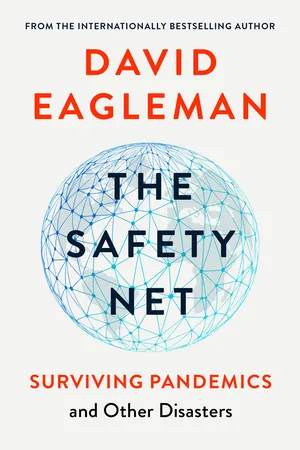
The advent of the internet has been one of the most significant technological developments in history. In this thought-provoking and ground-breaking work David Eagleman, author of international bestseller Sum, presents six ways in which the net saves us from major existential threats: pandemics, poor information flow, natural disasters, political corruption, resource depletion and economic meltdown.
Information
Subtopic
Popular CultureIndex
Social SciencesReferences
General References
Bennett, J.W., & Tumin, M.M. (1948). Social Life. New York: Alfred A. Knopf.
Brand, S. (2009). Whole Earth Discipline: An Ecopragmatist Manifesto. New York: Viking.
Diamond, J.M. (2005). Collapse: How Societies Choose to Fail or Succeed. New York: Viking.
Hall, C.A., Balogh, S., & Murphy, D.J. (2009). What is the minimum EROI that a sustainable society must have? Energies, 2(1), 25–47.
Homer-Dixon, T. (2006). The Upside of Down: Catastrophe, Creativity, and the Renewal of Civilization. Washington DC: Island Press.
Kelly, K. (2010). What Technology Wants. New York: Viking.
Spengler, O. (1936). The Decline of the West. Oxford: Oxford University Press.
Tainter, J.A. (1990). The Collapse of Complex Societies. Cambridge: Cambridge University Press.
Toynbee, A.J. (1934–1961). A Study of History. (Vols I–XII). Oxford: Oxford University Press.
Wright, R. (2004). A Short History of Progress. New York: Carroll & Graf Publishers.
Chapter 1: Sidestepping Epidemics
Brownstein J.S., Freifeld C.C., Reis B.Y., & Mandl K.D. (2008). Surveillance sans frontières: internet-based emerging infectious disease intelligence and the HealthMap project. Public Library of Science Medicine, 5(7), e151.
Eagleman, D.M. (2006). Will the Internet save us from epidemics? Nature, 441(7093), 574.
Eysenbach G. (2006). Infodemiology: tracking flu-related searches on the web for syndromic surveillance. AMIA Annual Symposium Proceedings. 244–8.
Ginsberg, J., Mohebbi, M.H., Patel, R.S., Brammer, L., Smolinski, M.S., & Brilliant, L. (2009). Detecting influenza epidemics using search engine query data. Nature, 457, 1012–1014.
Karlen, A. (1995). Man and Microbes: Disease and Plagues in History and Modern Times. New York: Touchstone.
Madoff, L.C. (2004). ProMED-mail: an early warning system for emerging diseases. Clinical Infectious Diseases, 39, 227–32.
McNeill, W.H. (1976). Plagues and Peoples. New York: Doubleday.
Oldstone, M. (2010). Viruses, Plagues, and History. Oxford: Oxford University Press.
Polgreen P.M., Chen Y., Pennock D.M., Nelson F.D. (2008). Using internet searches for influenza surveillance. Clinical Infectious Diseases, 47, 1443–1448.
Wilson, K., & Brownstein, J.S. (2009). Early detection of disease outbreaks using the Internet. Canadian Medical Association Journal, 180, 829–831.
Yoo, E.J., & Dudley, R.A. (2009). Evaluating telemedicine in the ICU. Journal of the American Medical Association, 302(24), 2705–2706.
Zinsser H. (1935). Rats, Lice and History. Boston: Little, Brown & Co.
Chapter 2: Remembrance of Things Past
Antonopoulos, J. (1992). The great Minoan eruption of Thera volcano and the ensuing tsunami in the Greek Archipelago. Natural Hazards, 5, 153–168.
Canfora, L. (1989). The Vanished Library. (Martin Ryle, Trans.). Berkeley: University of California Press.
Demarest, A. (2005). Ancient Maya: The Rise and Fall of a Rainforest Civilization. Cambridge: Cambridge University Press.
Ellis, W.M. (1994). Ptolemy of Egypt. New York: Routledge.
Fraser, P.M. (1972). Ptolemaic Alexandria. (Vol 1). Oxford: Oxford University Press.
Halsband, R. (1960). Life of Mary Wortley Montagu. Oxford: Oxford University Press.
Pareschi, M.T., Favalli, M. & Boschi, E. (2006). Impact of the Minoan tsunami of Santorini: Simulated scenarios in the eastern Mediterranean. Geophysical Research Letters, 33, L18607.
Plett, P.C. (2006). Peter Plett and other discoverers of cowpox vaccination before Edward Jenner. Sudhoffs Archiv, 90 (2), 219–32.
Ringmar, E. (2008). Liberate and disseminate. Times Higher Education Supplement. Retrieved 12 October 2010, from.
Wharncliffe, L. & Thomas W.M. (Eds.). (1861). The Letters and Works of Lady Mary Wortley Montagu. (Vol 1). London: Henry G. Bohn.
Chapter 3: Outpacing Disaster
Antonopoulos, J. (1992). The great Minoan eruption of Thera volcano and the ensuing tsunami in the Greek Archipelago. Natural Hazards, 5, 153–168.
Demarest, A. (2005). Ancient Maya: The Rise and Fall of a Rainforest Civilization. Cambridge: Cambridge University Press.
Conyers, L.B. (1996). Archaeological evidence for dating the Loma Caldera eruption, Cerén, El Salvador. Geoarchaeology, 11(5), 377–391.
Cordova, C., Martin del Pozzo, A.L., & Camacho, J.L. (1994). Paleolandforms and volcanic impact on the environment of prehistoric Cuicuilco, southern Mexico City. Journal of Archaeological Science, 21, 585–596.
Elson, M.D., Ort, M.H., Hesse, J. & Duffield, W.A. (2002). Lava, corn, and ritual in the Northern Southwest. American Antiquity, 67(1), 119–136.
Gonzalez, S., Pastrana, A., Siebe, C. & Duller, G. (2000). Timing of the prehistoric eruption of Xitle Volcano and the abandonment of Cuicuilco Pyramid, Southern Basin of Mexico. Geological Society, 171, 205–224.
Losey, R.J. (2005). Earthquakes and tsunami as elements of environmental disturbance on the Northwest Coast of North America. Journal of Anthropological Archaeology, 24(2), 110–116.
Manning, S.W., Ramsey, C.B., Kutschera, W., Higham, T., Kromer, B., Steier, P., & Wild, E.M. (2006). Chronology for the Aegean Late Bronze Age 1700–1400 B.C. Science, 312, 565–569.
Minor, R., & Grant, W.C. (1996). Earth-quake induced subsidence and reburial of Late Holocene archaeological sites, northern Oregon coast. American Antiquity, 61(4), 722–781.
O’Loughlin, K.F., & Lander J.F. (2003). Caribbean Tsunamis: A 500-year History from 1498–1998 (Advances in Natural and Technological Hazards Research). New York: Springer.
Pareschi, M.T., Favalli, M. & Boschi, E. (2006). Impact of the Minoan tsunami of Santorini: Simulated scenarios in the eastern Mediterranean. Geophysical Research Letters, 33, L18607.
Poulsen, K. (2007). Firsthand reports from California wildfires pour through Twitter. Wired News.
Sheets, P.D., & McKee, B.R. (1994). Archaeology, Volcanism, and Remote Sensing in the Arenal Region, Costa Rica. Austin: University of Texas Press.
Chapter 4: Mitigating Tyranny
Balkin, J.M. (2008). The future of free expression in a digital age. Pepperdine Law Review, 36.
Canton, D. (2005). Today’s business law: Attempt to suppress can backfire. London Free Press, 5 November 2005.
Carlstrom G. (2010). A messy vote: Fraud in Afghanistan. Al Jazeera. 17 September 2010.
Editorial: Iran’s Twitter revolution. Washington Times. 16 June 2009.
Facebook group: ‘We are all Khaled Said’, http://www.facebook.com/elshaheeed.co.uk.
Goldstein, R.J. (2001). Political Censorship. London: Taylor & Francis.
Greenberg, A. (2007). The Streisand Effect. Forbes, 11 May 2007.
Grossman, L. (2009). Iran Protests: Twitter, the Medium of the Movement. Time, 17 June 2009.
Horwitz, T. (1991). Baghdad Without a Map: And Other Misadventures in Arabia. New York: Dutton.
Kirkpatrick, D.D, Sanger, D.E. (2011). Dual Uprisings Show Potent New Threats to Arab States. New York Times, 13 February, 2011.
Kreimer, S.F. (2006). Censorship by proxy: The First Amendment, internet intermediaries, and the problem of the weakest link. University of Pennsylvania Law Review, 155(11).
Kwok, V.W. (2009). Aussie Internet Blacklist Has Gray Areas. Forbes.com. Retrieved 19 March 2009.
Moses, A. (2009). Leaked Australian blacklist reveals banned sites. Sydney Morning Herald. 19 March 2009.
Shane, S. (1994). Dismantling Utopia: How Information Ended the Soviet Union. Chicago: Ivan R. Dee.
Shirky, C. (2007). The internet’s output is data, but its product is freedom. Many2Many. Retrieved 10 July 2007.
Yang, G. (2009). The Power of the Internet in China: Citizen Activism Online. New York: Columbia University Press.
Chapter 5: Saving Energy
Ausubel, J.H. (1996). Can technology spare the earth? American Scientist, 84, 166–178.
Chertow, M.R. (2001). The IPAT equation and its variants: Changing views of technology and environmental impact. Journal of Industrial Ecology, 4, 13–29.
Cohen, J. (1995). How many people can the Earth support? New York: W.W. Norton.
Commoner, B. (1972). The Environmental Cost of Economic Growth. In Population, Resources and the Environment. Washington, DC: Government Printing Office. 339–63.
Ehrlich, P.R., Holdren, J.P. (1971). Impact of Population Growth. Science, 171, 1212–17.
Fagan, B. (2004). The Long Summer: How Climate Changed Civilization. Cambridge: Basic Books.
Gard, D.L., & Keoleian, G.A. (2002). Digital versus print: Energy performance in the selection and use of sch...
Table of contents
- Cover
- Title Page
- Table of Contents
- Preface to the New Edition
- Why Do Civilizations Collapse?
- Sidestepping Epidemics
- Remembrance of Things Past
- Outpacing Disaster
- Mitigating Tyranny
- Saving Energy
- Cultivating Human Capital
- The New Threats
- References
- Acknowledgments
- About the Author
Trusted by 375,005 students
Access to over 1.5 million titles for a fair monthly price.
Study more efficiently using our study tools.
Frequently asked questions
Yes, you can cancel anytime from the Subscription tab in your account settings on the Perlego website. Your subscription will stay active until the end of your current billing period. Learn how to cancel your subscription
No, books cannot be downloaded as external files, such as PDFs, for use outside of Perlego. However, you can download books within the Perlego app for offline reading on mobile or tablet. Learn how to download books offline
Perlego offers two plans: Essential and Complete
- Essential is ideal for learners and professionals who enjoy exploring a wide range of subjects. Access the Essential Library with 800,000+ trusted titles and best-sellers across business, personal growth, and the humanities. Includes unlimited reading time and Standard Read Aloud voice.
- Complete: Perfect for advanced learners and researchers needing full, unrestricted access. Unlock 1.5M+ books across hundreds of subjects, including academic and specialized titles. The Complete Plan also includes advanced features like Premium Read Aloud and Research Assistant.
We are an online textbook subscription service, where you can get access to an entire online library for less than the price of a single book per month. With over 1.5 million books across 990+ topics, we’ve got you covered! Learn about our mission
Look out for the read-aloud symbol on your next book to see if you can listen to it. The read-aloud tool reads text aloud for you, highlighting the text as it is being read. You can pause it, speed it up and slow it down. Learn more about Read Aloud
Yes! You can use the Perlego app on both iOS and Android devices to read anytime, anywhere — even offline. Perfect for commutes or when you’re on the go.
Please note we cannot support devices running on iOS 13 and Android 7 or earlier. Learn more about using the app
Please note we cannot support devices running on iOS 13 and Android 7 or earlier. Learn more about using the app
Yes, you can access The Safety Net by David Eagleman in PDF and/or ePUB format, as well as other popular books in Social Sciences & Popular Culture. We have over 1.5 million books available in our catalogue for you to explore.