- 88 pages
- English
- ePUB (mobile friendly)
- Available on iOS & Android
eBook - ePub
Waxing for Dental Students
About this book
When dental students are first taught how to wax teeth, they need clear instructions with logical steps and plenty of illustrations. With the omission of any distracting information about dies, crowns, bridges, and occlusion, this concise book is squarely directed to first-year dental students and can be used as a primary laboratory manual. The author covers the basics of wax instrumentation and addition, but the bulk of the book details the steps for waxing incisors, canines, premolars, and molars. Each chapter includes an introductory waxing exercise for the tooth type, followed by the key points of morphology for the tooth in question. Photographs detail the waxing steps for both a maxillary and a mandibular full crown on a tooth peg and show how the wax-up should mimic the contralateral tooth in terms of dimension, embrasures, heights of contour, line angles, and point angles. The logical and straightforward protocols in this book will help dental students quickly improve their waxing skills and reach expected goals.
Information
chapter 1
Introduction to Waxing
Purpose of Waxing Teeth
Waxing teeth is mainly done by laboratory technicians to fabricate indirect restorations using the lost wax technique. When anterior restorations are planned, waxing can also be done by the dentist to achieve the best possible outcome; it can as well be an effective patient communication tool. For students, the main purpose for waxing teeth is to learn the morphology and anatomy of each individual tooth, so you are able to eventually restore teeth to the correct form.
Each tooth in the dental arch has five surfaces. Those surfaces are not flat: Every surface has convexities and concavities that are unique to its location and tooth type. Anatomical landmarks should be duplicated precisely when teeth are restored so that good esthetics and function can be achieved. Waxing is a great exercise to learn how to duplicate the correct tooth contours. In addition, the process of waxing familiarizes dental students with hand instrumentation techniques and allows them to develop skills such as finger dexterity, hand steadiness, aiming, and reaction time. These skills are essential for the high precision needed in dentistry.
Waxing Armamentarium
• Bunsen burner and tubing
• Waxing instruments: PKT1, PKT2, waxing spatula, PKT3, PKT4 (ie, Hollenback carver), and two discoid-cleoid carvers (large and small)
• Casting wax: Renfert GEO Classic mint-opaque modeling wax (75 gm)
• Dental Typodont Model D85SDP-200 (Kilgore International) with 28 teeth and soft gingiva
• Screwdriver
• Kilgore model teeth (anatomical replica)
• Kilgore A21AN-200 Series Prep Teeth
– Facial no. 10 UL29D
– Facial incisal labial lingual no. 7 UR24
– Full crown no. 23 LL21A
– Full crown no. 9 UL11C
– Full crown no. 11 UL31D
– Facial, occlusal, mesial no. 12 UL49H
– Full crown no. 12 UL42B
– Full crown no. 29 LR52E
– Occlusal, mesial, distal, lingual no. 3 UR66C
– Full crown no. 19 LL62D
• Nylon stockings
• Pencil
• Ultrafine-point black marker
• Eye shields
Setup of the Workstation
The nature of the precision and efficiency of clinical and laboratory work in dentistry mandates organization of the work area. The use of instrument setups and the availability of needed items will expedite your work and facilitate the learning process. It is expected that you will work from an organized and properly supplied work station (Fig 1-1).
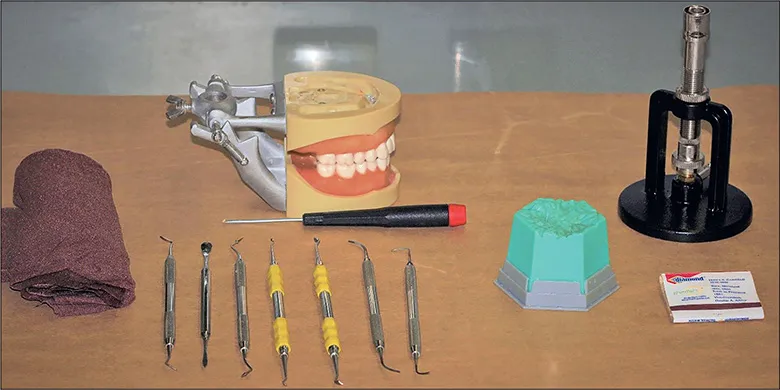
Fig 1-1
Waxing instruments
Waxing instruments are divided into wax-addition and wax-carving categories1,2 (Figs 1-2 and 1-3).
Wax-addition instruments
PKT1. Used to apply wax (Fig 1-2a). The tips are round, curved, and tapered and the shank can be safely heated.

Fig 1-2a
PKT2. Also used to apply wax and featuring a pointed tip that can be used to fill in voids or discrepancies between the crest of cusp ridges and the facial and lingual axial contours and on the occlusal surface (Fig 1-2b).

Fig 1-2b
Waxing spatula. Used to add a large amount of wax in the initial step of waxing or when waxing posterior teeth (Fig 1-2c). It can also be heated and applied to smooth a large surface.

Fig 1-2c
Wax-carving instruments
These instruments are used to carve the wax after it cools. They are not meant to be heated.
PKT3. Features a pointed burnisher and is used to perfect and enhance supplemental and developmental grooves (Fig 1-3a).

Fig 1-...
Table of contents
- Cover
- Title Page
- Dedication
- Copyright Page
- Contents
- Preface
- 1 Introduction to Waxing
- 2 Waxing Incisors
- 3 Waxing Canines
- 4 Waxing Premolars
- 5 Waxing Molars
- 6 Evaluation Criteria for Full-Crown Wax-Ups
- References
- Back Cover
Trusted by 375,005 students
Access to over 1.5 million titles for a fair monthly price.
Study more efficiently using our study tools.
Frequently asked questions
Yes, you can cancel anytime from the Subscription tab in your account settings on the Perlego website. Your subscription will stay active until the end of your current billing period. Learn how to cancel your subscription
No, books cannot be downloaded as external files, such as PDFs, for use outside of Perlego. However, you can download books within the Perlego app for offline reading on mobile or tablet. Learn how to download books offline
Perlego offers two plans: Essential and Complete
- Essential is ideal for learners and professionals who enjoy exploring a wide range of subjects. Access the Essential Library with 800,000+ trusted titles and best-sellers across business, personal growth, and the humanities. Includes unlimited reading time and Standard Read Aloud voice.
- Complete: Perfect for advanced learners and researchers needing full, unrestricted access. Unlock 1.5M+ books across hundreds of subjects, including academic and specialized titles. The Complete Plan also includes advanced features like Premium Read Aloud and Research Assistant.
We are an online textbook subscription service, where you can get access to an entire online library for less than the price of a single book per month. With over 1.5 million books across 990+ topics, we’ve got you covered! Learn about our mission
Look out for the read-aloud symbol on your next book to see if you can listen to it. The read-aloud tool reads text aloud for you, highlighting the text as it is being read. You can pause it, speed it up and slow it down. Learn more about Read Aloud
Yes! You can use the Perlego app on both iOS and Android devices to read anytime, anywhere — even offline. Perfect for commutes or when you’re on the go.
Please note we cannot support devices running on iOS 13 and Android 7 or earlier. Learn more about using the app
Please note we cannot support devices running on iOS 13 and Android 7 or earlier. Learn more about using the app
Yes, you can access Waxing for Dental Students by Rowinda Abdalla in PDF and/or ePUB format, as well as other popular books in Medicine & Dentistry. We have over 1.5 million books available in our catalogue for you to explore.