This exceptional new book is designed as a self-instruction guide to the diagnosis, management, and prevention of surgery-related complications in implant dentistry. It functions in two ways: First, it is a valuable resource for the implant surgeon seeking practical and succinct information about how to manage a complication in an emergency setting; and second, it can be read from cover to cover as a primer on implant surgery, from the initial consultation and treatment planning through the restorative phase of treatment. Besides addressing pre-, intra-, and postoperative implant surgery complications, the book also includes a comprehensive treatment-planning protocol that allows for the early detection of potential surgical complications and how to avoid them. Early detection of complications that are amenable to rescue therapies may reverse the fate of a failing implant or a bone-grafting procedure. Invaluable for the novice and experienced implant surgeon alike.
eBook - ePub
Surgical Complications in Oral Implantology
Etiology, Prevention, and Management
- 248 pages
- English
- ePUB (mobile friendly)
- Available on iOS & Android
eBook - ePub
About this book
Information
PART 1
Identifying Preoperative Conditions That Could Lead to Complications
Complications
- 1 Inadequate or Excessive Vertical Restorative Space
- 2 Inadequate Horizontal Restorative Space
- 3 Limited Jaw Opening and Interarch Distance
- 4 Inadequate Alveolar Width for Optimal Buccolingual Positioning
- 5 Maxillary and Mandibular Tori
COMPLICATION 1
Inadequate or Excessive Vertical Restorative Space
Vertical restorative space, or crown-height space, is the distance from the crest of the residual alveolar ridge to the occlusal plane of a planned restoration or to the opposing dentition. The amount of this space will influence your choice of prosthesis, restorative material, and surgical technique; therefore, it should be carefully measured intraorally or on properly articulated diagnostic wax-ups or master casts before surgery.1,2,3,4,5,6,7,8 Soft tissue thickness should also be assessed prior to surgery; thick soft tissue may yield greater vertical space than anticipated.
If the vertical restorative space is not considered until the implants have integrated and the patient is ready for restoration, the prosthetic outcome may be unacceptable. For example, the patient may require a different type of prosthesis than originally planned, need additional surgical procedures to correct the problem, or experience subsequent prosthetic failure, such as repeated porcelain or acrylic fracture.
Vertical space requirement for fixed restorations
Single-unit fixed restoration
In treatment planning a single-unit fixed restoration to replace a posterior tooth, the minimum vertical space needed for a cement-retained crown is 9 mm from the crestal bone to the occlusal plane of the opposing dentition or 6 mm from the soft tissue to the occlusal plane (Fig 1-1).
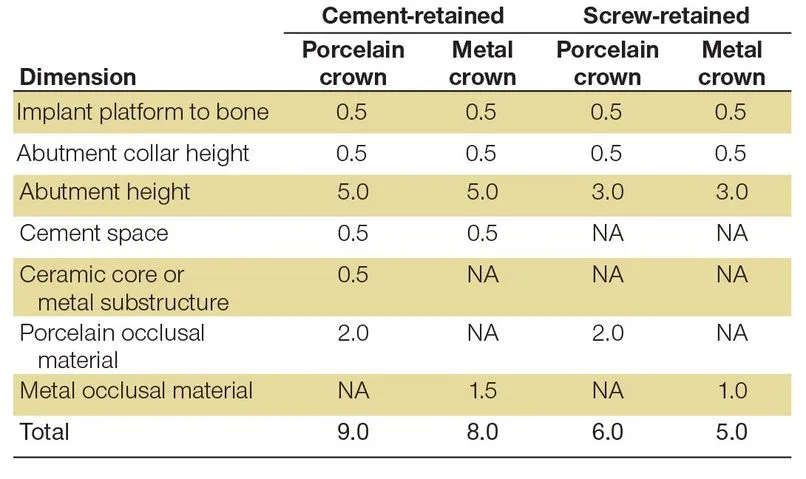
Components of the needed space are 3 mm cement, ceramic /metal substructure, and occlusal porcelain + 5 mm abutment height–1 mm abutment height typically below the soft tissue level + 2 mm peri-implant soft tissue = 9 mm. This space is reduced to 8 mm for a cement-retained prosthesis with a metal occlusal surface and 5 to 6 mm for a screw-retained prosthesis (Table 1-1). For an anterior crown, the space required is 1 to 2 mm greater to accommodate the longer abutment necessary for proper retention.
Ideally, the implant should be positioned 3 mm below the most apical point of the free gingival margin.9 Placement of the crown-abutment interface 1 mm below the most apical point of the free gingival margin will maintain the peri-implant biologic width (usually 2 mm).
Multi-unit fixed prosthesis
Space requirements for a multi-unit fixed prosthesis also vary by material. If the crown-height space is less than 15 mm, porcelain is the restorative material of choice rather than acrylic resin, which requires bulk for strength. If the space is 15 mm or greater, a hybrid prosthesis should be considered.
Vertical cantilever
Vertical cantilever, or the ratio of crown to implant, should be taken into consideration in the fabrication of a fixed implant-supported prosthesis.
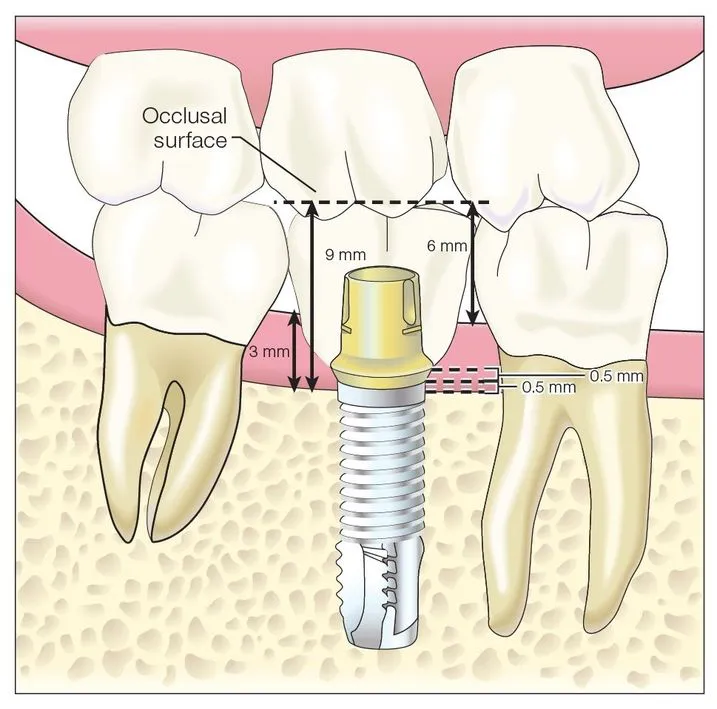
Fig 1-1 Vertical restorative space requirement for posterior single fixed cement-retained implant restoration with 3-mm-thick soft tissue.
Table 1-1 Minimum vertical space requirement (mm) from crestal bone to opposing dentition
Vertical space requirement for removable restorations
The two types of removable implant prostheses are bar-retained and low-profile independent attachments (eg, ball and Locator [Zest] attachments).
Bar-retained overdenture
The bar-retained overdenture requires a minimum of 17 mm of crown-height space depending on the type of attachment used. The space is divided as follows: 3 mm bone to soft tissue + 1 mm soft tissue to bar (necessary for proper hygiene; Fig 1-2) + 5 mm bar height. The remaining 8 mm is the minimum required thickness for acrylic resin from the superior edge of the bar to the incisal edges of the denture teeth.
Ball- or Locator-retained overdenture
A ball- or Locator-retained overdenture requires a minimum of 14 mm crown-height space, or 3 to 4 mm less than that needed for a bar overdenture. The space is divided as follows: 3 mm bone to soft tissue + 2.5 to 3.5 mm abutment height + 8 mm acrylic resin thickness between the top of the ball Locator abutment and the incisal edges of the denture teeth (Fig 1-3).

Fig 1-2 (a to c) Cast bar overdenture. A distance of 1 mm or more is maintained between the lower border of the bar and the soft tissues for adequate hygiene access.
Fig 1-3 (a to e) Ball-retained overdenture. These ball attachments have a higher profile than the Locator abutments, but this is acceptable in this scenario because there is adequate vertical restorative space.


Fig 1-4 (a) The ball abutment. (b) The ball abutment cap. (c) The low-profile Locator abutment.
Solutions for deficient vertical space
One or more of the following can be used to gain a satisfactory clinical res...
Table of contents
- Cover
- Title Page
- Copyright Page
- Table of Contents
- DEDICATION
- CONTRIBUTORS
- PREFACE
- ACKNOWLEDGMENTS
- PART 1 - Identifying Preoperative Conditions That Could Lead to Complications
- PART 2 - Intraoperative Complications in Implant Placement
- PART 3 - Postoperative Complications
- PART 4 - Complications Associated with Lateral Window Sinus Elevation
- PART 5 - Pharmacology: Prevention and Management of Pain, Infection, and Drug-Related Complications
- Appendices
- INDEX
Trusted by 375,005 students
Access to over 1.5 million titles for a fair monthly price.
Study more efficiently using our study tools.
Frequently asked questions
Yes, you can cancel anytime from the Subscription tab in your account settings on the Perlego website. Your subscription will stay active until the end of your current billing period. Learn how to cancel your subscription
No, books cannot be downloaded as external files, such as PDFs, for use outside of Perlego. However, you can download books within the Perlego app for offline reading on mobile or tablet. Learn how to download books offline
Perlego offers two plans: Essential and Complete
- Essential is ideal for learners and professionals who enjoy exploring a wide range of subjects. Access the Essential Library with 800,000+ trusted titles and best-sellers across business, personal growth, and the humanities. Includes unlimited reading time and Standard Read Aloud voice.
- Complete: Perfect for advanced learners and researchers needing full, unrestricted access. Unlock 1.5M+ books across hundreds of subjects, including academic and specialized titles. The Complete Plan also includes advanced features like Premium Read Aloud and Research Assistant.
We are an online textbook subscription service, where you can get access to an entire online library for less than the price of a single book per month. With over 1.5 million books across 990+ topics, we’ve got you covered! Learn about our mission
Look out for the read-aloud symbol on your next book to see if you can listen to it. The read-aloud tool reads text aloud for you, highlighting the text as it is being read. You can pause it, speed it up and slow it down. Learn more about Read Aloud
Yes! You can use the Perlego app on both iOS and Android devices to read anytime, anywhere — even offline. Perfect for commutes or when you’re on the go.
Please note we cannot support devices running on iOS 13 and Android 7 or earlier. Learn more about using the app
Please note we cannot support devices running on iOS 13 and Android 7 or earlier. Learn more about using the app
Yes, you can access Surgical Complications in Oral Implantology by Louie Al-Faraje in PDF and/or ePUB format, as well as other popular books in Medicine & Dentistry. We have over 1.5 million books available in our catalogue for you to explore.