Bodies of Work
eBook - PDF

Bodies of Work

Civic Display and Labor in Industrial Pittsburgh

  1. English
  2. PDF
  3. Available on iOS & Android
eBook - PDF

About this book

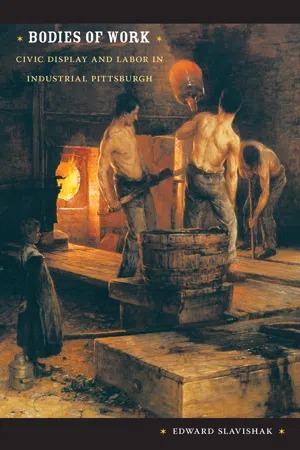
By the end of the nineteenth century, Pittsburgh emerged as a major manufacturing center in the United States. Its rise as a leading producer of steel, glass, and coal was fueled by machine technology and mass immigration, developments that fundamentally changed the industrial workplace. Because Pittsburgh's major industries were almost exclusively male and renowned for their physical demands, the male working body came to symbolize multiple often contradictory narratives about strength and vulnerability, mastery and exploitation. In Bodies of Work, Edward Slavishak explores how Pittsburgh and the working body were symbolically linked in civic celebrations, the research of social scientists, the criticisms of labor reformers, advertisements, and workers' self-representations. Combining labor and cultural history with visual culture studies, he chronicles a heated contest to define Pittsburgh's essential character at the turn of the twentieth century, and he describes how that contest was conducted largely through the production of competing images.

Slavishak focuses on the workers whose bodies came to epitomize Pittsburgh, the men engaged in the arduous physical labor demanded by the city's metals, glass, and coal industries. At the same time, he emphasizes how conceptions of Pittsburgh as quintessentially male limited representations of women in the industrial workplace. The threat of injury or violence loomed large for industrial workers at the turn of the twentieth century, and it recurs throughout Bodies of Work: in the marketing of artificial limbs, statistical assessments of the physical toll of industrial capitalism, clashes between labor and management, the introduction of workplace safety procedures, and the development of a statewide workmen's compensation system.

Frequently asked questions

Yes, you can cancel anytime from the Subscription tab in your account settings on the Perlego website. Your subscription will stay active until the end of your current billing period. Learn how to cancel your subscription.
At the moment all of our mobile-responsive ePub books are available to download via the app. Most of our PDFs are also available to download and we're working on making the final remaining ones downloadable now. Learn more here.
Perlego offers two plans: Essential and Complete
  • Essential is ideal for learners and professionals who enjoy exploring a wide range of subjects. Access the Essential Library with 800,000+ trusted titles and best-sellers across business, personal growth, and the humanities. Includes unlimited reading time and Standard Read Aloud voice.
  • Complete: Perfect for advanced learners and researchers needing full, unrestricted access. Unlock 1.4M+ books across hundreds of subjects, including academic and specialized titles. The Complete Plan also includes advanced features like Premium Read Aloud and Research Assistant.
Both plans are available with monthly, semester, or annual billing cycles.
We are an online textbook subscription service, where you can get access to an entire online library for less than the price of a single book per month. With over 1 million books across 1000+ topics, we’ve got you covered! Learn more here.
Look out for the read-aloud symbol on your next book to see if you can listen to it. The read-aloud tool reads text aloud for you, highlighting the text as it is being read. You can pause it, speed it up and slow it down. Learn more here.
Yes! You can use the Perlego app on both iOS or Android devices to read anytime, anywhere — even offline. Perfect for commutes or when you’re on the go.
Please note we cannot support devices running on iOS 13 and Android 7 or earlier. Learn more about using the app.
Yes, you can access Bodies of Work by Edward Slavishak, Arjun Appadurai, Jean L. Comaroff, Judith Farquhar, Arjun Appadurai,Jean L. Comaroff,Judith Farquhar in PDF and/or ePUB format, as well as other popular books in History & North American History. We have over one million books available in our catalogue for you to explore.

Table of contents

  1. CONTENTS
  2. Illustrations
  3. Acknowledgments
  4. Note on usage
  5. Introduction
  6. 1 The Magic of the Nineteenth Century: Industrial Change and Work in Pittsburgh
  7. 2 Working-Class Muscle in the Battle of Homestead
  8. 3 The Working Body as a Civic Image
  9. 4 The Pittsburgh Survey and the Body as Evidence
  10. 5 ‘‘Delicately Built’’: The ‘‘Problem’’ of Working Women in Pittsburgh
  11. 6 Hiding and Displaying the Broken Body
  12. Epilogue. ‘‘That’s Work, and That’s What People Like to Watch!’’
  13. Notes
  14. Bibliography
  15. Index