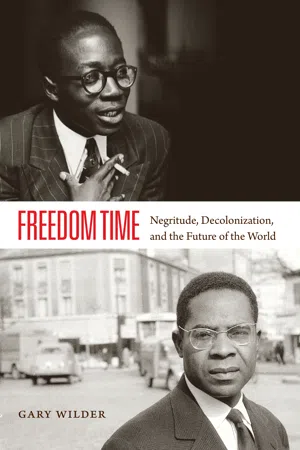
Freedom Time reconsiders decolonization from the perspectives of Aimé Césaire (Martinique) and Léopold Sédar Senghor (Senegal) who, beginning in 1945, promoted self-determination without state sovereignty. As politicians, public intellectuals, and poets they struggled to transform imperial France into a democratic federation, with former colonies as autonomous members of a transcontinental polity. In so doing, they revitalized past but unrealized political projects and anticipated impossible futures by acting as if they had already arrived. Refusing to reduce colonial emancipation to national independence, they regarded decolonization as an opportunity to remake the world, reconcile peoples, and realize humanity's potential. Emphasizing the link between politics and aesthetics, Gary Wilder reads Césaire and Senghor as pragmatic utopians, situated humanists, and concrete cosmopolitans whose postwar insights can illuminate current debates about self-management, postnational politics, and planetary solidarity. Freedom Time invites scholars to decolonize intellectual history and globalize critical theory, to analyze the temporal dimensions of political life, and to question the territorialist assumptions of contemporary historiography.
- 401 pages
- English
- PDF
- Available on iOS & Android
eBook - PDF
About this book
Information
Publisher
Duke University Press BooksYear
2015Print ISBN
9780822358503
9780822358398
eBook ISBN
9780822375791
Table of contents
- Contents
- Preface
- Acknowledgments
- 1. Unthinking France, Rethinking Decolonization
- 2. Situating Césaire: Antillean Awakening and Global Redemption
- 3. Situating Senghor: African Hospitality and Human Solidarity
- 4. Freedom, Time, Territory
- 5. Departmentalization and the Spirit of Schoelcher
- 6. Federalism and the Future of France
- 7. Antillean Autonomy and the Legacy of Louverture
- 8. African Socialism and the Fate of the World
- 9. Decolonization and Postnational Democracy
- Chronology
- Notes
- Works Cited
- Index
Trusted by 375,005 students
Access to over 1.5 million titles for a fair monthly price.
Study more efficiently using our study tools.
Frequently asked questions
Yes, you can cancel anytime from the Subscription tab in your account settings on the Perlego website. Your subscription will stay active until the end of your current billing period. Learn how to cancel your subscription
No, books cannot be downloaded as external files, such as PDFs, for use outside of Perlego. However, you can download books within the Perlego app for offline reading on mobile or tablet. Learn how to download books offline
Perlego offers two plans: Essential and Complete
- Essential is ideal for learners and professionals who enjoy exploring a wide range of subjects. Access the Essential Library with 800,000+ trusted titles and best-sellers across business, personal growth, and the humanities. Includes unlimited reading time and Standard Read Aloud voice.
- Complete: Perfect for advanced learners and researchers needing full, unrestricted access. Unlock 1.5M+ books across hundreds of subjects, including academic and specialized titles. The Complete Plan also includes advanced features like Premium Read Aloud and Research Assistant.
We are an online textbook subscription service, where you can get access to an entire online library for less than the price of a single book per month. With over 1.5 million books across 990+ topics, we’ve got you covered! Learn about our mission
Look out for the read-aloud symbol on your next book to see if you can listen to it. The read-aloud tool reads text aloud for you, highlighting the text as it is being read. You can pause it, speed it up and slow it down. Learn more about Read Aloud
Yes! You can use the Perlego app on both iOS and Android devices to read anytime, anywhere — even offline. Perfect for commutes or when you’re on the go.
Please note we cannot support devices running on iOS 13 and Android 7 or earlier. Learn more about using the app
Please note we cannot support devices running on iOS 13 and Android 7 or earlier. Learn more about using the app
Yes, you can access Freedom Time by Gary Wilder in PDF and/or ePUB format, as well as other popular books in History & 20th Century History. We have over 1.5 million books available in our catalogue for you to explore.