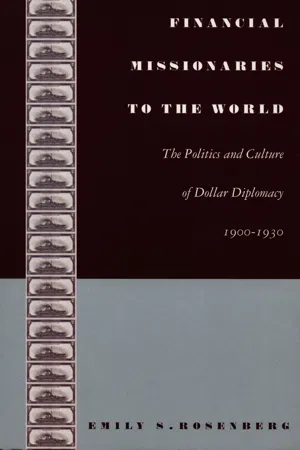
Financial Missionaries to the World establishes the broad scope and significance of "dollar diplomacy"—the use of international lending and advising—to early-twentieth-century U.S. foreign policy. Combining diplomatic, economic, and cultural history, the distinguished historian Emily S. Rosenberg shows how private bank loans were extended to leverage the acceptance of American financial advisers by foreign governments. In an analysis striking in its relevance to contemporary debates over international loans, she reveals how a practice initially justified as a progressive means to extend "civilization" by promoting economic stability and progress became embroiled in controversy. Vocal critics at home and abroad charged that American loans and financial oversight constituted a new imperialism that fostered exploitation of less powerful nations. By the mid-1920s, Rosenberg explains, even early supporters of dollar diplomacy worried that by facilitating excessive borrowing, the practice might induce the very instability and default that it supposedly worked against.
eBook - PDF
Financial Missionaries to the World
The Politics and Culture of Dollar Diplomacy, 1900-1930
- 349 pages
- English
- PDF
- Available on iOS & Android
eBook - PDF
Financial Missionaries to the World
The Politics and Culture of Dollar Diplomacy, 1900-1930
About this book
Information
Table of contents
- Contents
- Introduction
- 1 Gold-Standard Visions: International Currency Reformers, 1898–1905
- 2 The Roosevelt Corollary and the Dominican Model of 1905
- 3 The Changing Forms of Controlled Loans under Taft and Wilson
- 4 Private Money, Public Policy, 1921–1923
- 5 Opposition to Financial Imperialism, 1919–1926
- 6 Stabilization Programs and Financial Missions in New Guises, 1924–1928
- 7 Faith in Professionalism, Fascination with Primitivism
- 8 Dollar Diplomacy in Decline, 1927–1930
- Abbreviations
- Notes
- Index
Trusted by 375,005 students
Access to over 1.5 million titles for a fair monthly price.
Study more efficiently using our study tools.
Frequently asked questions
Yes, you can cancel anytime from the Subscription tab in your account settings on the Perlego website. Your subscription will stay active until the end of your current billing period. Learn how to cancel your subscription
No, books cannot be downloaded as external files, such as PDFs, for use outside of Perlego. However, you can download books within the Perlego app for offline reading on mobile or tablet. Learn how to download books offline
We are an online textbook subscription service, where you can get access to an entire online library for less than the price of a single book per month. With over 1.5 million books across 990+ topics, we’ve got you covered! Learn about our mission
Look out for the read-aloud symbol on your next book to see if you can listen to it. The read-aloud tool reads text aloud for you, highlighting the text as it is being read. You can pause it, speed it up and slow it down. Learn more about Read Aloud
Yes! You can use the Perlego app on both iOS and Android devices to read anytime, anywhere — even offline. Perfect for commutes or when you’re on the go.
Please note we cannot support devices running on iOS 13 and Android 7 or earlier. Learn more about using the app
Please note we cannot support devices running on iOS 13 and Android 7 or earlier. Learn more about using the app
Yes, you can access Financial Missionaries to the World by Emily S. Rosenberg, Gilbert M. Joseph in PDF and/or ePUB format, as well as other popular books in Economics & International Economics. We have over 1.5 million books available in our catalogue for you to explore.