![]()
CHAPTER ONE
THE IRISH DAMES OF YPRES
Benedictine Nuns and their Convents
In the twentieth century, when they settled in Kylemore, the Irish Dames of Ypres would be influenced in many ways by their distinctly ‘Irish’ surroundings in Connemara. They flourished even as Ireland secured her independence from Britain and the Irish Free State was formed. But at its moment of foundation, almost two hundred and fifty years earlier, their Ypres monastery was a centre of piety founded ‘to relieve the spiritual distress of the English Catholic communities’.1 Where did the Ypres foundation originate? It belongs to the history of English Benedictine houses exiled from England in the seventeenth century. To understand how they came into existence, it is necessary to look at the origins of Benedictine convents.2
St Benedict of Nursia founded twelve monasteries in the vicinity of Subiaco, Italy, in the early decades of the sixth century. In 530, he founded the great Benedictine monastery of Monte Cassino, which lies on a hilltop between Rome and Naples. It would appear that St Benedict never had in mind to found a religious order, rather each Benedictine monastery was to be autonomous and under the guidance of an abbot. Benedict’s sister, St Scholastica, was the first Benedictine nun, so Benedictine monasticism has had monks and nuns from when it first began. While the Irish Benedictines at Kylemore Abbey trace their history to the first monasteries of St Benedict, they are directly connected to the English Benedictine houses of the seventh century.
The first English Benedictine convent was the Abbey of Folkestone, founded in AD 630. At around this time, convents were being founded in England for daughters of the nobility. There were many nuns of royal blood, including princesses and queens. Barking Abbey had, as abbesses, three queens and two princesses: Queen Edelthryd was abbess of Ely and her sister, Sexburga, succeeded her in office.3 Convents were part of the religious life of the people; and abbesses were consulted on many issues, including public disputes. They participated in ecclesiastical meetings and they were respected as wise women. Anglo-Saxon convents were often situated close to monasteries for monks. In some instances, the centralised government of both communities was under the authority of the abbess.4 The seventh century also saw a large number of convents being founded in Gaul and many of these bound themselves to the Rule of St Benedict. In the centuries that followed, Benedictine convents were founded in countries including France, Italy, Germany, Spain, Portugal, Poland, Hungary and Denmark. By the year 1200, ‘all the countries of Western Christendom had convents according to the Rule of St Benedict’.5
In the Early Middle Ages, the legal position of Benedictine convents varied, depending on their circumstances. They were under the supervision of the bishop in whose diocese they were located and the bishop consecrated the abbess and the nuns, and had the right to make visitation of the convent. Many convents also recognised the authority of an abbot. Additionally, if a convent was established by a king or emperor, it was a royal or imperial convent and had royal protection. Alongside imperial or royal convents, there was a multitude of ‘dependent convents’, some of which were under the direction of an elected abbess. As a mark of distinction, the abbess of the Middle Ages carried a staff. Other officials in the convent included the chantress, who directed the choir and composed music; the infirmarian, who was trained to serve as pharmacist and physician to the convent, and the teachers, who gave lessons in Latin, reading, writing, music and needlework. Following the Rule of St Benedict, the nuns performed domestic work and managed their bakery and garden. They accepted lay sisters to do domestic work, though the numbers of lay Benedictines remained small until the eighteenth century. Communities lived on the produce from their farms and they rented land and vineyards to servants and tenants, to raise income.
Religious life for nuns centred on the performance of choir service. By the Middle Ages, the nuns’ choir was located in a gallery within the church, or in an upper storey of the church, while the vault of the church often served as a tomb. Nuns spent much time walking and praying in the cloisters and reading was done in niches along the cloister. There was also a scriptorium for the copyists and scribes. Some nuns were particularly known for their scholarship and theological training, such as St Hildegard of Bingen and Elizabeth of Schönau.6 The Benedictine house was a place where the word of God was read and heard, as well as put into practice. The emphasis on ‘listening’ to the scriptures, through the Benedictine practice of lectio divina, was – and still is – central to Benedictine monasticism.7
Lady Mary Percy and the Benedictine Foundation at Ypres
The thirteenth century saw a decline in Benedictinism, which has been linked to economic changes. Convents were generally small and relied on barter and their own industry in order to survive. Poor harvests, crop failures, bad management and internal disputes all served to weaken the fabric of monastic life. Convents were also made weak through the practice of having to accept noblewomen who had no serious commitment to religious life. In the fourteenth and fifteenth centuries, the number of nuns in convents fell. In France and England, the Black Plague and the Hundred Years’ War contributed to the demise of many convents. When the Protestant Reformation brought about the complete suppression of the English monasteries, nuns were forced to either abandon religious life or flee to continental Europe. By 1539, there was no longer ‘a single convent in England’.8 However, this was not the end of the English convents; in the century that followed, the English convents in exile joined other communities on the Continent and new convents were founded. The first post-Reformation community of English Benedictines to be established on the Continent was the monastery of the Glorious Assumption of Our Lady, founded by Lady Mary Percy in Brussels in 1598.9
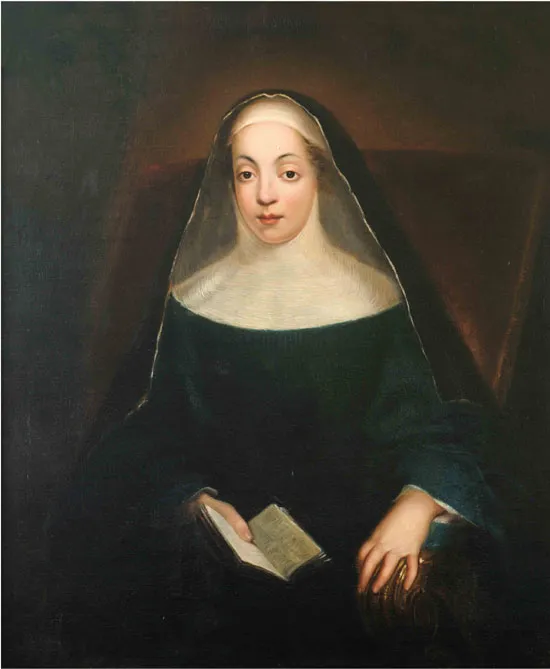
Lady Mary Percy, foundress of the monastery of the Glorious Assumption of Our Lady, Brussels (1598).
The foundation in Brussels, which was made by Lady Mary Percy, was intended...