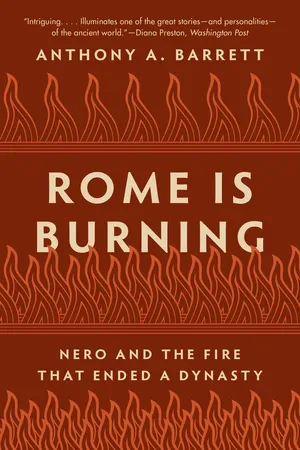
Drawing on new archaeological evidence, an authoritative history of Rome's Great Fire—and how it inflicted lasting harm on the Roman Empire
According to legend, the Roman emperor Nero set fire to his majestic imperial capital on the night of July 19, AD 64 and fiddled while the city burned. It's a story that has been told for more than two millennia—and it's likely that almost none of it is true. In Rome Is Burning, distinguished Roman historian Anthony Barrett sets the record straight, providing a comprehensive and authoritative account of the Great Fire of Rome, its immediate aftermath, and its damaging longterm consequences for the Roman world. Drawing on remarkable new archaeological discoveries and sifting through all the literary evidence, he tells what is known about what actually happened—and argues that the disaster was a turning point in Roman history, one that ultimately led to the fall of Nero and the end of the dynasty that began with Julius Caesar.
Rome Is Burning tells how the fire destroyed much of the city and threw the population into panic. It describes how it also destroyed Nero's golden image and provoked a financial crisis and currency devaluation that made a permanent impact on the Roman economy. Most importantly, the book surveys, and includes many photographs of, recent archaeological evidence that shows visible traces of the fire's destruction. Finally, the book describes the fire's continuing afterlife in literature, opera, ballet, and film.
A richly detailed and scrupulously factual narrative of an event that has always been shrouded in myth, Rome Is Burning promises to become the standard account of the Great Fire of Rome for our time.
- English
- ePUB (mobile friendly)
- Available on iOS & Android
eBook - ePub
About this book
Information
Publisher
Princeton University PressYear
2020Print ISBN
9780691233949
9780691172316
eBook ISBN
9780691208503
INDEX
Romans are normally indexed by nomen, where it is known, but famous individuals, such as emperors, are indexed by the form of the name that is generally familiar.
The entries on the most important literary sources, Pliny the Elder, Tacitus, Suetonius, and Dio, are restricted to substantive discussions of their evidence.
- Achaea. See Greece
- Acratus, 234
- Actium, 7, 63
- AD 80, fire of, 31, 54–55, 70, 112–113
- aedile, 42, 43, 44, 99, 175, 179, 272, 273nn60 and 61, 305
- Aemiliana, 13, 51, 53, 58, 60, 99–100, 116, 131, 234, 261, 274n94, 280n104
- Aemilius Scaurus, Marcus, 235
- Aeneas, 134, 139
- Africa, province of, 11, 14, 64, 75, 97, 160, 166
- Agrippa, Herod, 66
- Agrippa, Lake of, 128
- Agrippa, Marcus Vipsanius, 43, 62, 63, 98, 99, 135, 260
- Agrippa, thermae of, 54, 99
- Agrippa II of Judea, 230
- Agrippina the Elder, 98, 120, 187
- Agrippina the Younger, 8, 9, 10, 51, 119–120, 155, 223, 227, 238, 254, 274n93, 276n32
- Aiblinger, Johann Caspar, 255
- A...
Table of contents
- Cover Page
- Series Page
- Title Page
- Copyright Page
- Contents
- List of Illustrations
- Series Editor’s Foreword
- Acknowledgments
- Timeline
- Map
- Prologue
- I. Introduction
- The Fire
- The Aftermath
- Epilogue: The Great Fire as an Enduring Cultural Phenomenon
- Principal Sources: Tacitus, Suetonius, and Dio
- Notes
- Glossary
- Bibliography
- Index
Trusted by 375,005 students
Access to over 1.5 million titles for a fair monthly price.
Study more efficiently using our study tools.
Frequently asked questions
Yes, you can cancel anytime from the Subscription tab in your account settings on the Perlego website. Your subscription will stay active until the end of your current billing period. Learn how to cancel your subscription
No, books cannot be downloaded as external files, such as PDFs, for use outside of Perlego. However, you can download books within the Perlego app for offline reading on mobile or tablet. Learn how to download books offline
Perlego offers two plans: Essential and Complete
- Essential is ideal for learners and professionals who enjoy exploring a wide range of subjects. Access the Essential Library with 800,000+ trusted titles and best-sellers across business, personal growth, and the humanities. Includes unlimited reading time and Standard Read Aloud voice.
- Complete: Perfect for advanced learners and researchers needing full, unrestricted access. Unlock 1.5M+ books across hundreds of subjects, including academic and specialized titles. The Complete Plan also includes advanced features like Premium Read Aloud and Research Assistant.
We are an online textbook subscription service, where you can get access to an entire online library for less than the price of a single book per month. With over 1.5 million books across 990+ topics, we’ve got you covered! Learn about our mission
Look out for the read-aloud symbol on your next book to see if you can listen to it. The read-aloud tool reads text aloud for you, highlighting the text as it is being read. You can pause it, speed it up and slow it down. Learn more about Read Aloud
Yes! You can use the Perlego app on both iOS and Android devices to read anytime, anywhere — even offline. Perfect for commutes or when you’re on the go.
Please note we cannot support devices running on iOS 13 and Android 7 or earlier. Learn more about using the app
Please note we cannot support devices running on iOS 13 and Android 7 or earlier. Learn more about using the app
Yes, you can access Rome Is Burning by Anthony A. Barrett in PDF and/or ePUB format, as well as other popular books in History & Roman Ancient History. We have over 1.5 million books available in our catalogue for you to explore.