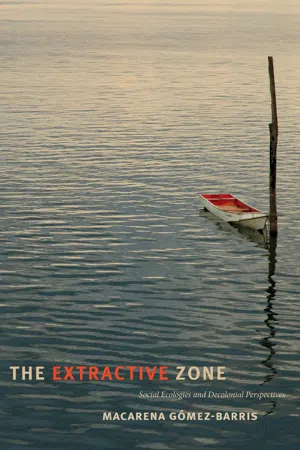
In The Extractive Zone Macarena Gómez-Barris traces the political, aesthetic, and performative practices that emerge in opposition to the ruinous effects of extractive capital. The work of Indigenous activists, intellectuals, and artists in spaces Gómez-Barris labels extractive zones—majority indigenous regions in South America noted for their biodiversity and long history of exploitative natural resource extraction—resist and refuse the terms of racial capital and the continued legacies of colonialism. Extending decolonial theory with race, sexuality, and critical Indigenous studies, Gómez-Barris develops new vocabularies for alternative forms of social and political life. She shows how from Colombia to southern Chile artists like filmmaker Huichaqueo Perez and visual artist Carolina Caycedo formulate decolonial aesthetics. She also examines the decolonizing politics of a Bolivian anarcho-feminist collective and a coalition in eastern Ecuador that protects the region from oil drilling. In so doing, Gómez-Barris reveals the continued presence of colonial logics and locates emergent modes of living beyond the boundaries of destructive extractive capital.
- 209 pages
- English
- PDF
- Available on iOS & Android
eBook - PDF
About this book
Information
Publisher
Duke University Press BooksYear
2017Print ISBN
9780822368977
9780822368755
eBook ISBN
9780822372561
Table of contents
- Cover
- Contents
- Acknowledgments
- Preface. Below the Surface
- Introduction. Submerged Perspectives
- 1. The Intangibility of the Yasuní
- 2. Andean Phenomenology and New Age Settler Colonialism
- 3. An Archive for the Future: Seeing through Occupation
- 4. A Fish-Eye Episteme: Seeing Below the River’s Colonization
- 5. Decolonial Gestures: Anarcho-Feminist Indigenous Critique
- Conclusion. The View from Below
- Notes
- Bibliography
- Index
Trusted by 375,005 students
Access to over 1.5 million titles for a fair monthly price.
Study more efficiently using our study tools.
Frequently asked questions
Yes, you can cancel anytime from the Subscription tab in your account settings on the Perlego website. Your subscription will stay active until the end of your current billing period. Learn how to cancel your subscription
No, books cannot be downloaded as external files, such as PDFs, for use outside of Perlego. However, you can download books within the Perlego app for offline reading on mobile or tablet. Learn how to download books offline
Perlego offers two plans: Essential and Complete
- Essential is ideal for learners and professionals who enjoy exploring a wide range of subjects. Access the Essential Library with 800,000+ trusted titles and best-sellers across business, personal growth, and the humanities. Includes unlimited reading time and Standard Read Aloud voice.
- Complete: Perfect for advanced learners and researchers needing full, unrestricted access. Unlock 1.5M+ books across hundreds of subjects, including academic and specialized titles. The Complete Plan also includes advanced features like Premium Read Aloud and Research Assistant.
We are an online textbook subscription service, where you can get access to an entire online library for less than the price of a single book per month. With over 1.5 million books across 990+ topics, we’ve got you covered! Learn about our mission
Look out for the read-aloud symbol on your next book to see if you can listen to it. The read-aloud tool reads text aloud for you, highlighting the text as it is being read. You can pause it, speed it up and slow it down. Learn more about Read Aloud
Yes! You can use the Perlego app on both iOS and Android devices to read anytime, anywhere — even offline. Perfect for commutes or when you’re on the go.
Please note we cannot support devices running on iOS 13 and Android 7 or earlier. Learn more about using the app
Please note we cannot support devices running on iOS 13 and Android 7 or earlier. Learn more about using the app
Yes, you can access The Extractive Zone by Macarena Gómez-Barris in PDF and/or ePUB format, as well as other popular books in Social Sciences & Latin American & Caribbean History. We have over 1.5 million books available in our catalogue for you to explore.