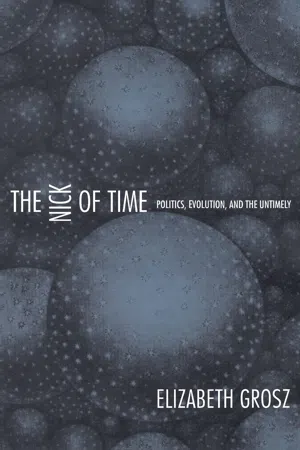
Grosz develops her argument by juxtaposing the work of three major figures in Western thought: Charles Darwin, Friedrich Nietzsche, and Henri Bergson. She reveals that in theorizing time as an active, positive phenomenon with its own characteristics and specific effects, each of these thinkers had a profound effect on contemporary understandings of the body in relation to time. She shows how their allied concepts of life, evolution, and becoming are manifest in the work of Gilles Deleuze and Luce Irigaray. Throughout The Nick of Time, Grosz emphasizes the political and cultural imperative to fundamentally rethink time: the more clearly we understand our temporal location as beings straddling the past and the future without the security of a stable and abiding present, the more transformation becomes conceivable.
- 327 pages
- English
- PDF
- Available on iOS & Android
eBook - PDF
About this book
In this pathbreaking philosophical work, Elizabeth Grosz points the way toward a theory of becoming to replace the prevailing ontologies of being in social, political, and biological discourse. Arguing that theories of temporality have significant and underappreciated relevance to the social dimensions of science and the political dimensions of struggle, Grosz engages key theoretical concerns related to the reality of time. She explores the effect of time on the organization of matter and on the emergence and development of biological life. Considering how the relentless forward movement of time might be conceived in political and social terms, she begins to formulate a model of time that incorporates the future and its capacity to supersede and transform the past and present.
Information
Publisher
Duke University Press BooksYear
2004Print ISBN
9780822333975
9780822334002
eBook ISBN
9780822386032
Topic
FilosofiaSubtopic
Mente e corpo in filosofiaTable of contents
- CONTENTS
- Acknowledgments
- Abbreviations
- Introduction: To the Untimely
- PART I. DARWIN AND EVOLUTION
- PART II. NIETZSCHE AND OVERCOMING
- PART III. BERGSON AND BECOMING
- Conclusion: The Future
- Notes
- References
- Index
Trusted by 375,005 students
Access to over 1.5 million titles for a fair monthly price.
Study more efficiently using our study tools.
Frequently asked questions
Yes, you can cancel anytime from the Subscription tab in your account settings on the Perlego website. Your subscription will stay active until the end of your current billing period. Learn how to cancel your subscription
No, books cannot be downloaded as external files, such as PDFs, for use outside of Perlego. However, you can download books within the Perlego app for offline reading on mobile or tablet. Learn how to download books offline
Perlego offers two plans: Essential and Complete
- Essential is ideal for learners and professionals who enjoy exploring a wide range of subjects. Access the Essential Library with 800,000+ trusted titles and best-sellers across business, personal growth, and the humanities. Includes unlimited reading time and Standard Read Aloud voice.
- Complete: Perfect for advanced learners and researchers needing full, unrestricted access. Unlock 1.5M+ books across hundreds of subjects, including academic and specialized titles. The Complete Plan also includes advanced features like Premium Read Aloud and Research Assistant.
We are an online textbook subscription service, where you can get access to an entire online library for less than the price of a single book per month. With over 1.5 million books across 990+ topics, we’ve got you covered! Learn about our mission
Look out for the read-aloud symbol on your next book to see if you can listen to it. The read-aloud tool reads text aloud for you, highlighting the text as it is being read. You can pause it, speed it up and slow it down. Learn more about Read Aloud
Yes! You can use the Perlego app on both iOS and Android devices to read anytime, anywhere — even offline. Perfect for commutes or when you’re on the go.
Please note we cannot support devices running on iOS 13 and Android 7 or earlier. Learn more about using the app
Please note we cannot support devices running on iOS 13 and Android 7 or earlier. Learn more about using the app
Yes, you can access The Nick of Time by Elizabeth Grosz in PDF and/or ePUB format, as well as other popular books in Filosofia & Mente e corpo in filosofia. We have over 1.5 million books available in our catalogue for you to explore.