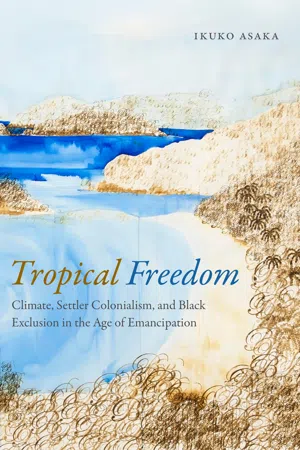
In Tropical Freedom Ikuko Asaka engages in a hemispheric examination of the intersection of emancipation and settler colonialism in North America. Asaka shows how from the late eighteenth century through Reconstruction, emancipation efforts in the United States and present-day Canada were accompanied by attempts to relocate freed blacks to tropical regions, as black bodies were deemed to be more physiologically compatible with tropical climates. This logic conceived of freedom as a racially segregated condition based upon geography and climate. Regardless of whether freed people became tenant farmers in Sierra Leone or plantation laborers throughout the Caribbean, their relocation would provide whites with a monopoly over the benefits of settling indigenous land in temperate zones throughout North America. At the same time, black activists and intellectuals contested these geographic-based controls by developing alternative discourses on race and the environment. By tracing these negotiations of the transnational racialization of freedom, Asaka demonstrates the importance of considering settler colonialism and black freedom together while complicating the prevailing frames through which the intertwined histories of British and U.S. emancipation and colonialism have been understood.
eBook - PDF
Tropical Freedom
Climate, Settler Colonialism, and Black Exclusion in the Age of Emancipation
- 305 pages
- English
- PDF
- Available on iOS & Android
eBook - PDF
Tropical Freedom
Climate, Settler Colonialism, and Black Exclusion in the Age of Emancipation
About this book
Trusted by 375,005 students
Access to over 1.5 million titles for a fair monthly price.
Study more efficiently using our study tools.
Information
Publisher
Duke University Press BooksYear
2017Print ISBN
9780822369103
9780822368816
eBook ISBN
9780822372752
Table of contents
- Cover
- Contents
- Acknowledgments
- Note on Terms
- Introduction
- Chapter 1: Black Freedom and Settler Colonial Order
- Chapter 2: Black Geographies and the Politics of Diaspora
- Chapter 3: Intimacy and Belonging
- Chapter 4: Gendered Mobilities and White Settler Boundaries
- Chapter 5: Race, Climate, and Labor
- Chapter 6: U.S. Emancipation and Tropical Black Freedom
- Conclusion
- Notes
- Bibliography
- Index
Frequently asked questions
Yes, you can cancel anytime from the Subscription tab in your account settings on the Perlego website. Your subscription will stay active until the end of your current billing period. Learn how to cancel your subscription
No, books cannot be downloaded as external files, such as PDFs, for use outside of Perlego. However, you can download books within the Perlego app for offline reading on mobile or tablet. Learn how to download books offline
Perlego offers two plans: Essential and Complete
- Essential is ideal for learners and professionals who enjoy exploring a wide range of subjects. Access the Essential Library with 800,000+ trusted titles and best-sellers across business, personal growth, and the humanities. Includes unlimited reading time and Standard Read Aloud voice.
- Complete: Perfect for advanced learners and researchers needing full, unrestricted access. Unlock 1.5M+ books across hundreds of subjects, including academic and specialized titles. The Complete Plan also includes advanced features like Premium Read Aloud and Research Assistant.
We are an online textbook subscription service, where you can get access to an entire online library for less than the price of a single book per month. With over 1.5 million books across 990+ topics, we’ve got you covered! Learn about our mission
Look out for the read-aloud symbol on your next book to see if you can listen to it. The read-aloud tool reads text aloud for you, highlighting the text as it is being read. You can pause it, speed it up and slow it down. Learn more about Read Aloud
Yes! You can use the Perlego app on both iOS and Android devices to read anytime, anywhere — even offline. Perfect for commutes or when you’re on the go.
Please note we cannot support devices running on iOS 13 and Android 7 or earlier. Learn more about using the app
Please note we cannot support devices running on iOS 13 and Android 7 or earlier. Learn more about using the app
Yes, you can access Tropical Freedom by Ikuko Asaka in PDF and/or ePUB format, as well as other popular books in Social Sciences & 19th Century History. We have over 1.5 million books available in our catalogue for you to explore.