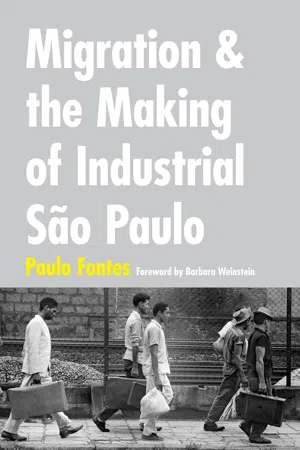
Published in 2008 and winner of the 2011 Thomas E. Skidmore Prize, Paulo Fontes's Migration and the Making of Industrial São Paulo is a detailed social history of São Paulo's extraordinary urban and industrial expansion. Fontes focuses on those migrants who settled in the suburb of São Miguel Paulista, which grew from 7,000 residents in the 1940s to over 140,000 two decades later. Reconstructing these migrants' everyday lives within a broad social context, Fontes examines the economic conditions that prompted their migration, their creation of an integrated identity and community, and their efforts to gain worker rights. Fontes challenges the stereotypes of Northeasterners as culturally backward, uneducated, violent, and unreliable, instead seeing them as a resourceful population with considerable social and political resolve. Fontes's investigations into Northeastern life in São Miguel Paulista yield a fresh understanding of São Paulo's incredible and difficult growth while outlining how a marginalized population exercised its political agency.
- 297 pages
- English
- PDF
- Available on iOS & Android
eBook - PDF
Migration and the Making of Industrial São Paulo
About this book
Information
Publisher
Duke University Press BooksYear
2016Print ISBN
9780822361343
9780822361152
eBook ISBN
9780822374299
Table of contents
- Cover
- Contents
- Foreword by Barbara Weinstein
- Acknowledgments
- Introduction
- One. A Cardboard Suitcase and a Backpack: Northeastern Migrations to São Paulo in the 1950s
- Two. Land of the Northeasterners: Migration, Urbanization, and Factory Work in São Miguel Paulista
- Three. Worker Community and Everyday Life: “Becoming Northeastern” in São Paulo
- Four. The Right to Practice Politics: Parties and Political Leadership in São Miguel Paulista
- Five. Workers and the Neighborhood: Social Movements and the Struggle for Autonomy
- Conclusion
- Notes
- Bibliography
- Index
Trusted by 375,005 students
Access to over 1.5 million titles for a fair monthly price.
Study more efficiently using our study tools.
Frequently asked questions
Yes, you can cancel anytime from the Subscription tab in your account settings on the Perlego website. Your subscription will stay active until the end of your current billing period. Learn how to cancel your subscription
No, books cannot be downloaded as external files, such as PDFs, for use outside of Perlego. However, you can download books within the Perlego app for offline reading on mobile or tablet. Learn how to download books offline
Perlego offers two plans: Essential and Complete
- Essential is ideal for learners and professionals who enjoy exploring a wide range of subjects. Access the Essential Library with 800,000+ trusted titles and best-sellers across business, personal growth, and the humanities. Includes unlimited reading time and Standard Read Aloud voice.
- Complete: Perfect for advanced learners and researchers needing full, unrestricted access. Unlock 1.5M+ books across hundreds of subjects, including academic and specialized titles. The Complete Plan also includes advanced features like Premium Read Aloud and Research Assistant.
We are an online textbook subscription service, where you can get access to an entire online library for less than the price of a single book per month. With over 1.5 million books across 990+ topics, we’ve got you covered! Learn about our mission
Look out for the read-aloud symbol on your next book to see if you can listen to it. The read-aloud tool reads text aloud for you, highlighting the text as it is being read. You can pause it, speed it up and slow it down. Learn more about Read Aloud
Yes! You can use the Perlego app on both iOS and Android devices to read anytime, anywhere — even offline. Perfect for commutes or when you’re on the go.
Please note we cannot support devices running on iOS 13 and Android 7 or earlier. Learn more about using the app
Please note we cannot support devices running on iOS 13 and Android 7 or earlier. Learn more about using the app
Yes, you can access Migration and the Making of Industrial São Paulo by Paulo Fontes in PDF and/or ePUB format, as well as other popular books in History & Latin American & Caribbean History. We have over 1.5 million books available in our catalogue for you to explore.