Cardiac Pacing and ICDs
  1. English
  2. ePUB (mobile friendly)
  3. Available on iOS & Android
eBook - ePub

About this book

The consummate guide to cardiac pacing and defibrillator therapy in a clinical setting

Designed to provide clinicians and fellows with a complete, up-to-date breakdown of current device therapies for pacing and defibrillation, Cardiac Pacing and ICDs reflects the latest developments in the device treatment of heart rhythm abnormalities. Topics ranging from essential principals to new and innovative techniques are explored in focused chapters, illustrated with full-color images, charts, and diagrams. Addressing every aspect of permanent and temporary pacing and defibrillation therapy, this invaluable resource covers patient indications, pacing mode selection, implantation and removal techniques, troubleshooting, and much more.

The seventh edition has been expanded and revised to enable clear and practical understanding of the field as it exists today. Drawing upon real-world experience and cutting-edge research, it offers accessible, systematic guidance with a clinical focus, as well as a wealth of bitesize tips and tricks. Access to a new companion website provides insightful supplementary material, complete with downloadable images and video clips of key techniques. This essential book:

  • Provides an intuitive, easy-to-navigate guide to cardiac pacing techniques and devices
  • Explains pacing hemodynamics in practical, clinically relevant terms
  • Features simple algorithms for mode selection and device programming
  • Offers details of novel pacing systems and techniques, such as leadless pacemaker and His bundle pacing.
  • Covers pacemaker timing cycles, special features, and evaluation and management of pacing system malfunctions
  • Summarizes indications and details implantation techniques of ICDs, including transvenous and subcutaneous systems
  • Includes best practices in MRI safety, patient consultation, and remote patient follow-up

Cardiac Pacing and ICDs is an ideal resource for clinicians and fellows in cardiology and electrophysiology, those preparing for the IHRBE Examination in Devices, and any nurses, technicians, and other professionals caring for patients with implantable cardiac devices.
Frequently asked questions

Yes, you can cancel anytime from the Subscription tab in your account settings on the Perlego website. Your subscription will stay active until the end of your current billing period. Learn how to cancel your subscription.
No, books cannot be downloaded as external files, such as PDFs, for use outside of Perlego. However, you can download books within the Perlego app for offline reading on mobile or tablet. Learn more here.
Perlego offers two plans: Essential and Complete
  • Essential is ideal for learners and professionals who enjoy exploring a wide range of subjects. Access the Essential Library with 800,000+ trusted titles and best-sellers across business, personal growth, and the humanities. Includes unlimited reading time and Standard Read Aloud voice.
  • Complete: Perfect for advanced learners and researchers needing full, unrestricted access. Unlock 1.4M+ books across hundreds of subjects, including academic and specialized titles. The Complete Plan also includes advanced features like Premium Read Aloud and Research Assistant.
Both plans are available with monthly, semester, or annual billing cycles.
We are an online textbook subscription service, where you can get access to an entire online library for less than the price of a single book per month. With over 1 million books across 1000+ topics, we’ve got you covered! Learn more here.
Look out for the read-aloud symbol on your next book to see if you can listen to it. The read-aloud tool reads text aloud for you, highlighting the text as it is being read. You can pause it, speed it up and slow it down. Learn more here.
Yes! You can use the Perlego app on both iOS or Android devices to read anytime, anywhere — even offline. Perfect for commutes or when you’re on the go.
Please note we cannot support devices running on iOS 13 and Android 7 or earlier. Learn more about using the app.
Yes, you can access Cardiac Pacing and ICDs by Kenneth A. Ellenbogen, Karoly Kaszala, Kenneth A. Ellenbogen,Karoly Kaszala in PDF and/or ePUB format, as well as other popular books in Medicine & Physiology. We have over one million books available in our catalogue for you to explore.

Information

Year
2020
Print ISBN
9781119578338
eBook ISBN
9781119578284
Edition
7
Subtopic
Physiology

CHAPTER 1
Indications for permanent cardiac pacing

Roy M. John
Center for Advanced Management of Ventricular Arrhythmias, Northshore University Hospital, Manhasset, NY, USA

Introduction

Defects of cardiac impulse generation and conduction can occur at various levels in the cardiac conduction system. In general, intrinsic disease of the conduction system is often diffuse. For example, normal atrioventricular (AV) conduction cannot necessarily be assumed when a pacemaker is implanted for a disorder seemingly localized to the sinus node. Similarly, normal sinus node function cannot be assumed when a pacemaker is implanted in a patient with AV block. Conduction disorders that lead to important bradycardia or asystole may result from reversible or irreversible causes. Recognition of reversible causes is critical to avoid unnecessary commitment to long‐term pacemaker therapy. This chapter reviews the common disorders that warrant cardiac pacing and lists the recommended indications set out by published guidelines.

Anatomy and physiology of the conduction system

For a complete understanding of rhythm generation and intracardiac conduction, and of their pathology, a brief review of the anatomy and physiology of the specialized conduction system is warranted.

Sinus node

The sinus node or sinoatrial (SA) node is a crescent‐shaped subepicardial structure located at the junction of the right atrium and superior vena cava along the terminal crest. It measures 10–20 mm (with larger extension in some studies) and has abundant autonomic innervation and blood supply, with the sinus node artery commonly coursing through the body of the node. Endocardially, the crista terminalis overlies the nodal tissue, although the inferior aspect of the node has a more subendocardial course. Histologically, the sinus node comprises specialized nodal cells (P cells) packed within a dense matrix of connective tissue. At the periphery, these nodal cells intermingle with transitional cells and the atrial working myocardium, with radiations extending toward the superior vena cava, the crista terminalis, and the intercaval regions [1,2]. The absence of a distinct border and the presence of distal fragmentation explain the lack of a single breakthrough of the sinus node excitatory wavefront. The radiations of the node, although histologically distinct, are not insulated from the atrial myocardium. Hence, a clear anatomical SA junction is absent. The sinus node is protected from the hyperpolarizing effect of the surrounding atria, probably by its unique structure wherein electrical coupling between cells and expression of ion channels vary from the center of the node to the periphery. The pacemaker cells at the center of the node are more loosely coupled, while those at the periphery are more tightly coupled with higher density If (funny current, a mixed sodium and potassium current carried by the HCN channels) and INa currents [2].
The SA node has the highest rate of spontaneous depolarization (automaticity) in the specialized conduction system and is responsible for the generation of the cardiac impulse under normal circumstances, although normal human pacemaker activity may be widely distributed in the atrium. The unique location of the sinus node astride the large SA nodal artery provides an ideal milieu for continuous monitoring and instantaneous adjustment of heart rate to meet the body’s changing metabolic needs.
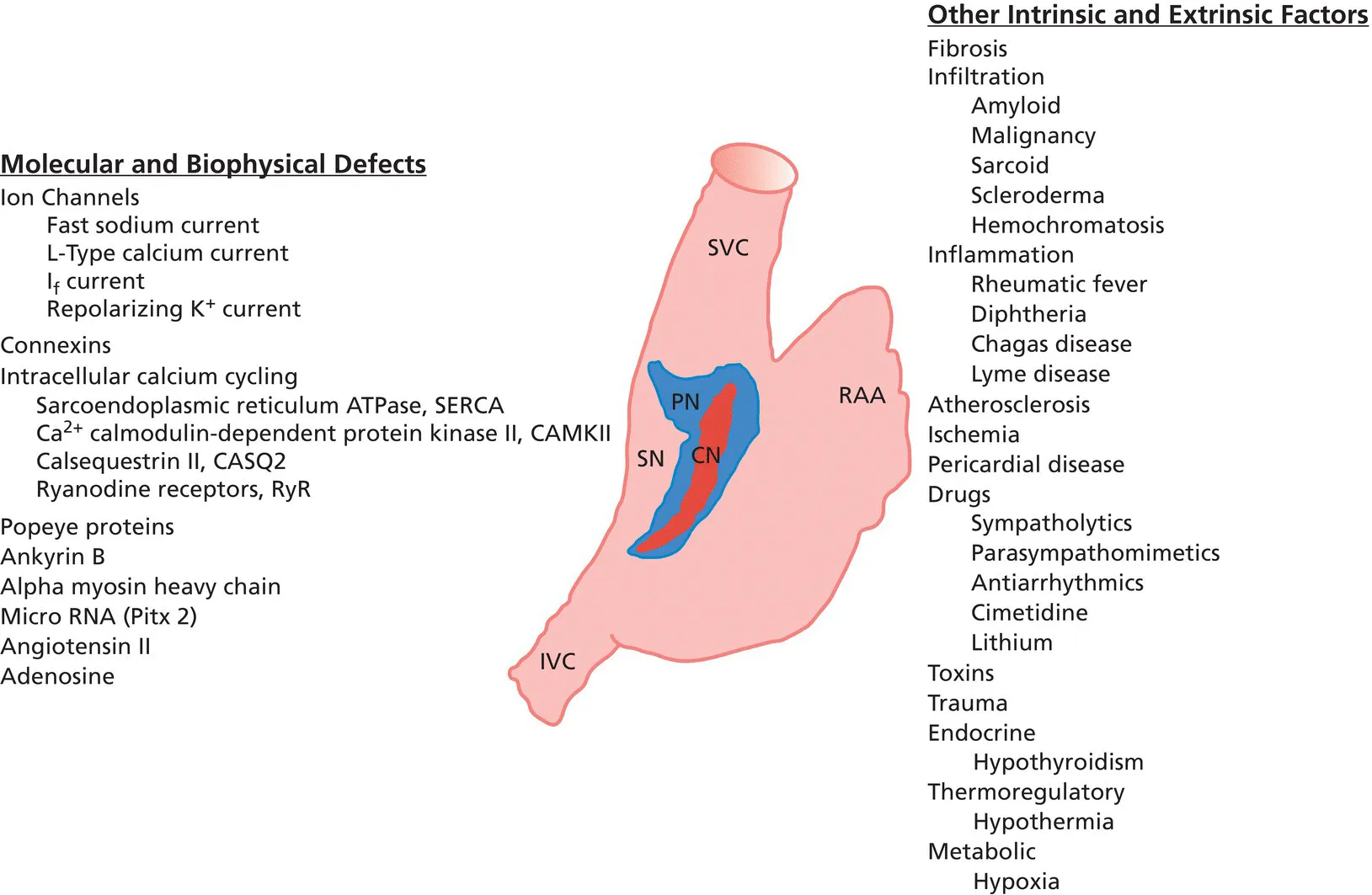
Impulse generation in the sinus node remains incompletely understood. Sinus nodal cells have a low resting membrane potential of −50 to −60 mV. Spontaneous diastolic (phase 4) depolarizations are probably triggered by several currents, including If. The predominant inward current in the center of the node is ICaL that generates a “slow” action potential. The action potentials spread peripherally into the musculature of the terminal crest. In the periphery of the node, INa is operative and necessary for providing sufficient inward current to depolarize the larger mass of atrial tissue. Defects of a number of molecular and biophysical factors that govern the ionic channels of the sinus node can lead to sinus node dysfunction (Figure 1.1).
Differential sensitivity to adrenergic and vagal inputs exists along the nodal pacemaker cells, such that superior sites tend to dominate during adrenergic drive while the inferior sites predominate during vagal stimulation [3]. Interventions including premature stimulation, autonomic stimulation, and drugs have been shown to induce pacemaker shifts (due to multicentric origins) with variable exit locations [4].
Diagram of the right atrium of the heart displaying the central node, sinus node, etc. The molecular and biophysical defects are listed at the left, while the other intrinsic and extrinsic factors are listed at the right.
Figure 1.1 Summary of factors contributing to sinus node (SN) dysfunction. The central node (CN) shown in red is surrounded by the peripheral nodal (PN) structure in blue. RAA, right atrial appendage; SVC, superior vena cava; IVC, inferior vena cava.
Source: modified from Monfredi O, Boyett MR. Sinus sinus syndrome and atrial fibrillation in older persons: a view from the sinoatrial nodal myocyte. J Mol Cell Cardiol 2015;83:88–100. Reproduced with permission of Elsevier.

Atrioventricular node

The compact AV node is a subendocardial structure situated within the triangle of Koch and measuring 5–7 mm in length and 2–5 mm in width [5,6]. On the atrial side, the node is an integral part of the atrial musculature, in contrast to the AV bundle which is insulated within the central fibrous body and merges with the His bundle. Based on action potential morphology in rabbit hearts, atrial (A), nodal (N), and His (H) cells have been defined. Intermediate cell types such as AN and NH define areas toward the atrial and His bundle ends of the compact node, respectively. Histologically, the mid nodal part has densely packed cells in a basket‐like structure interposed between the His bundle and the loose atrial approaches to the node. The AN cells are composed primarily of transitional cells. Distinct electrical and morphological specialization is seen only in the progressively distal His fibers. Rightward and leftward posterior extensions of the AV node were described by Inoue and Becker [7]. These extensions have clinical implications for defining reentrant circuits that act as a substrate of AV nodal reentrant tachycardia.
The AV node has ext...

Table of contents

  1. Cover
  2. Table of Contents
  3. List of Contributors
  4. Preface
  5. Acknowledgments
  6. CHAPTER 1: Indications for permanent cardiac pacing
  7. CHAPTER 2: Basics of cardiac pacing: components of pacing, defibrillation, and resynchronization therapy systems
  8. CHAPTER 3: Hemodynamics of cardiac pacing and pacing mode selection
  9. CHAPTER 4: Temporary cardiac pacing
  10. CHAPTER 5: Techniques of pacemaker and ICD implantation and removal
  11. CHAPTER 6: Pacemaker timing cycles and special features
  12. CHAPTER 7: Evaluation, troubleshooting, and management of pacing system malfunctions
  13. CHAPTER 8: The implantable cardioverter–defibrillator
  14. CHAPTER 9: Cardiac resynchronization therapy
  15. CHAPTER 10: ICD follow‐up and troubleshooting
  16. CHAPTER 11: Follow‐up of the patient with a CIED
  17. Index
  18. End User License Agreement