BYSTANDER EFFECT EB
eBook - ePub

BYSTANDER EFFECT EB

  1. English
  2. ePUB (mobile friendly)
  3. Available on iOS & Android
eBook - ePub

BYSTANDER EFFECT EB

About this book

'Fantastic … It explains the misperception of stacked odds and personal powerlessness that stops individuals challenging bad behaviour. Stunning. Humbling. Thought-provoking'
Kathryn Mannix, author of With the End in Mind

In the face of discrimination, bad behaviour, evil and abuse, why do good people so often do nothing?

Every day, we see examples of bad or immoral behaviour – from sexual harassment to political corruption, from negligence to bullying.

Why did no one stop the abduction of Jamie Bulger, despite many witnesses reporting they felt uneasy seeing the two-year-old's distress? How did the USA gymnastics team doctor, Larry Nassar, abuse hundreds of young women under his care for so long? Why didn't anyone intervene when David Dao, an innocent sixty-nine-year-old man, was forcibly removed from his seat on a United Airlines aeroplane and dragged down the aisle by security officers? How did large crowds of men get away with sexually assaulting an estimated 1,200 women in Cologne during the 2015 New Year's Eve celebrations?

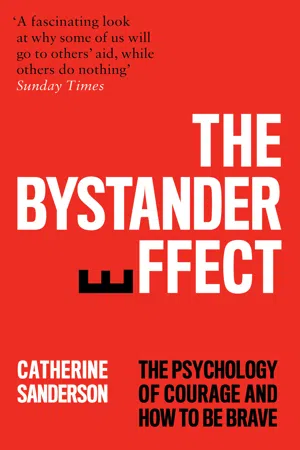
In The Bystander Effect, pioneering psychologist Catherine Sanderson uses real-life examples, neuroscience and the latest psychological studies to explain why we might be good at recognising bad behaviour but bad at taking action against it. With practical strategies to transform your thinking, she shows how we can all learn to speak out, intervene, think outside the group mentality and ultimately become braver versions of ourselves.

Courage is not a virtue we're born with. A bystander can learn to be brave.

Frequently asked questions

Yes, you can cancel anytime from the Subscription tab in your account settings on the Perlego website. Your subscription will stay active until the end of your current billing period. Learn how to cancel your subscription.
No, books cannot be downloaded as external files, such as PDFs, for use outside of Perlego. However, you can download books within the Perlego app for offline reading on mobile or tablet. Learn more here.
Perlego offers two plans: Essential and Complete
  • Essential is ideal for learners and professionals who enjoy exploring a wide range of subjects. Access the Essential Library with 800,000+ trusted titles and best-sellers across business, personal growth, and the humanities. Includes unlimited reading time and Standard Read Aloud voice.
  • Complete: Perfect for advanced learners and researchers needing full, unrestricted access. Unlock 1.4M+ books across hundreds of subjects, including academic and specialized titles. The Complete Plan also includes advanced features like Premium Read Aloud and Research Assistant.
Both plans are available with monthly, semester, or annual billing cycles.
We are an online textbook subscription service, where you can get access to an entire online library for less than the price of a single book per month. With over 1 million books across 1000+ topics, we’ve got you covered! Learn more here.
Look out for the read-aloud symbol on your next book to see if you can listen to it. The read-aloud tool reads text aloud for you, highlighting the text as it is being read. You can pause it, speed it up and slow it down. Learn more here.
Yes! You can use the Perlego app on both iOS or Android devices to read anytime, anywhere — even offline. Perfect for commutes or when you’re on the go.
Please note we cannot support devices running on iOS 13 and Android 7 or earlier. Learn more about using the app.
Yes, you can access BYSTANDER EFFECT EB by Catherine Sanderson in PDF and/or ePUB format, as well as other popular books in Psychology & Social History. We have over one million books available in our catalogue for you to explore.

Information

Notes


1. The Myth of Monsters

1. Quoted in S. L. Plous and P. G. Zimbardo, “How social science can reduce terrorism,” Chronicle of Higher Education, September 10, 2004.
Back to text
2. S. Klebold, A Mother’s Reckoning: Living in the Aftermath of Tragedy (New York: Crown, 2016).
Back to text
3. P. G. Zimbardo, “The human choice: Individuation, reason, and order vs. deindividuation, impulse, and chaos,” in Nebraska Symposium on Motivation, ed. W. J. Arnold and D. Levine, 237–307 (Lincoln: University of Nebraska Press, 1969).
Back to text
4. A. Silke, “Deindividuation, anonymity, and violence: Findings from Northern Ireland,” Journal of Social Psychology 143 (2003): 493–499.
Back to text
5. E. Diener, R. Lusk, D. DeFour, and R. Flax, “Deindividuation: Effects of group size, density, number of observers, and group member similarity on self-consciousness and disinhibited behavior,” Journal of Personality and Social Psychology 39 (1980): 449–459.
Back to text
6. A. J. Ritchey and R. B. Ruback, “Predicting lynching atrocity: The situational norms of lynchings in Georgia,” Personality and Social Psychology Bulletin 44, no. 5 (2018): 619–637.
Back to text
7. Some neuroscience researchers have been criticized for making a particular statistical error, the nonindependence error, when testing their predictions. This error occurs when researchers first use one statistical test to select which data to analyze and then use a second (nonindependent) statistical test to analyze the data. Some of these statistical concerns are detailed in, for example, American Psychological Association, “P-values under question,” Psychological Science Agenda, March 2016, https://www.apa.org/science/about/psa/2016/03/p-values; A. Abbot, “Brain imaging studies under fire,” Nature News, January 13, 2009, https://www.nature.com/news/2009/090113/full/457245a.html.
Back to text
8. Massachusetts Institute of Technology, “When good people do bad things,” ScienceDaily, June 12, 2014, https://www.sciencedaily.com/releases/2014/06/140612104950.htm.
Back to text
9. M. Cikara, A. C. Jenkins, N. Dufour, and R. Saxe, “Reduced self-referential neural response during intergroup competition predicts competitor harm,” NeuroImage 96 (2014): 36–43.
Back to text
10. A. C. Jenkins and J. P. Mitchell, “Medial prefrontal cortex subserves diverse forms of self-reflection,” Social Neuroscience 6, no. 3 (2011): 211–218; W. M. Kelley, C. N. Macrae, C. L. Wyland, S. Caglar, S. Inati, and T. F. Heatherton, “Finding the self? An event-related fMRI study,” Journal of Cognitive Neuroscience 14 (2002): 785–794; C. N. Macrae, J. M. Moran, T. F. Heatherton, J. F. Banfield, and W. M. Kelley, “Medial prefrontal activity predicts memory for self,” Cerebral Cortex 14, no. 6 (2004): 647–654.
Back to text
11. Quoted in A. Trafton, “Group mentality,” MIT Technology Review website, posted August 5, 2014, https://www.technologyreview.com/s/529791/group-mentality/.
Back to text
12. S. Milgram, “Behavioral study of obedience,” Journal of Abnormal and Social Psychology 67, no. 4 (1963): 371–378.
Back to text
13. J. M. Burger, “Replicating Milgram: Would people still obey today?” American Psychologist 64 (2009): 1–11; D. Doliński, T. Grzyb, M. Folwarczny, P. Grzybała, K. Krzyszycha, K. Martynowska, and J. Trojanowski, “Would you deliver an electric shock in 2015? Obedience in the experimental paradigm developed by Stanley Milgram in the 50 years following the original studies,” Social Psychological and Personality Science 8, no. 8 (2017): 927–933.
Back to text
14. W. H. Meeus and Q. A. Raaijmakers, “Administrative obedience: Carrying out orders to use psychological–administrative violence,” European Journal of Social Psychology 16 (1986): 311–324.
Back to text
15. T. Blass, “Attribution of responsibility and trust in the Milgram obedience experiment,” Journal of Applied Social Psychology 26 (1996): 1529–1535.
Back to text
16. A. Bandura, “Moral disengagement in the perpetration of inhumanities,” Personality and Social Psychology Review 3, no. 3 (1999): 193–209.
Back to text
17. H. A. Tilker, “Socially responsible behavior as a function of observer responsibility and victim feedback,” Journal of Personality and Social Psychology 14, no. 2 (1970): 95–100.
Back to text
18. J. M. Burger, Z. M. Girgis, and C. C. Manning, “In their own words: Explaining obedience to authority through an examination of participants’ comments,” Social Psychological and Personality Science 2 (2011): 460–466. Two-thirds of those whose comments during the study suggested that they felt personally responsible for harming the learner stopped before giving the maximum shock, while only 12 percent of those who kept giving shocks up to the highest level ever expressed any feelings of personal responsibility.
Back to text
19. E. A. Caspar, J. F. Christensen, A. Cleeremans, and P. Haggard, “Coercion changes the sense of agency in the human brain,” Current Biology 26, no. 5 (2016): 585–592.
Back to text
20. E. Filevich, S. Kühn, and P. Haggard, “There is no free won’t: antecedent brain activity predicts decisions to inhibit,” PloS One 8, no. 2 (2013): e53053.
Back to text
21. S. D. Reicher, S. A. Haslam, and J. R. Smith, “Working toward the experimenter: reconceptualizing obedience within the Milgram paradigm as identification-based followership,” Perspectives on Psychological Science 7, no. 4 (2012): 315–324.
Back to text
22. L. Ross and R. E. Nisbett, The Person and the Situation: Perspectives of Social Psychology (London: Pinter and Martin, 2011).
Back to text
23. Milgram, “Behavioral study of obedience.”
Back to text
24. M. M. Hollander, “The repertoire of resistance: Non-compliance with directives in Milgram’s ‘obedience’ experiments,” British Journal of Social Psychology 54 (2015): 425–444.
Back to text
25. F. Gino, L. D. Ordóñez, and D. Welsh, “How unethical behavior becomes habit,” Harvard Business Review blogpost, September 4, 2014, https://hbr.org/2014/09/how-unethical-behavior-becomes-habit.
Back to text
26. D. T. Welsh, L. D. Ordóñez, D. G. Snyder, and M. S. Christian, “The slippery slope: How small ethical transgressions pave the way for larger future transgressions,” Journal of Applied Psychology 100, no. 1 (2015): 114–127.
Back to text
27. I. Suh, J. T. Sweeney, K. Linke, and J. M. Wall, “Boiling the frog slowly: The immersion of C-suite financial executives into fraud,” Journal of Business Ethics (July 2018): 1–29.
Back to text
28. B. T. Denny, J. Fan, X. Liu, S. Guerreri, S. J. Mayson, L. Rimsky, et al., “Insula-amygdala functional connectivity is correlated with habituation to repeated nega...

Table of contents

  1. Cover
  2. Title Page
  3. Copyright
  4. Dedication
  5. Contents
  6. Preface
  7. I. The Silence of the Good People
  8. II. Bullies and Bystanders
  9. III. Learning to Act
  10. Notes
  11. Index
  12. Acknowledgements
  13. About the Author
  14. About the Publisher