1
My birth certificate says that I was born on September 8, 1946, in Ziegenhain, Germany. It’s the wrong date, wrong city, wrong country. It would take me years to understand why my father created this fabrication. Why, each year, my mother came into my room on March 17 and gave me a kiss and whispered, “Happy birthday.”
Piecing together the fragments of my family story has been a lifelong pursuit. I am the offspring of Holocaust survivors, which, by definition, means there is a tragic and complicated history. My childhood was filled with silences that were punctuated by occasional shocking disclosures. I understood there was a lot that I didn’t know, besides the secret of my invented birthday. My parents were reluctant to speak of the past, and I learned to maneuver around difficult subjects.
When I was in my early forties, preparing to give a talk at a local synagogue, I decided that this might be a good opportunity to fill in a few gaps of our family story. I sat down with my mother in the pink kitchen of her 1950s-suburban tract house, on a street where most of the other homes were occupied by families of Holocaust survivors. Sitting at her faux-marble laminate kitchen table, I could see the carefully cut coupons sorted into neat piles by the refrigerator, ready for the next shopping trip. In the cabinet below, there was enough flour and cereal, all of it purchased on sale, to withstand a major catastrophe.
I started with a few questions about my father and his experience during the war. He had been an enigma, a mercurial figure that all conversation danced around, even in my own head. My mother took a sip of the instant coffee that she loved and casually mentioned that my father had been in a ghetto with his wife and daughter. He’d been on a work detail when they were both murdered by the Nazis. Absolutely stunned, I blurted out, “He had a wife and daughter? Why haven’t you ever told me this before? How can you be telling me now for the first time?”
I had grown up surrounded by ghosts—haunted by relatives who were rarely talked about and by the stories that no one would share. Now there was a new ghost that I hadn’t even known about—my own sister. I pressed my mother for more, but she made it clear that the conversation was over. Genug shoyn. Enough already. I’m not sure how much she even knew about his family—I suspected that she and my father didn’t speak much of the past, even to each other. Life was all about moving forward.
I walked out of my mother’s house in a daze.
I didn’t know it then, but this was the beginning of a search that would define the next phase of my life.
Determined to learn more, I scoured online Holocaust databases to see if I could find a birth or death record for my sister, to no avail. I hired researchers in Ukraine. I even hired an FBI agent to analyze photographs. My searches came up empty. I talked to everyone I could think of to see what they knew, and I got the same response: “There were so many people killed, so many babies, how can we remember all of the names?”
I didn’t want all of the names. I wanted the name of my sister.
Of the person closest to me killed in the Holocaust, my half sibling, I had not one detail, not a name, not a picture—not one piece of a memory. Here was a child, one among at least six million Jews, one of almost 1.5 million children who were murdered during the Holocaust, and there was no way to remember that this child had even lived.
How do you remember someone who has left no trace?
The search took me to places that allowed me to more deeply understand the Holocaust and how it continued to reverberate long past the liberation and into future generations. It was ultimately a search that took me to places inside myself that scared me.
It has been said that Jews are an ahistorical people, concerned more with memory than history. A curious fact: There is no word in the Hebrew language that precisely connotes history. Zikaron and zakhor, used in its stead, translate to “memory.” The word for “history” in modern Hebrew is lifted from the English word, which was originally lifted from the Greek historia. History is public. Memory is personal. It is about stories and select experiences. History is the end of something. Memory is the beginning of something.
“Jews have six senses. Touch, taste, sight, smell, hearing … memory.” This is the way my son Jonathan summed it up in his 2002 novel, Everything Is Illuminated. “The Jew is pricked by a pin and remembers other pins … When a Jew encounters a pin, he asks: What does it remember like?”
Parsing this intersection of history and memory may seem an abstraction, a mere matter of linguistics, but for me it is quite real. I have spent much of my life trying to excavate the memories that elude me.
On the mantel in my living room is a curated still life of glass jars. A casual visitor to my home might think I have created a shrine to dirt and debris, and they wouldn’t be entirely wrong. Inside each carefully labeled jar is a sliver of memory: a piece of earth from my mother’s shtetl in Kolki, Ukraine; sandstone from the massive Uluru rock in Central Australia; remnants of the Berlin Wall; rubble from the Warsaw Ghetto. Once, on a trip to Sardis, Turkey, I noticed that a piece of the marble mosaic floor of an ancient synagogue had come loose, and I discreetly slipped a fragment of tile into my bag when my husband had turned the other way. Despite his frequent admonitions to please not abscond, let alone cross international borders, with my purloined ruins, my husband, Bert, knows that getting me to abide is hopeless. I’m an aggressive collector, a woman with a mission, who walks around stuffing pieces of personal history into Ziploc bags.
Memory is everywhere in my house. The twenty-one jars in my living room are part of a larger collection that spills into my kitchen, where along the window ledge are nearly forty more.
This obsession runs in my family. Who knows, it might even be genetic. As improbable as it sounds, the youngest of my three sons, Joshua, was the 2006 U.S.A. Memory Championship winner. It’s a subject about which he wrote a book: Moonwalking with Einstein: The Art and Science of Remembering Everything. Frank, my oldest, a writer and historian, recently spoke on a panel in Kiev, Ukraine, our ancestral homeland, titled: “Can memory save us from history? Can history save us from memory?” Jonathan, my middle child, managed to elicit the words “holy shit” from fire inspectors who paid a routine visit to his dorm room at Princeton in the late 1990s, where they saw, along with the usual collegiate fire hazards of tangled electrical cords and DIY lighting, a collection of Ziploc bags carefully tacked to his wall in rows—his own receptacles of memory.
Even when entombed inside a jar, memory is both tangible and shape-shifting. Memories aren’t static; they change with time, sometimes to a point where they bear only a passing resemblance to what actually happened.
Even so, I feel a great responsibility to keep the past alive.
“How will I know who these people are?” my oldest grandchild, Sadie, asked me one day, while we were sitting in my home office, which overflows with photographs, documents, and maps, some neatly organized in labeled boxes and others in piles around the room.
Sadie’s question haunts me. I haven’t bothered to identify the people in these photographs, because I know who they are. My mother, interestingly, took the time to label and categorize all of her pictures—not just the old ones, but even those of her children and grandchildren and great-grandchildren.
Sadie’s query made me want to cast aside all other obligations and tend to my vast messy archive. In those crammed boxes, most of what is known of my family’s past resides. The photos are all that remain of long-dead relatives with no direct descendants to tell their stories or even to remember their names. They are not just photos of those killed in the Holocaust but even of family in America, such as the one of my young cousin Mark, whose grandparents and parents took my parents and me in when we arrived in Washington, D.C., in 1949, after almost three years in a displaced-persons camp in Germany. Mark, an only child and an only grandchild, died shortly after this photograph was taken, after a routine tonsillectomy, at the age of four—just a few months before we came to the United States. We left behind the deprivations of the DP camp and the horrors of war only to slip into the wake of this other quiet tragedy. Now that his parents are gone, too, it is up to me to keep the memory of this wisp of a boy alive.
To know me, you would think I am a happy woman with an easy smile—which I am. But at the same time, my joy is tempered by the shadows of the past. In the darker corners of my mind live the ghosts who visit me from the shtetls in Ukraine where my family once lived, and where most of them died. Some of the details that make these visions so vivid are imagined, because I grew up in a family where memories were too terrible to commit to words.
My parents, Ethel Bronstein and Louis Safran, were the only members of their large extended families to survive the Holocaust. My mother spent the war on the run. I don’t know how my father survived, although we know he was hidden by a family for at least some part of it. Their parents, siblings, nieces and nephews, aunts and uncles, and cousins were all murdered. I can’t bring myself to use the common euphemism “perished.”
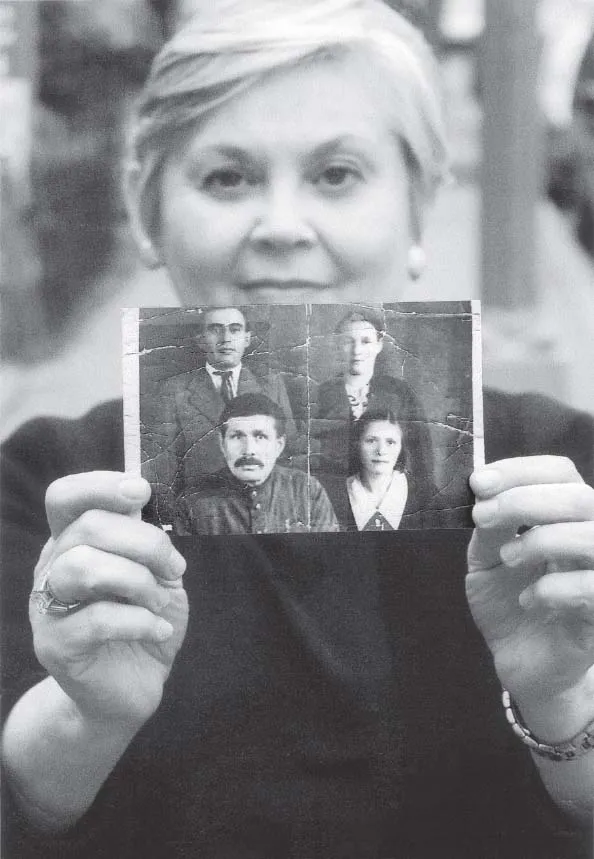
Children can bring down walls and open doors for their parents. Jonathan’s first novel, based on a journey to Europe before his final year of college, did just that. He was in search of a topic for his senior thesis, and I urged him to visit the shtetl Trochenbrod, in Ukraine, where I thought my father had come from. Before he left for Europe that summer of 1998, I gave him forty copies of a tattered black-and-white picture of four people—my father, an older man, and two women—the people who my mother thought had hidden him in their house for some part of the war. The hope was that Jonathan might find the family that gave my father shelter.
A black-and-white photo of my father, Louis Safran (top, left) and the family that hid him during the war.
Jonathan found nothing. Lacking facts, he spent the rest of the summer writing a work of fiction based very loosely upon the few details we knew of our family history. The novel opened doors that filled in many of the most important memory holes in my life, as fiction mysteriously generated facts.
In Jonathan’s novel, the self-declared hero, whose name is also Jonathan Safran Foer, is in pursuit of a character named Augustine, who is thought to have hidden the fictional Jonathan’s grandfather. It is fiction layered on possible fact layered with more fiction. It’s a dazzling, playful Rubik’s Cube of a book that spins on its head our family history and leaves even me a tad confused. It’s fiction, yes, but here Jonathan, unwittingly, had touched a nerve. My family’s deeply buried memories, their tendency toward silence, would have its own tragic repercussions. Jonathan writes of a suicide that echoes one in our own family—something he was unaware of at the time that he wrote the book.
The release of the book, and the film that followed, sparked new interest in the shtetls our family came from and opened the door for new information from a variety of sources. My own obsession grew accordingly. I began working genealogy websites, picking up new clues during travel in Brazil and Israel.
There was only so much I could do from afar. Like the character in Jonathan’s novel, I armed myself with maps and photographs and eventually boarded a Lufthansa flight to Ukraine in 2009. I brought with me, of course, a supply of Ziploc bags.
I set out to find the family that had hidden my father during the war and to see what I could learn about the sibling I had never known. I set out to find a shtetl that, by all accounts, was no more. I set out to learn about my father. I set out to know about my sister. I set out to let my ancestors know that I haven’t forgotten them. That we are still here.
2
One morning in early July 1941, as Nazi parachutes rained down from the sky, as people froze and watched, or raced home to barricade themselves inside, or collected their families and prepared to hide, my mother decided to flee.
But first she ran back along the dirt road to her house to grab a pair of scissors, a few items of clothing, and her winter coat.
In my imagination, it was a beautiful, temperate summer day, but she nevertheless thought to take her winter coat, along with the scissors and a change of clothes. Her own mother stood by and watched in silence. They parted without saying goodbye.
My mother’s younger sister, seventeen-year-old Pesha, ran after her, chasing her down the dirt road that led from their small wooden house to the main street of Kolki.
“You are so lucky to be leaving,” Pesha said, as she took off her shoes and gave them to my mother so she would have an extra pair. Pesha then turned and walked home barefoot along the same dirt road.
My mother almost immediately lost one of the shoes.
This was one of the foundational stories I grew up with—Pesha and the shoes. My mother came back to this again and again. As with the stories about my father, she would every now and then let slip some astounding detail and then refuse to elaborate. Genug. Enough. It was too painful to recount, but in this case, I suspect her reluctance was infused with the guilt of leaving Pesha behind, of not saying goodbye to her mother. They were two strong-willed women, and there had been plenty of recent tension.
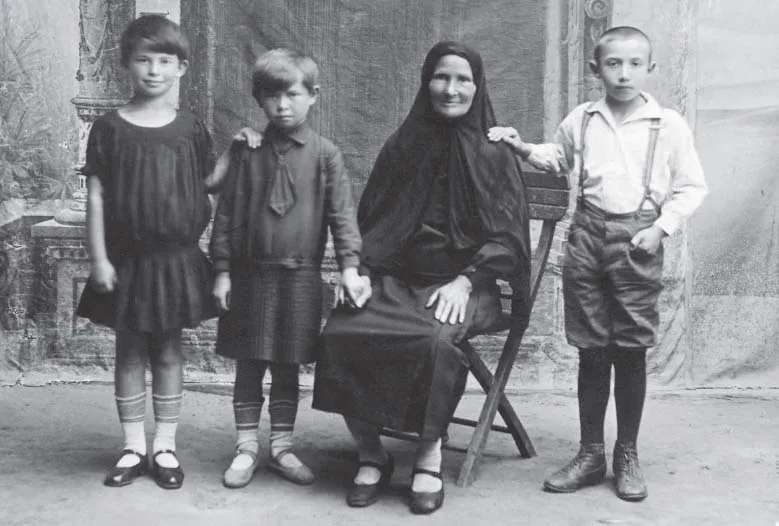
My mother Ethel with her younger sister Pesha, their grandmother Rose, and my mother’s cousin Freika.
I wanted to know Pesha, to hear her, to see her, to know what she was like, but my mother wasn’t willing to tell me more, other than repeating over and over again the story of the shoes. I have a photo of Pesha from when she was maybe five or six, standing between my mother and their maternal grandmother Rose. She is a cute, impish child, with short brown hair, wearing a shirt with a long bow, more a tie than a bow. She is holding her grandmother’s hand. On the other side of their grandmother is my mother’s cousin Freika. The photograph looks somewhat formal—or what passed for formal in those days—with a makeshift curtain in the backdrop, and it’s the only photograph of Pesha that survives. The photo, with an inscription from my mother on the back, was sent to my mother’s Aunt Chia in the United States. The few photographs I have were sent to American and Brazilian relatives. I am grateful because it is the only thing that enables me to see Pesha as something other than a ghost.
If you asked my mother how she survived the war, she would say it was luck and intuition. She was always on the lookout for four-leaf clovers. She visited fortune-tellers. Late in her life, she kept a pencil and paper with her to play inscrutable games of chance. Tiny scratchings, numbers that she jotted down and then crossed out, appeared at random on scraps of paper or even in the middle of greeting cards she received. A small table in her bedroom was full of elephants brought to her as gifts, their trunks tilted upward, a sign of good luck. She was full of old-world superstition: If you bragged about your good fortune around my mother, she would tell you that the evil eye, or gatoyik in Yiddish, would see you and bring on troubles.
So perhaps...