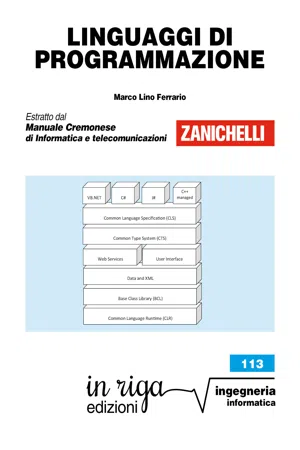
I linguaggi di programmazione rappresentano la chiave di accesso a un sistema di elaborazione. Un computer è una macchina programmabile, in grado di eseguire un insieme definito di istruzioni. Un programma è una sequenza di istruzioni che permette di svolgere un compito assegnato. Tramite un linguaggio di programmazione è possibile scrivere un programma che, opportunamente interpretato o processato (compilazione) può essere eseguito nell'Unità Centrale di un elaboratore. Storicamente sono stati sviluppati diversi possibili modelli (paradigmi) di programmazione, seguendo approcci procedurali, imperativi oppure a oggetti. Fra i diversi linguaggi merita una citazione particolare il linguaggio C, rinomato per la sua efficienza, ampiamente standardizzato, utilizzato come fondamento dei sistemi Unix, GNU/Linux, Microsoft Windows, ed evoluto poi nel C++. A partire dall'affermazione dei servizi Internet, si è compresa l'importanza dei paradigmi dichiarativi, che si concentrano sull'obiettivo da raggiungere in un problema di programmazione, piuttosto che sulle modalità di implementazione. Su queste basi sono stati sviluppati linguaggi come HTML o SQL. Nelle soluzioni tecnologicamente più innovative si fa ormai ampio utilizzo delle macchine virtuali, intese come ambienti di esecuzione svincolati dalle caratteristiche HW della macchina fisica sottostante. Le macchine virtuali orientate ai processi sono, di fatto, programmi o architetture che girano come applicazioni in un sistema operativo, e consentono a loro volta l'esecuzione di altri programmi in un ambiente standard. I casi più noti sono la Java Virtual Machine e il framework.NET in Windows.
- 59 pages
- English
- PDF
- Available on iOS & Android
eBook - PDF
Linguaggi di programmazione
About this book
Trusted by 375,005 students
Access to over 1.5 million titles for a fair monthly price.
Study more efficiently using our study tools.
Information
Subtopic
Programming LanguagesIndex
Computer ScienceTable of contents
- 1. LINGUAGGI DI PROGRAMMAZIONE
- 2. METODOLOGIE DI PROGRAMMAZIONE
- 3. PARADIGMI DI PROGRAMMAZIONE
- 4. STRUTTURE DI CONTROLLO
- 5. SCOMPOSIZIONE FUNZIONALE: PROCEDURE E FUNZIONI
- 5.1. Regole di visibilità
- 5.2. Parametri e passaggio dei parametri
- 5.3. Ricorsione
- 6. COMPILATORI E INTERPRETI
- 7. LINKER
- 7.1. Formato ELF
- 8. LINGUAGGI ASSEMBLATORI
- 9. Linguaggio C: la libreria standard
- 9.1. assert.h
- 9.2. ctype.h
- 9.3. errno.h
- 9.4. float.h
- 9.5. limits.h
- 9.6. locale.h
- 9.7. math.h
- 9.8. setjmp.h
- 9.9. signal.h
- 9.10. stdarg.h
- 9.11. stddef.h
- 9.12. stdio.h
- 9.13. stdlib.h
- 9.14. string.h
- 9.15. time.h
- 10. Linguaggio C: esempi d’uso
- 11. Macchine virtuali
- 11.1. Java Virtual Machine
- 11.2. Framework .NET
Frequently asked questions
Yes, you can cancel anytime from the Subscription tab in your account settings on the Perlego website. Your subscription will stay active until the end of your current billing period. Learn how to cancel your subscription
No, books cannot be downloaded as external files, such as PDFs, for use outside of Perlego. However, you can download books within the Perlego app for offline reading on mobile or tablet. Learn how to download books offline
Perlego offers two plans: Essential and Complete
- Essential is ideal for learners and professionals who enjoy exploring a wide range of subjects. Access the Essential Library with 800,000+ trusted titles and best-sellers across business, personal growth, and the humanities. Includes unlimited reading time and Standard Read Aloud voice.
- Complete: Perfect for advanced learners and researchers needing full, unrestricted access. Unlock 1.5M+ books across hundreds of subjects, including academic and specialized titles. The Complete Plan also includes advanced features like Premium Read Aloud and Research Assistant.
We are an online textbook subscription service, where you can get access to an entire online library for less than the price of a single book per month. With over 1.5 million books across 990+ topics, we’ve got you covered! Learn about our mission
Look out for the read-aloud symbol on your next book to see if you can listen to it. The read-aloud tool reads text aloud for you, highlighting the text as it is being read. You can pause it, speed it up and slow it down. Learn more about Read Aloud
Yes! You can use the Perlego app on both iOS and Android devices to read anytime, anywhere — even offline. Perfect for commutes or when you’re on the go.
Please note we cannot support devices running on iOS 13 and Android 7 or earlier. Learn more about using the app
Please note we cannot support devices running on iOS 13 and Android 7 or earlier. Learn more about using the app
Yes, you can access Linguaggi di programmazione by Marco Lino Ferrario in PDF and/or ePUB format, as well as other popular books in Computer Science & Programming Languages. We have over 1.5 million books available in our catalogue for you to explore.