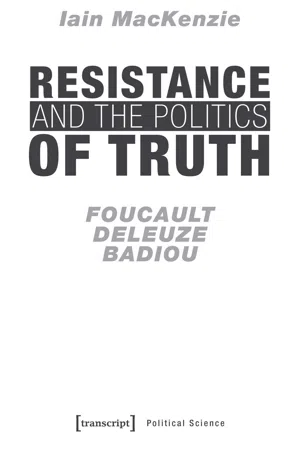
`The truth will set you free' is a maxim central to both theories and practices of resistance. Nonetheless, it is a claim that has come under fire from an array of critical perspectives in the second half of the 20th century. Iain MacKenzie analyses two of the most compelling of these perspectives: the poststructuralist politics of truth formulated by Michel Foucault and Gilles Deleuze and the alternative post-foundational account of truth and militancy developed by Alain Badiou. He argues that a critically oriented version of poststructuralism provides both an understanding of the deeply entwined nature of truth and power and a compelling account of the creative practices that may sustain resistance.
- English
- ePUB (mobile friendly)
- Available on iOS & Android
eBook - ePub
About this book
Information
Chapter 1: From the Truth about Politics to the Politics of Truth
In the Introduction, the themes that will guide this discussion were framed with reference to the similarities and differences between poststructuralist and post-foundationalist political theory. This chapter will develop and increasingly specify the key questions within these themes that will guide the rest of the book. It will focus on the famous exchange between Chomsky and Foucault in 1971 as this helps establish what is at stake when one invokes truth in the name of resistance (Chomsky) and when one suspends the category of truth in order to subject it to a political analysis while remaining committed to resistance (Foucault). The stakes of this debate could not have been higher. It was a time of great political upheaval as well as national and international conflict: the waves of unrest that characterised the civil rights movements and the conflict in Vietnam being the most obvious contexts framing this discussion between two emergent public intellectuals of global significance. Although this exchange begins with what seems like a rather arcane discussion of the nature of scientific claims, this does help to establish the difference between Chomsky’s naturalism and radical humanism and the poststructuralist scepticism regarding both of these terms underpinning Foucault’s account of knowledge. As such, the terms are set for what becomes an increasingly clear political dispute between the two activist philosophers. Tracing this dispute we come to appreciate the importance of the differing accounts they give of the relationship between language and creativity and the way this frames their discussions of the idea of human nature and a range of more straightforwardly political matters such as the different ways they view the relationship between justice and power. Furthermore, the differences between the two positions become ever clearer and the stakes of the questions that emerge ever more pronounced. As we will see, this also enables us to define both the structuralism that guides Foucault’s version of a poststructuralist position and, in a certain sense, its similarity to the humanism that animates Chomsky’s. Nonetheless, the political implications of Foucault’s poststructuralist claims become more evident as the challenge to Chomsky’s humanism is developed through their conversation. The chapter will end with a clear statement of what it means to bring ‘the politics of truth’ centre stage in our philosophies of resistance, with a first hint of why it is important to focus on what happens in practices of resistance.
What’s science got to do with it?
In the modern world, when we think about how we are guided by the truth in our practices of resistance, it is commonplace to look to science for the claims that can count as true. Although there are many forms of naturalism (the idea that the natural sciences provide the best available methods and conclusions for claims about nature and our nature as human beings) the general pervasiveness of this position is evident in social, cultural, economic, political and philosophical debates to this day. Furthermore, that naturalism and humanism emerged at similar historical periods, in the epochs of the Renaissance and the early modern development of the inductive scientific method, indicates a deep connection between these two positions. Even if, strictly speaking, they are not the same thing – one can be a humanist without being a naturalist and vice-versa – it is evident that when we are motivated to resist by the idea that ‘the truth will set us free’ it is often scientific truths that shape what we have in mind, and that give us the courage to think that the false claims of convention and ideology will, in the end, be overcome just as surely as the Medieval lies about women deemed to be witches, for example, were similarly overcome. Of course, we also know that scientific claims have been subject to rigorous critique from those who see it as a discipline intimately bound to money, power and state militarism. So, naturalists have to articulate their claims with an awareness of how to distinguish the importance of the method over the conclusions, lest they be tainted by convention and ideology, as well as a way of separating the integrity of scientific claims from those claims that have emerged from within science that have since been shown to be not just false but dangerous, even disastrous (such as the scientific claims about racial eugenics that emerged from within the Nazi regime). If one wants to motivate one’s practices of resistance with claims that are both naturalist and humanist, therefore, it is important to be subtle and reflective about exactly what claims one is defending and why. We see this subtlety and reflexivity in the way that Chomsky approaches the discussion with Foucault, especially with regard to the concept of ‘human nature’. In setting up the discussion, and introducing Chomsky, the mediator, Fons Elders, neatly establishes the problem when he says:
All studies of man, from history to linguistics and psychology, are faced with the question of whether, in the last instance, we are the product of external factors, or if, in spite of our differences, we have something we could call a common human nature, by which we can recognise each other as human beings…Which arguments can you [Chomsky] derive from linguistics to give such a central position to this concept of human nature? (2006: 2).
Chomsky’s opening foray in the discussion in response to this question presents just the kind of subtle naturalism and humanism that is often at stake in contemporary forms of radical positions that defend the importance of our need to resist structures of oppression and domination in the name of truth.
In establishing his vision of human nature, Chomsky is keen to acknowledge that the scientific concepts ‘presently available to us’ do not necessarily give him hope with regard to a full and rich understanding of human cognitive capacities – our capacity to know the world and to reflect on our knowledge of the world (2006: 8). Rather, scientists will have to ‘broaden their scope’ in order to investigate, without prejudice, the nature of human cognition. Nonetheless, this cautious naturalism is still a form of naturalism, to the extent that Chomsky is pinning his methodological hopes on the natural sciences to provide such a theory of human cognition. This becomes clear when he says that one of the tasks of this broad vision of science is to bring the rigors of science to bear not just on the interaction of bodies – be they human, physical or cosmological – but on the mind. It is with this spirit that he speculates that it is possible, in principle at least, and necessary from a methodological point of view, to get behind ‘the task of carrying on and developing [a] mathematical theory of mind’ (2006: 13). By which he means: ‘a precisely articulated, clearly formulated, abstract theory which will have empirical consequences, which will let us know whether the theory is right or wrong, or on the wrong track or the right track’ (2006: 13). This last qualification is important. Subtle and reflective forms of naturalism and humanism must accept that sometimes scientists get it wrong or are on the wrong track, but behind this claim is the idea that it is only scientific method that will enable us to know whether or not this is the case. For all this caution, though, we see Chomsky’s position harden as the conversation develops. As he defends the role of science in establishing naturalist claims about human cognition, and in doing so acknowledges that the prospect of a complete accommodation of a science of human cognition within the natural sciences as they currently exist is a long way off in the future, he remains steadfast with regard to the possibility of such a unified science of what we know and how we know what we know about the world. Indeed, for Chomsky, it is ‘the fact that science converges and progresses’, a fact he deems established by the historical development of the disciplines of the natural sciences, that gives him this optimism that naturalism and humanism will combine forces in a science of human creativity with real political clout. We will dwell on the substance of this optimism, Chomsky’s empirical and theoretical investigations into the nature of language and creativity, in the next section. It is important to establish first, though, that Foucault takes a different view of scientific development and progress because this helps frame the substantive dispute between them and the political positions that emerge later in the conversation.
When he is invited by Elders to respond to Chomsky’s view of scientific progress with the presumption that he will have ‘severe criticism of this’, Foucault initially suggests that ‘there are one or two little historical points’ that he would like to add. In fact, these ‘little historical points’ turn out to be precursors to a rather major difference in the way that Foucault views science and the idea of progress that animates it; generally, and for Chomsky. The ‘little historical points’ amount to interpretive dispute about which of the seventeenth and eighteenth century rationalists are closer to Chomsky’s position; Leibniz and Pascal, rather than Descartes, according to Foucault. However, as Elders presses him on his historical understanding of science, Foucault begins to give a more pertinent set of responses. While both Chomsky and Foucault acknowledge that the truths produced by science have changed over time, even since the modern period and the development of scientific method, it is notable that Foucault does not situate those changes within the methodological apparatus itself. For Foucault, the problem with assuming that its method defines what we think of as science is that the scientific method itself presumes both ‘the principle of the sovereignty of the subject’ and that ‘the historical dimension of knowledge is always negative in relation to truth’ (2006: 16). In the first of these presumptions there is, for Foucault, a tendency to overplay the originality of the great scientific inventor; over and above, that is, the conditions that make such invention possible. Although he doesn’t put it exactly like this, Foucault is, in effect, casting doubt on what we might call a ‘great man’ theory of historical change when imported into the history of science. The beginnings of his sceptical attitude to humanism are, as such, already evident. The second presumption, that truth and the history of scientific development stand in a negative relation to each other, casts doubt on the role that distancing scientific knowledge from convention and traditional forms of knowledge constitutes a, perhaps, unwarranted guarantee of the idea of scientific progress as embedded within the idea of scientific method. Rather than presume such things, that science progresses through the ‘eccentric’ intervention of great scientists in traditional fields of knowledge, he argues that we should ‘superimpose’ the history of scientific development with that of the history of the idea of the subject and of progress (so as not to presume both the subject and progress and then separate them out from the development of the sciences themselves).
Taking as an example medicine at the end of the eighteenth century, Foucault says it would be ‘artificial’ to attribute the developments made at this time to any one individual just as it would be a mistake to attribute these to the negation of traditional medicinal routines. Rather, he says that these transformations were the result ‘of a collective and complex transformation of medical understanding in its practices and rules’ (2006: 18). Such collective and complex transformation cannot, for Foucault, either simply be attributed to individuals applying proper scientific method or to the ways in which they distanced themselves from their immediate past. Rather, for Foucault, his historical approach to the changing truths of science makes him attentive to the analysis of the conditions that account for the ways in which ‘the understanding modifies itself in its formative rules, without passing through an original “inventor” discovering the “truth”’ (2006: 18).
Although Foucault initially attributes this difference in perspective to ‘the state of the disciplines’, linguistics and history respectively (2006: 19, 32-33), by the time Chomsky’s declared belief in scientific progress has come to the fore Foucault is adopting a rather more critical stance. He says:
For a long time the idea has existed that the sciences, knowledge, followed a certain ‘progress’, obeying the principle of ‘growth’, and the principle of the convergence of all these kinds of knowledge. And yet when one sees how the European understanding, which turned out to be a worldwide and universal understanding in a historical and geographical sense, developed, can one say that there has been growth? I, myself, would say that it has been much more a matter of transformation. (2006: 26)
Not only is Foucault challenging by this point the very idea of an, in principle, convergence of the sciences of bodies (what we know about the world) and of minds (how we know what we know about the world), he is also demonstrating his fundamental suspicion of the very idea of such convergence being treated as the hallmark of progress. Preferring the more neutral term, transformation, Foucault is already raising doubts about the value of pinning our hopes on science for the truths that will set us free. Chomsky’s avowed hope that one day the natural sciences will give a full and deep account of the cognitive faculties that allow us to know the world as human beings and that such progress is built into the scientific method is met with Foucault’s rather more historical view that the best one can say is that knowledge, the practices, routines and rituals that sustain it, have transformed over time, without being able to say for sure whether or not we can call this progress.
It is worth pausing to sum up what this has to do with our guiding themes about resistance, politics and truth. In this opening exchange between Chomsky and Foucault we see the crux of the debates between humanism and poststructuralism. Humanists tend to ally themselves with naturalism and the scientific method to the extent that this method puts human beings, as subjects that come to know the world and thereby give it meaning, at the centre of things. For the poststructuralist, the rules and systems underlying the production of knowledge are more important such that the knowing subject is displaced from centre stage and the changes to the systems of rules become paramount. The key epistemological but also political question that emerges is whether or not we can rely on the sciences to bring about if not the truth then progressively better, more truthful, understandings of the world and our place in it. Chomsky, without naivety, pins his hopes on this view of scientific progress, whereas Foucault’s historical investigations have made him wary of placing too much emphasis on this idea. If we moderns tend to look to science, therefore, as the source of the truths that will set us free then it is usually done so in the name of social and political progress. Indeed, it is hard to imagine practices of resistance that do not avow such an ideal (though one can think of conservative forms of resistance that seek to maintain the status quo). What happens to our idea of resistance if we give up progress? If we accept Foucault’s more cautious rendering of the ‘transformations’ wrought by science then are we already robbing ourselves of that which motivates us to resist in the first place: that the truth will set us free and therefore the world will be a better place? It is important to specify these questions early in the discussion because they will return throughout, even up to the particular version of a mathematically articulated set of precise claims animating Badiou’s theory of the militant subject and its fidelity to truth (Chapter 4). However, at this stage it is important to specify the substance of the opening debate between Chomsky and Foucault, as this takes us closer to the philosophical stakes of their dispute. As we will see, it is not just a dispute between scientific method and the history of the sciences but one about the sources of human creativity, especially vis-à-vis language.
Language and Creativity
We noted in the Introduction that structuralists tend to treat language as a set of relations that generate meaning rather than focus on human intentionality. This is not to say that humanists have not been concerned with the nature of language, or that they haven’t developed sophisticated accounts of the structures that impinge on human intentionality; far from it. In the debate between Chomsky and Foucault, in fact, we see how a subtle account of linguistic creativity is given a humanist twist by Chomsky. But we also see how Foucault situates this creativity outside of the human in a manner that gives his poststructuralist emphasis on transformation a distinctly structuralist basis.
Perhaps Chomsky’s most innovative theoretical claim is that there is a universal grammar underpinning all known languages (see, for example, Chomsky 1965 and 1968). In this discussion with Foucault, he gives a particularly lucid account of how he came to this position and, as we will see, how it motivates a radically oriented set of social and political claims for which he has become equally well known (see, for example, Chomsky 2008, for a text that brings together his key texts in linguistics and politics). His interest in linguistics started with ‘a very definite empirical problem’ (2006: 2): it is clear that competent language users have a capacity for the highly creative use of their language(s). As he says, ‘much of what a person says in his normal intercourse with others is novel, much of what you hear is new…in fact, it has much of the characteristics of what I think might very well be called creativity’ (2006: 2). Nonetheless, it is equally clear, for Chomsky, that in the midst of such creativity it remains true that speakers of the same language can, mostly, understand one another. ‘There is only one possible explanation’, he says, ‘namely, the assumption that the individual contributes a good deal’ to both creative language use and to being able to understand the creative language use of others (2006: 3). Given the great diversity of language use and understanding, this contribution of the individual must be instinctive or innate. As he concludes his opening summary, ‘I would claim then that this instinctive knowledge, if you like, this schematism that makes it possible to derive complex and intricate knowledge on the basis of very partial data, is one fundamental constituent of human nature’ (2006: 4).
Chomsky’s use of the term ‘schematism’ is particularly instructive. Later on in the discussion he gives a succinct version of what he means by this: it is ‘the concept of free creation within a system of rule’ (2006: 12). In both instances, it is impossible not to hear the Kantian overtones of this claim; even though in this context Chomsky does not make this link explicit. In Kant, schematism is a cognitive procedure by which the categories of the understanding are linked to empirical sensations as presented to the understanding through the intuition (1998: 271-277). Without delving too deeply into the interpretive quagmire surrounding this term, the Kantian vision of human cognition treats all sensation as filtered, first, through the intuition that organises our sensations in space and time and then, second, as categorised by the twelve abstract concepts of the understanding (causality, modality, quality, quantity, etc). In a further act of imagination, the knowing subject then schematises the intuited experience with their placement in the categories of the understanding to produce knowledge of the world. As Caygill defines it, the schematism ‘is a procedure of the judgement which adapts otherwise heterogeneous concepts to the spatial and temporal conditions of intuition’ (1995: 360). Explaining this (rather loosely, admittedly), one can say, for example, that the thing I perceive here and now in front of me on the mat, has the quality of fluffiness, four legs, makes a meowing sound etc and when joined together, my experience of the thing and how it fits with my understanding requires me to combine, schematically, the two aspects together to know that it is, in fact, a cat sitting on the mat. What is instructive for us, in this discussion, is that Chomsky embraces Kant’s ‘Copernican revolution’ (1998: 110) and treats the human capacity for creative language use and understanding as a product of our innate cognitive structures. In language we can creatively explore what it is that joins our sense experience to our understanding of that experience – coming up with new words and images for the cat on the mat – but we do so within a system of rules that means we understand each other when our interlocutor is similarly creative. In essence, as Chomsky puts it, ‘the structure of the knowledge that is acquired in the case of language is basically internal to the human mind’ (2006: 24).
Where one might be tempted to say that such human creativity situated within the human mind is beyond the reach of science, we have already noted that Chomsky takes a different view: ‘now my belief is that science can look forward to the problem of normal creativity as a topic that it can perhaps incorporate within itself’ (2006: 20). It is worth pausing on this statement. The ‘normal creativity’ alluded to here is his way of distinguishing the claim he wishes to make from what he thinks Foucault is saying about the rare creative moments when the sciences transform their rules and systems. So, at one level, he is adopting Foucault’s view that their differing ...
Table of contents
- Cover
- Title Page
- Copyright
- Contents
- Acknowledgements
- Introduction: A Time to Think and Act Differently?
- Chapter 1: From the Truth about Politics to the Politics of Truth
- Chapter 2: Truth and Power
- Chapter 3: Learning to Resist
- Chapter 4: The Militant Subject of a Political Truth
- Chapter 5: Resistance in Control Societies
- Conclusion: How to Think and Act Differently
- Bibliography
Trusted by 375,005 students
Access to over 1.5 million titles for a fair monthly price.
Study more efficiently using our study tools.
Frequently asked questions
Yes, you can cancel anytime from the Subscription tab in your account settings on the Perlego website. Your subscription will stay active until the end of your current billing period. Learn how to cancel your subscription
No, books cannot be downloaded as external files, such as PDFs, for use outside of Perlego. However, you can download books within the Perlego app for offline reading on mobile or tablet. Learn how to download books offline
We are an online textbook subscription service, where you can get access to an entire online library for less than the price of a single book per month. With over 1.5 million books across 990+ topics, we’ve got you covered! Learn about our mission
Look out for the read-aloud symbol on your next book to see if you can listen to it. The read-aloud tool reads text aloud for you, highlighting the text as it is being read. You can pause it, speed it up and slow it down. Learn more about Read Aloud
Yes! You can use the Perlego app on both iOS and Android devices to read anytime, anywhere — even offline. Perfect for commutes or when you’re on the go.
Please note we cannot support devices running on iOS 13 and Android 7 or earlier. Learn more about using the app
Please note we cannot support devices running on iOS 13 and Android 7 or earlier. Learn more about using the app
Yes, you can access Resistance and the Politics of Truth by Iain MacKenzie in PDF and/or ePUB format, as well as other popular books in Politics & International Relations & Ethics & Moral Philosophy. We have over 1.5 million books available in our catalogue for you to explore.