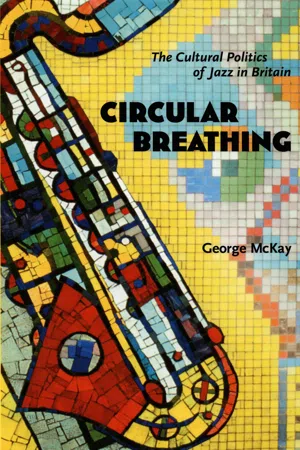
McKay explores the music in relation to issues of whiteness, blackness, and masculinity—all against a backdrop of shifting imperial identities, postcolonialism, and the Cold War. He considers objections to the music's spread by the "anti-jazzers" alongside the ambivalence felt by many leftist musicians about playing an "all-American" musical form. At the same time, McKay highlights the extraordinary cultural mixing that has defined British jazz since the 1950s, as musicians from Britain's former colonies—particularly from the Caribbean and South Africa—have transformed the genre. Circular Breathing is enriched by McKay's original interviews with activists, musicians, and fans and by fascinating images, including works by the renowned English jazz photographer Val Wilmer. It is an invaluable look at not only the history of jazz but also the Left and race relations in Great Britain.
- 377 pages
- English
- PDF
- Available on iOS & Android
eBook - PDF
About this book
In Circular Breathing, George McKay, a leading chronicler of British countercultures, uncovers the often surprising ways that jazz has accompanied social change during a period of rapid transformation in Great Britain. Examining jazz from the founding of George Webb's Dixielanders in 1943 through the burgeoning British bebop scene of the early 1950s, the Beaulieu Jazz Festivals of 1956–61, and the improvisational music making of the 1960s and 1970s, McKay reveals the connections of the music, its players, and its subcultures to black and antiracist activism, the Campaign for Nuclear Disarmament, feminism, and the New Left. In the process, he provides the first detailed cultural history of jazz in Britain.
Information
Publisher
Duke University Press BooksYear
2005Print ISBN
9780822335733
9780822335603
eBook ISBN
9780822387282
Subtopic
Britische GeschichteTable of contents
- Contents
- Preface
- Acknowledgments
- Introduction: Jazz, Europe, Americanization
- New Orleans Jazz, Protest (Aldermaston),and Carnival (Beaulieu)
- Whiteness and (British) Jazz
- Jazz of the Black Atlantic and the Commonwealth
- The Politics and Performance of Improvisationand Contemporary Jazz in the 1960s and 1970s
- From ‘‘Male Music’’ to Feminist Improvising
- Conclusion
- Notes
- Bibliography
- Index
Trusted by 375,005 students
Access to over 1.5 million titles for a fair monthly price.
Study more efficiently using our study tools.
Frequently asked questions
Yes, you can cancel anytime from the Subscription tab in your account settings on the Perlego website. Your subscription will stay active until the end of your current billing period. Learn how to cancel your subscription
No, books cannot be downloaded as external files, such as PDFs, for use outside of Perlego. However, you can download books within the Perlego app for offline reading on mobile or tablet. Learn how to download books offline
Perlego offers two plans: Essential and Complete
- Essential is ideal for learners and professionals who enjoy exploring a wide range of subjects. Access the Essential Library with 800,000+ trusted titles and best-sellers across business, personal growth, and the humanities. Includes unlimited reading time and Standard Read Aloud voice.
- Complete: Perfect for advanced learners and researchers needing full, unrestricted access. Unlock 1.5M+ books across hundreds of subjects, including academic and specialized titles. The Complete Plan also includes advanced features like Premium Read Aloud and Research Assistant.
We are an online textbook subscription service, where you can get access to an entire online library for less than the price of a single book per month. With over 1.5 million books across 990+ topics, we’ve got you covered! Learn about our mission
Look out for the read-aloud symbol on your next book to see if you can listen to it. The read-aloud tool reads text aloud for you, highlighting the text as it is being read. You can pause it, speed it up and slow it down. Learn more about Read Aloud
Yes! You can use the Perlego app on both iOS and Android devices to read anytime, anywhere — even offline. Perfect for commutes or when you’re on the go.
Please note we cannot support devices running on iOS 13 and Android 7 or earlier. Learn more about using the app
Please note we cannot support devices running on iOS 13 and Android 7 or earlier. Learn more about using the app
Yes, you can access Circular Breathing by George McKay in PDF and/or ePUB format, as well as other popular books in Medien & darstellende Kunst & Britische Geschichte. We have over 1.5 million books available in our catalogue for you to explore.