Stacey examines the body-horror movies Alien: Resurrection and Species in light of Jean Baudrillard's apocalyptic proclamations about cloning and "the hell of the same," and she considers the art-house thrillers Gattaca and Code 46 in relation to ideas about imitation, including feminist theories of masquerade, postcolonial conceptualizations of mimicry, and queer notions of impersonation. Turning to Teknolust and Genetic Admiration, independent films by feminist directors, she extends Walter Benjamin's theory of aura to draw an analogy between the replication of biological information and the reproducibility of the art object. Stacey suggests new ways to think about those who are not what they appear to be, the problem of determining identity in a world of artificiality, and the loss of singularity amid unchecked replication.
- 346 pages
- English
- PDF
- Available on iOS & Android
eBook - PDF
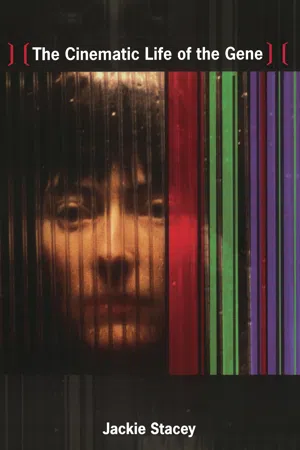
The Cinematic Life of the Gene
About this book
What might the cinema tell us about how and why the prospect of cloning disturbs our most profound ideas about gender, sexuality, difference, and the body? In The Cinematic Life of the Gene, the pioneering feminist film theorist Jackie Stacey argues that as a cultural technology of imitation, cinema is uniquely situated to help us theorize "the genetic imaginary," the constellation of fantasies that genetic engineering provokes. Since the mid-1990s there has been remarkable innovation in genetic engineering and a proliferation of films structured by anxieties about the changing meanings of biological and cultural reproduction. Bringing analyses of several of these films into dialogue with contemporary cultural theory, Stacey demonstrates how the cinema animates the tropes and enacts the fears at the heart of our genetic imaginary. She engages with film theory; queer theories of desire, embodiment, and kinship; psychoanalytic theories of subject formation; and debates about the reproducibility of the image and the shift from analog to digital technologies.
Information
Publisher
Duke University Press BooksYear
2010Print ISBN
9780822345077
9780822344940
eBook ISBN
9780822390947
Subtopic
Film History & CriticismTable of contents
- Contents
- Preface
- Acknowledgments
- Introduction: Technologies of Imitation andthe Genetic Imaginary
- PART 1 - Sameness Ad Infinitum
- PART 2 - Imitations of Life
- PART 3 - Stairway to Heaven
- Afterword: Double Take, Déjà Vu
- Notes
- Bibliography
- Filmography
- Index
Trusted by 375,005 students
Access to over 1.5 million titles for a fair monthly price.
Study more efficiently using our study tools.
Frequently asked questions
Yes, you can cancel anytime from the Subscription tab in your account settings on the Perlego website. Your subscription will stay active until the end of your current billing period. Learn how to cancel your subscription
No, books cannot be downloaded as external files, such as PDFs, for use outside of Perlego. However, you can download books within the Perlego app for offline reading on mobile or tablet. Learn how to download books offline
We are an online textbook subscription service, where you can get access to an entire online library for less than the price of a single book per month. With over 1.5 million books across 990+ topics, we’ve got you covered! Learn about our mission
Look out for the read-aloud symbol on your next book to see if you can listen to it. The read-aloud tool reads text aloud for you, highlighting the text as it is being read. You can pause it, speed it up and slow it down. Learn more about Read Aloud
Yes! You can use the Perlego app on both iOS and Android devices to read anytime, anywhere — even offline. Perfect for commutes or when you’re on the go.
Please note we cannot support devices running on iOS 13 and Android 7 or earlier. Learn more about using the app
Please note we cannot support devices running on iOS 13 and Android 7 or earlier. Learn more about using the app
Yes, you can access The Cinematic Life of the Gene by Jackie Stacey in PDF and/or ePUB format, as well as other popular books in Media & Performing Arts & Film History & Criticism. We have over 1.5 million books available in our catalogue for you to explore.