- 232 pages
- English
- ePUB (mobile friendly)
- Available on iOS & Android
eBook - ePub
Marti Friedlander
About this book
From journeys through various countries to New Zealand's transformation in the last half century, this is a riveting and comprehensive look at the work of photographer Marti Friedlander. Showing how this distinguished artist has not only recorded the places, events, and personalities of recent history, this engaging study also demonstrates how she brings subjectivity, empathy, and a distinctive eye to her subjects. From her arrival in New Zealand as a Jewish immigrant from England in 1958, this biography proves how her photographs—whether of artists, writers, protests, or street scenes—have consistently drawn out the key human dynamics of conflict, ambivalence, anger, and warmth. Beautifully illustrated amidst a world of throwaway images, this monograph provides evidence of how a sustained, inquiring, and attentive perspective for both the photographer and viewers can lead to new truths.
Information
Topic
ArtSubtopic
PhotographyChapter 1 Looking Closely
IN THE EARLY 1970S MARTI FRIEDLANDER TOOK A photograph amidst a women’s movement demonstration in Karangahape Road, Auckland (opposite). We see fragments of the event. ‘No woman is free until all women are free’, declares a banner filling half the picture. The photograph’s meanings are not as straightforward as the slogan. In the right foreground a young woman holding a suitcase faces frontwards. Bare-armed, wearing high-waisted trousers and a loose-necked jersey, she looks sombre and uncommunicative, her gaze fixed on the photographer. On the other side of the picture, we see the head of another woman, cut off at the shoulders. She looks down and away to the left, as if oblivious to what is happening all around her. In this image the legible words on the banner, which could easily come across as a hackneyed catch-cry, take on a fresh poignancy. These two young women, seemingly alone and silent in the crowd, are accidental embodiments of the slogan. The photograph raises questions: Are these two women free? What is freedom?
Marti Friedlander’s photograph does not define either these women or the women’s movement. The photograph is not just a record of an event. Rather, Friedlander’s image offers an open conversation with its subject, one that produces ambiguous, multiple meanings. The photographer herself is engaged in that conversation. In this image one senses both her sympathies for feminism and her suspicion of totalising ideologies. Integral to Marti Friedlander’s work of more than 50 years are the frequently ambivalent relationships between people in the photographic space, and between the subject and the photographer. Her images intimate feelings and thoughts, including her own, of which the people in the photograph themselves might not have been aware.
This book focuses on photographs. Work and life, of course, are intimately entangled, but while Marti Friedlander’s personality is inseparable from how and why she photographs, this is not a biography. Though she is now publicly well known, she remains very private. Consider an early self-portrait (following page). It is radically cropped. What we see is about a third of the negative. Taken before a mirror as she peered down into the viewfinder of her Rolleiflex camera, it may look spontaneous. Yet the photograph is clearly a studied construction. It brings to mind a well-known image type, the photographer mirrored in the act of taking her portrait, such as those of the German-Jewish exiles Ilse Bing and Lotte Jacobi.1 The composition is tight and spare. Marti’s right arm and the side of her face are lit. The left is in partial shadow. Her figure is right in the front plane, as if almost in our space. The interior behind (in fact a corridor in her husband Gerrard’s dental practice) is both amorphously closed-in and cues recession into depth, with a fugitive trace of a doorframe to the left. The taut arrangement suggests a strong sense of inwardness. How did she get there? There need to be beginnings.
MARTI FRIEDLANDER WAS BORN IN BARNSLEY HOUSES, near Bethnal Green in London’s East End, in 1928, the daughter of Sophie and Philip Gordon, Russian-Jewish immigrants. At the age of three Marti was placed in the nearby Ben Jonson Home administered by the London County Council. In 1933 she shifted to the Norwood Orphan Aid Asylum, a Jewish institution for about 350 children in South East London, near Streatham Common. Marti lived there in a secure and supportive environment: ‘We did not think of ourselves as disadvantaged.’2 When war broke out in 1939, the orphanage was evacuated to Worthing, with the children billeted by local families. From 1942 to 1943 Marti studied photography on a trade scholarship at Bloomsbury Technical School, relocated in Letchworth Garden City for a couple of years. Then she had another year on a scholarship at the excellent Camberwell School of Art in South London. The social climate there was refreshingly bohemian, and the important modernist artists John Minton, Victor Pasmore, and Michael Ayrton were inspirational teachers: ‘I soon discovered that painting was not my forte. I remember the principal … William Johnstone looking at a painting of a “still life” on my easel, and commenting on my singular lack of any idea of perspective. He was right.’3
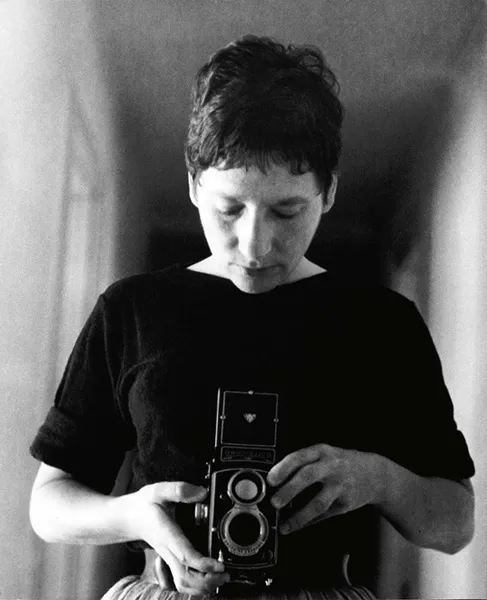
Self-portrait, Auckland, 1964
Financial need ended her tertiary education. Serendipitously responding to an advertisement in the British Journal of Photography in 1946, Marti Friedlander got a job that turned out invaluable – as an assistant first to Douglas Glass and then to Gordon Crocker, both leading photographers, in their shared Kensington studio. Glass (1901–1978) had been a United Nations Relief and Rehabilitation Administration photographer documenting life in displaced persons’ camps in Germany after the war. He became a prominent portraitist of artists, writers, actors, musicians, and politicians for the Sunday Times. A 1953 self-portrait presents a robust, pugnacious, bearded figure, clad in a checked shirt, a waistcoat and a bow tie. A twinkle in his eye, he poses against a wall of images. Although born in New Zealand, Douglas Glass’, he wrote, ‘likes to fancy himself a European with a strong colonial background, and his early escapades and origins are conveniently buried in the obscurity of the bush.’4 Glass professed to hate New Zealand and never returned. Crocker (c 1908-1981) could hardly have been more different. He was a modest, gentle and deeply religious man, who worked primarily as a fashion photographer. His personal kindness meant a lot to Marti, and his portraits of her and her sister, Anne, are images of quiet warmth, as if taken by a devoted father.5
Working for Glass and Crocker, Marti Friedlander honed her technical skills in printing and retouching and vastly expanded her knowledge of photographic practices and processes. Glass famously observed that she could produce an image from a blank negative. In 1951 she visited Germany where she did menial work at a camp in Nuremberg for displaced German youth. During the early 1950s she made trips to Israel and Paris.
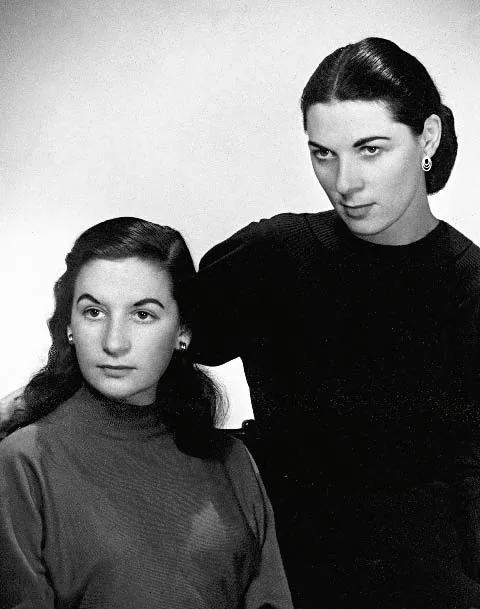
Martha and Anne Gordon, c1954. PHOTOGRAPH BY GORDON CROCKER
Marti continued at the studio until 1957 and her marriage to Gerrard Friedlander. He, fatefully, was from New Zealand, and a dentist (even if mistaken for a farmer by some of Marti’s London friends). Gerrard, though, had been born Gerhard in Berlin in 1930. With his family he had emigrated in 1935, first to the British Mandate of Palestine and then in 1937 to New Zealand, not an easy place for Jewish refugees from Nazism to gain entry to. In April 1957 the couple set off on a honeymoon journey by Lambretta motor scooter through Europe and then spent a couple of months in Israel before moving to New Zealand. ‘Looking forward to arriving with a sense of adventure. I had few ideas of what to expect,’ she later wrote in her journal.6
Disembarking in Wellington on an early morning in February 1958, the couple drove with Gerrard’s father and brother through the centre of the North Island to Auckland. Marti remembers: ‘We stopped for a meal enroute; fried fish and chips and mashed potatoes, bread and butter and a cup of tea, which even hunger could not quite digest.’7 Home for the next nine years, except for an extended break in England and Israel in 1962-63, was Henderson, a mix of rural holdings and new suburbs on the western edges of the expanding city. For a London girl this could well have been a subtropical Siberia. ‘The first three years were the hardest thing I’ve ever experienced. I had to toughen myself to survive,’8 she recently remarked. Marti found official attitudes and behaviour puritanical: ‘I think I fell off the edge of the world when I came to New Zealand. Being in a society that was so authoritarian was like going back to an institution, and I had escaped the institution.’9 She felt isolated, often unhappy, and out of place: ‘In London I had made my own sort of life, living in a bedsit, able to make my own decisions. I felt I had returned to the classroom. You had to put up your hand to do anything.’10
BACK IN 1958, MARTI FRIEDLANDER HAD NO THOUGHTS of a career as a photographer. She worked as a nurse for Gerrard for three years, returning seriously to photography because she needed something of her own: ‘The only way I could cope with being here was to express what I felt about the place by taking photographs,’ she said in 1997.11 Picture-making became the means by which she made sense of the new country and society around her. She was driven, and still is. ‘I take pictures because I have to,’ she later remarked.12 It was also a shield: ‘People used to say you’re hiding behind the viewfinder, and I’d say that’s right, I am.’13
Her first published photographs in New Zealand were two of modernist sculptures by Jim Allen and John Kingston in the September 1959 issue of Landfall. But it was only after the stillbirth of her baby in 1963 while overseas that Marti Friedlander decided to return to New Zealand with the aim of becoming a freelance professional photographer. She quickly made her mark with her work from 1965 for the quarterly Wine Review,’14 and over the next two decades established herself as a pre-eminent photographer in this country. The diverse publications in which her photographs have appeared attest to her broad range in subject, theme, and genre. In the 1960s and 1970s her work featured in periodicals such as the New Zealand Herald, the Auckland Star, the Auckland Weekly News, the New Zealand Listener, the Town Planning Quarterly, Playdate, various medical periodicals, and the women’s magazine Thursday (‘for Younger Women’). The feminist magazine Broadsheet, the arts periodicals Landfall, Ascent, Islands, New Argot and Art New Zealand, the Maori affairs periodical Mana, and Hearing News also published her photographs.’15 Marti Friedlander’s ground-breaking books include Moko: Maori Tattooing in the 20th Century (1972, and reprinted several times through to 2008, with text by Michael King), Larks in a Paradise: New Zealand Portraits (1974, text by James McNeish), Contemporary New Zealand Painters, Volume One A – M (1980, text by Jim and Mary Barr), Marti Friedlander Photographs, the catalogue accompanying the 2001 Auckland Art Gallery exhibition curated by Ron Brownson, and, with Dick Scott, Pioneers of New Zealand Wine (2002).
Marti Friedlander’s photographs feature, too, in a host of other books, their subjects and concerns equally wide-ranging – old age, sociology, New Zealand history, language use, female high achievers, tourism, Fiji and the Tokelau Islands, biographies, monographs on artists and exhibition catalogues, for instance – and on the dust jackets of novels and volumes of poetry. The 2001 show, which focused mainly on her photographs from the mid-1960s to the mid-1980s – decades of far-reaching social, cultural, and political shifts in New Zealand – travelled the country from 2001 to 2004. It made Marti Friedlander, not entirely willingly, into a prominent public figure, interviewed, photographed and filmed, most notably in Shirley Horrocks’s Marti: The Passionate Eye (2004). This documentary went on to success and awards in film festivals in Germany, Italy, Israel, the United States, Canada, and Australia.’16 Since the exhibition, Marti’s earlier photographs have taken on second lives, while there is also a growing demand in New Zealand and overseas for her work since the 1990s.
Marti Friedlander’s photographs have been used for documentary purposes and many provide valuable records of individuals and groups that have made substantial impacts on New Zealand society over the last 50 years.’17 However, she does not take a detached, ‘fly-on-the-wall’ approach to photography. Rather, many of her photographs picture interactive moments and events in which Marti herself participates. To convey relationships effectively, the immediate visuality of the photographs must compel. The architecture of the image is crucial: how light and dark areas are orchestrated within the space of the photo...
Table of contents
- Cover Page
- Title Page
- Copyright Page
- Contents
- Foreword
- 1 Looking Closely
- 2 Inside Outside, Public Private
- 3 First New Zealanders
- 4 Investigating New Zealand
- 5 On the Street, at the Beach
- 6 Displacement, Migration, Travel
- 7 ‘A Competent Mistress of Life’
- Chronology
- Exhibitions
- Notes
- References
- Acknowledgements
- List of Plates
- Index
- Back Cover
Trusted by 375,005 students
Access to over 1.5 million titles for a fair monthly price.
Study more efficiently using our study tools.
Frequently asked questions
Yes, you can cancel anytime from the Subscription tab in your account settings on the Perlego website. Your subscription will stay active until the end of your current billing period. Learn how to cancel your subscription
No, books cannot be downloaded as external files, such as PDFs, for use outside of Perlego. However, you can download books within the Perlego app for offline reading on mobile or tablet. Learn how to download books offline
Perlego offers two plans: Essential and Complete
- Essential is ideal for learners and professionals who enjoy exploring a wide range of subjects. Access the Essential Library with 800,000+ trusted titles and best-sellers across business, personal growth, and the humanities. Includes unlimited reading time and Standard Read Aloud voice.
- Complete: Perfect for advanced learners and researchers needing full, unrestricted access. Unlock 1.5M+ books across hundreds of subjects, including academic and specialized titles. The Complete Plan also includes advanced features like Premium Read Aloud and Research Assistant.
We are an online textbook subscription service, where you can get access to an entire online library for less than the price of a single book per month. With over 1.5 million books across 990+ topics, we’ve got you covered! Learn about our mission
Look out for the read-aloud symbol on your next book to see if you can listen to it. The read-aloud tool reads text aloud for you, highlighting the text as it is being read. You can pause it, speed it up and slow it down. Learn more about Read Aloud
Yes! You can use the Perlego app on both iOS and Android devices to read anytime, anywhere — even offline. Perfect for commutes or when you’re on the go.
Please note we cannot support devices running on iOS 13 and Android 7 or earlier. Learn more about using the app
Please note we cannot support devices running on iOS 13 and Android 7 or earlier. Learn more about using the app
Yes, you can access Marti Friedlander by Leonard Bell in PDF and/or ePUB format, as well as other popular books in Art & Photography. We have over 1.5 million books available in our catalogue for you to explore.