- 445 pages
- English
- ePUB (mobile friendly)
- Available on iOS & Android
eBook - ePub
About this book
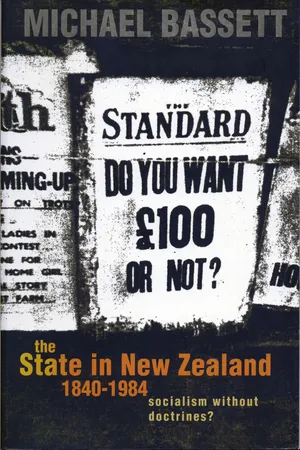
In this innovative study Michael Bassett, historian and former politician, explores how and why the state became such an active and interventionist player in New Zealand life, developing, subsidising and regulating the economy and protecting citizens from the cradle to the grave. He looks in detail at the many schemes in which a paternalistic government became involved, especially the extensive social programmes. These were taken for granted by the people but from the 1960s were increasingly difficult to sustain economically. By 1984, he concludes, this process of intervention had to be slowed. Drawing on departmental archives, many not previously consulted by historians,
The State in New Zealand covers in a new way, and with clarity and style, a subject of great contemporary interest.
Information
Subtopic
Australian & Oceanian HistoryIndex
HistoryChapter 1
Establishing Order in Colonial
New Zealand
Captain William Hobson stepped ashore at Kororareka on the afternoon of 30 January 1840. He proceeded to a small church. There he read Queen Victoria’s commissions that annexed New Zealand to the British Crown and appointed him Lieutenant Governor of New Zealand.1 He had brought with him several officials from Sydney who were to form a rudimentary civil service. Their combined authority depended on the outcome of negotiations with Maori for the cession of sovereignty of New Zealand to the British Crown. After discussions with local Maori, the Treaty of Waitangi was signed by Hobson and many Maori chiefs on the afternoon of 6 February 1840. Other chiefs signed the Treaty during the next few months. In theory the country now possessed a fledgling form of European authority by consent of the indigenous people. As Ranginui Walker puts it, ‘the British Crown [had] a tenuous beachhead on New Zealand soil’.2
According to the historian Harrison Wright, ‘almost everybody in New Zealand, both Maori and white, welcomed the British annexation when it came’.3 Within their tribal structures, Maori had usually respected leadership and acknowledged the authority of their chiefs. Since the 1820s Maori society had been devastated by inter-tribal warfare which was made more lethal by European muskets. Maori leaders expressed their unease at the threat settlers posed to their social cohesion in their 1831 petition to King William IV and the Declaration of Independence in 1835.4 In 1840 Maori saw advantages to be gained from the arrival of British sovereignty. A Kaitaia chief is said to have welcomed Hobson’s arrival in New Zealand with the words ‘Now we have a helmsman’.5 Most Pakeha settlers also greeted the arrival of an authority figure in the north. Putting an end to chaos was the first justification for Hobson’s new government. Kororareka had become a ‘vile hole’ in the opinion of one of his officials. It seemed full of’half-drunken, impudent devil-may-care’ European inhabitants. The historian J. C. Beaglehole called it ‘an al fresco thieves’ kitchen’. Previous efforts to bring order to the area had largely failed.6
In the weeks after the signing of the Treaty Hobson also became a repository for people’s ambitions. There were approximately 100,000 Maori in the whole country in 1840. They were more densely concentrated in the north. For five years now they had been seeking ways among themselves to regulate trade and land dealings with the steadily increasing number of European settlers, who totalled approximately 2000 at the time of the Treaty.7 Europeans with access to the Lieutenant Governor and his officials soon sought to use his authority for their own purposes. The residents of Kororareka who signed a memorandum on 3 February 1840 welcoming Hobson’s arrival craved the introduction of enforceable rules and regulations. Some wanted to buy more land, others to sell land or services to the new administration, often at inflated prices. Others were beginning to think about the desirability of assistance with transport and communications. The very first settlers envisaged a role for government that went far beyond law and order.
Hobson’s deputy, Willoughby Shortland, who was confirmed as Colonial Secretary on 7 March, received a similar welcome to Hobson’s when he went south, arriving in Wellington on 2 June 1840. The Lieutenant Governor’s authority was much in demand despite the pitifully small budget at his disposal. Governor Gipps of New South Wales had transferred only £3,000 to New Zealand’s account in the Bank of Australasia before Hobson left Sydney in January 1840,8 and Hobson had barely 100 troops to back his authority throughout the country.
Settlements were springing up in other parts of New Zealand. While Auckland advanced in an ad hoc, unplanned manner, there was little that was laissez faire about those in the middle of the country. To use J. D. Salmond’s expression, they were ‘essentially regulative’ in origin.9 Planning was in their woof and warp. Edward Gibbon Wakefield, whose hand lay behind Wellington and Wanganui (1840), Nelson (1841), New Plymouth (1842), Otago (1848) and Canterbury (1850), wanted the process of colonisation to be ‘scientifically controlled’. Wakefield set out his views in A Letter from Sydney and later in A View of the Art of Colonisation. The words ‘plan’ and ‘systematic colonisation’ were often used as he wrestled with what was needed to produce his ‘best society’ in the South Seas. If land was sold to settlers at a uniform and ‘sufficient’ price then there would be money for public works and some left over to pay for the fares from the British Isles of a labouring class. In this way a vertical slice of English life would be transferred to the new settlements.10 This was New Zealand’s first experiment in social engineering.
The fact that many of the early settlers received assistance with their fares led them to claim something akin to a contractual relationship with authorities in the new land. They expected much after being enticed half way round the world. Once in New Zealand they became conscious of being in the most remote place on earth. New Zealand’s rugged terrain made many parts of it difficult to penetrate. ‘The hills and dense forest by which we are enclosed … will cause it to be some time before we shall know much about our whereabouts’, wrote one of the first Wellington immigrants.11 Felling trees and planting grass was arduous work. Labour was in short supply. In the various encampments there was little fencing; animals roamed about, sometimes destroying newly planted gardens. All settlements initially consisted of tents, makeshift housing and a grog shop or two. Roads were no more than bridle paths. It was not until the middle of the 1850s that any of New Zealand’s settlements could be said to resemble a small British market town.
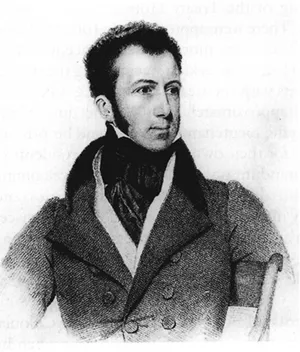
Edward Gibbon Wakefield: promised steady employment and opportunities in the new land. ATLF-131790 1/2
Assistance with communications and with opening up the land became early settler priorities. However, some expectations went beyond this. As John Martin shows, the New Zealand Company led the first workers in Nelson and Wellington to expect assistance in finding employment. Systematic colonisation hinted at a new social order, where labourers could reasonably expect to improve their lot by jobs, fair wages and access to land. What Martin calls ‘a long term relationship between politics, public works and the pattern of protest’ soon developed, and it carried on into the twentieth century.12
The first area where Hobson sought to establish his authority was the pivotal issue of land sales. For reasons paternal, as well as the Government’s financial needs, Hobson took for the Crown the sole right to purchase land from Maori. He soon promised to investigate deals struck between individuals and Maori before the signing of the Treaty. This worried many in the Wakefield settlements. A lot of migrants had signed up for land before leaving England. It transpired that in some cases the land had not been purchased at the point it was onsold to them. While the Wakefield settlers enjoyed a special relationship with the New Zealand Company, they always felt that the Governor was the ultimate guarantor that their expectations would be fulfilled. Like the northern settlers, they wanted his authority to back the land they had bought in good faith. They were kept in suspense. It was not until 1845, during Governor FitzRoy’s term of office, that the Land Claims Commissioner, William Spain, recommended confirmation of several land purchases made by the New Zealand Company. In the end the New Zealand Company was required to pay more money to local Maori. This only reduced the company’s available resources for infrastructural projects demanded by the settlers. Once more settlers turned to the Governor. The reality was that while the bulk of Wakefield immigrants had received some assistance with their passages, organised settlement fell short of Wakefield’s ideal.13 Ultimately government intervention became necessary, as it would on many future occasions, to ensure that the blandishments waved before emigrants before they left the ‘Old Country’ turned into something approaching reality in the new.
In all settlements the newcomers were impatient for the Crown to purchase further land, and for it then to be onsold. In Taranaki where New Zealand Company claims were largely disallowed after Spain’s investigations, settlers became obsessed with the desire for more space. Everywhere the settlers also wanted an active immigration policy. A rapid inflow of people was likely to provide more labour in the new country and it would push up the value of land already in settler hands. Nowhere is there evidence that any settlers wanted an inactive government, or believed that they were in the best position to control their environments. Constructive use of authority was essential to success in early colonial life.
Maori, on the other hand, were ambivalent about land sales. While the concept of selling land was alien to their customs, many liked the trade that settlers brought with them. Before 1840 many Maori had readily provided access to land. Others, however, were more cautious, soon realising that settlers regarded access to Maori land as something permanent. In the years immediately after the Treaty, Maori hoped that Hobson’s Government would ensure that articles two and three of the Treaty spelling out their rights would be enforced. Since Maori were numerically so much stronger than the settlers, a fact that made all the settlements ‘mere encampments on the fringe of Polynesia’,14 the governors had of necessity to be mindful of Maori rights. Governor FitzRoy, who became governor at the end of 1843, was regarded by settlers as too pro-Maori. In fact he lacked the force to be otherwise. However, as Alan Ward points out, the first governors made little effort to ‘engage the Maori leadership in the formal machinery of state’. Maori did not become part of the Governors’ travelling police detachments, nor was there much effort made to incorporate their customs into British law as it was gradually enforced throughout the country. These failures contributed to a sense of subordination that led to resentment among Maori.15
Governor Sir George Grey (1845-53) made a better attempt both to understand and consult Maori. And he contrived to give the impression that his government was fair. But it was mutual economic advantage that maintained a degree of racial harmony in the early years of Pakeha settlement. According to Ranginui Walker, ‘the first fifteen years after the Treaty saw a period of economic expansion and prosperity for many tribes, especially those close to Pakeha markets’.16 De facto authority at the local level lay with Maori. So long as governments did nothing to disturb the status quo both races were, by and large, prepared to accept the Governor’s authority.
Among the settlers, expectations of the new Government were high. When officials first arrived at Kororareka, commercial activity was rudimentary. Hobson found it necessary to appoint a Colonial Storekeeper before he left Sydney. His job was to purchase goods on the Government’s behalf. The handful of Kororareka retailers soon sought government assistance with the importing of supplies. The irregularity of shipping meant retailing was a chancy business. Dr William Davies, who took office later in 1840 as Colonial Surgeon, expected the Colonial Secretary to purchase, among other things, supplies of aqua rosa, nitric acid, potassium sulphate and sarsaparilla on his behalf. The local harbourmaster wanted the Colonial Secretary to procure him a boat. A postal official sought a canoe to reach outlying places. It was soon clear that no service worked unless Hobson’s officials gave it a helping hand.17
Settlers’ demands grew exponentially. Besides order, they soon wanted employment opportunities and an array of services. On 11 April 1840 a group of 37 inhabitants of Kororareka sought to have Hobson introduce a form of town planning to ensure that the narrow streets with their sea of tents did not ‘prevent altogether the rise of the township’. There was a steady stream of place-seekers, too, who looked to the new administration to provide paid employment. And those accustomed to access to hospitals in the ‘Old Country’ expected such amenities in the new, and were not too fussy about who took the initiative. On 28 May 1840 Hobson chaired a meeting of between 30 and 40 residents of Kororareka to discuss the setting up of a local hospital. There was talk of private subscription, but there seems to have been an underlying assumption that the Crown would take a role in financing the hospital’s construction. The State was being drawn into activities by force of circumstance.
Education quickly became an issue in Kororareka, since several of Hobson’s officials had children. The Colonial Secretary was soon involved in efforts to establish a school. In August 1840 he was asked to purchase 8 Bibles, 24 spelling books, 24 slates and 100 pencils to help with the children’s instruction. The provision of education elsewhere in the colony was not yet regarded as a government responsibility, although the Colonial Secretary’s files in the 1840s reveal many requests for government help from missions providing education.18 Settlers were possessed of what might be called pragmatic pioneer experimentalism. From earliest days the line between what was their own responsibility and what could reasonably be expected of the Government was blurred. If authority was close at hand, settlers did their best to take advantage of it.
While the settlers were for the most part able-bodied and young, a few fell by the wayside. In 1841 the Governor refused to entertain making money available for an indigent brought to his notice, arguing that it was ‘a case for private charity’. Such arguments soon became hollow; whatever virtues the settlers possessed, private charity, which was premised on some people having surplus resources, was not their strong suit. A few well-positioned women donated their time to charitable concerns. However, most of those with spare money preferred to speculate; the pickings could be lucrative. Even as late as 1900 relatively few people who had succeeded in accumulating wealth left charitable bequests.19
Governors were slow to find a way of dealing with those who seemed unable to look after themselves. In the Destitute Persons Ordinance 1846 responsibility for the poor and elderly, of whom there were as yet very few, was placed firmly on ‘near relatives’. If there were none, then the Government would help so long as a Justice of the Peace or a Magistrate first reviewed the case...
Table of contents
- Cover Page
- Title Page
- Copyright Page
- Contents
- Abbreviations
- Introduction
- 1. Establishing Order in Colonial New Zealand
- 2. Settlers Search for Prosperity
- 3. The Search for Security
- 4. The Essential Goodness of State Action
- 5. World War Winds Up the State
- 6. The State Under Challenge: The 1920s and the Depression
- 7. Labour, Social Security and ‘Insulation’
- 8. War and the Omnipotent State
- 9. Freedom or Controls? National Deals with Labour’s Legacy
- 10. Labour and National Struggle with the Economy, 1957–72
- 11. Big Government Begins to Overreach Itself, 1972–79
- 12. Big Government's Last Hurrah, 1979–84
- Notes
- Index
- Back Cover
Trusted by 375,005 students
Access to over 1.5 million titles for a fair monthly price.
Study more efficiently using our study tools.
Frequently asked questions
Yes, you can cancel anytime from the Subscription tab in your account settings on the Perlego website. Your subscription will stay active until the end of your current billing period. Learn how to cancel your subscription
No, books cannot be downloaded as external files, such as PDFs, for use outside of Perlego. However, you can download books within the Perlego app for offline reading on mobile or tablet. Learn how to download books offline
We are an online textbook subscription service, where you can get access to an entire online library for less than the price of a single book per month. With over 1.5 million books across 990+ topics, we’ve got you covered! Learn about our mission
Look out for the read-aloud symbol on your next book to see if you can listen to it. The read-aloud tool reads text aloud for you, highlighting the text as it is being read. You can pause it, speed it up and slow it down. Learn more about Read Aloud
Yes! You can use the Perlego app on both iOS and Android devices to read anytime, anywhere — even offline. Perfect for commutes or when you’re on the go.
Please note we cannot support devices running on iOS 13 and Android 7 or earlier. Learn more about using the app
Please note we cannot support devices running on iOS 13 and Android 7 or earlier. Learn more about using the app
Yes, you can access The State in New Zealand, 1840-198 by Michael Bassett in PDF and/or ePUB format, as well as other popular books in History & Australian & Oceanian History. We have over 1.5 million books available in our catalogue for you to explore.