eBook - ePub
Labour's Path to Political Independence
Origins and Establishment of the New Zealand Labour Party, 1900-19
- 200 pages
- English
- ePUB (mobile friendly)
- Available on iOS & Android
eBook - ePub
Labour's Path to Political Independence
Origins and Establishment of the New Zealand Labour Party, 1900-19
About this book
Labour's Path to Political Independence remains the best introduction to the origins of one of New Zealand's two major political parties. Not only does it trace the birth of the Labour Party, but it sheds light on the political, economic and social history of New Zealand during the years 1900–19. Gustafson demonstrates that political parties are not impersonal structures, but are dynamic in their make up – living entities of interaction and change. While party members are bound together in their commitment by common ideals and goals, their detailed interests and values often differ, making for rich variety. Gustafson's highly readable account is enriched by his careful selection of over 100 illustrations and a comprehensive biographical appendix of major figures associated with the early history of the New Zealand Labour Party.
Information
1 Liberal or Labour: the IPLL and the first NZLP, 1890–1909
In 1890, following the bitter depression of the 1880s and the debacle of the 1890 maritime strike, working-class voters combined with white-collar radicals, struggling farmers, and would-be farmers to create almost simultaneously a new Liberal Party and a Liberal Government. The Liberals were to hold office for the following twenty-one years. Within a few years the mighty Liberal coalition started to fragment. Sectional interests made continued co-operation increasingly difficult. Many farmers, once established on the land with government assistance, became relatively prosperous and much more conservative in outlook. After 1900, there evolved a conservative, farmer-supported Reform Party, which also attracted some urban middle-class support. Simultaneously, there appeared a succession of trade-union and socialist political organizations. These were formed by a small minority of trade unionists and political radicals who were disenchanted with a Liberal Government which they regarded as timid, unprincipled, and paternalistic. At times the various left-wing groups appeared to be more hostile to each other than they were to either the Liberal or Reform parties.
The advent of an independent political labour party in New Zealand paralleled and reflected the evolution of trade unionism in the country during the latter part of the nineteenth and the early part of the twentieth centuries. Prior to 1900, trade unionism was very weak and incohesive, and predominantly of a skilled craft union nature. The increasing numbers of unskilled workers were not organized to any extent, except for those connected with the Maritime Council which was destroyed in the 1890 strike. The major provincial centres of Auckland, Wellington, Christchurch, and Dunedin were isolated from each other by distance, inadequate communications, different types of settler, and a strong parochialism nurtured by the provincial system that existed in New Zealand until 1876. Little wonder that although unions were given legal recognition in 1878 and the first central conference of unions was held in Dunedin in January 1885, no central, combined trade-union organization of any consequence was formed during the following twenty years.
The local Trades and Labour Councils did not ignore political activity. At first they believed that the interests of the labour movement could be best served by working closely with and through the Liberal Party. In a predominantly rural, pioneer society with a strong emphasis on individual initiative and equality of opportunity, many labour leaders felt obliged to support a Liberal Government which in its early years introduced industrial and social legislation of obvious advantage to less privileged sections of society. As early as 1884 the Otago and Wellington Trades and Labour Councils had set up parliamentary committees to work for the election of approved candidates, while in Auckland and Christchurch, Working Men’s Political Associations, which were formed in 1879 and 1881, were disbanded in 1885 in favour of working through the Trades and Labour Councils and later an organization known as the Knights of Labour.1 Similar committees of the trades councils continued to exist for the remainder of the century, supporting throughout the 1890s the Liberal-Labour Party, or Liberal-Labour Federation as the Prime Minister, Richard John (King Dick) Seddon, renamed his party in 1899.
At the 1890 election, following the 1889 Representation Act which established the principle of ‘one man, one vote’, five manual workers were elected to Parliament: W. W. Tanner, a bootmaker from Christchurch; D. Pinkerton, a bootmaker, and W. Earnshaw, a brass finisher, both from Dunedin; J. L. Buick, a carpenter from Wairau; and J. W. Kelly, a tailor from Invercargill. In 1891 a by-election in Christchurch added a sixth: E. W. Sandford, a compositor. J. A. Millar, the Dunedin union leader, joined them in 1893. Only two, Tanner and Millar, were to survive undefeated beyond 1899.2 They functioned as a very minor element within the parliamentary Liberal Party and the government. Labour’s representation was a little more than tokenism, but only a little more.
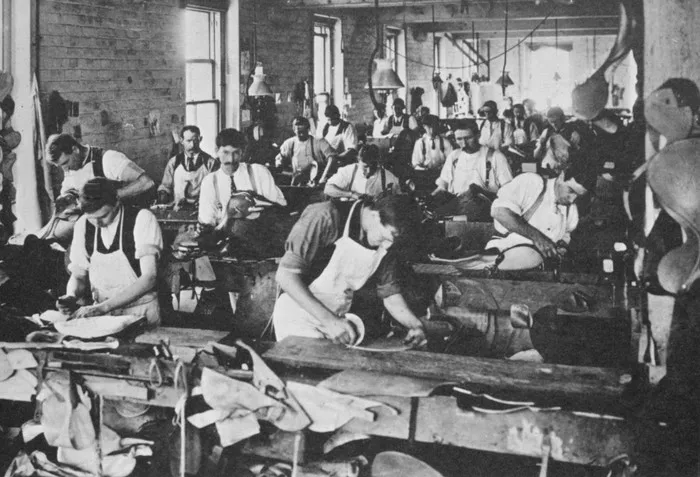
Wiseman’s saddlery. Small factories and small craft unions were common in the early twentieth century
Even before the 1893 election, some trade-union leaders were concerned that there should be some kind of formal organization capable of selecting candidates truly representative of the labour movement, albeit still in alliance with the Liberal Party. They feared, correctly, that the Liberal-Labour Party would be reluctant to adopt more than a handful of working-class candidates. In April 1893 the Otago Trades and Labour Council set up a Workers’ Political Committee consisting of the Executive of the Council, three delegates from each organized Labour and Liberal body, and three delegates from any other organization interested in Labour. The object of the Committee was: ‘To consolidate the Labour Party, framing of policy, selecting of suitable candidates to represent the people in Parliament and to generally watch over their political and social interests.’3
Following the 1893 election, and even more so after the 1896 election, the Liberal Government showed less concern for trade-union opinions. With the defeat, death, resignation, or conversion of many of the more radical Liberal members of parliament, the reforming zeal of the government slackened. Thenceforth, the Liberals became increasingly preoccupied with an unsuccessful attempt to retain the support of the farmers, who wanted to freehold the land they leased at its original price plus one per cent, and city businessmen, who opposed ‘excessive’ social legislation. The Liberals adopted a middle-of-the-road policy and tried to satisfy fundamentally conflicting demands by avoiding actions in favour of one section of society which might antagonize another. Such an essentially conservative attitude, while failing to conciliate the farmers, alienated not only the trade unionists but also a white-collar, land-reform element, led by the Liberal MPs George Fowlds and Alexander Hogg.
Even before the death of Seddon in 1906 removed his personally cohesive force, discontent and disintegration within the parliamentary Liberal Party itself had been revealed by the open revolt of the ill-fated New Liberal Party. This faction was formed in 1905 by the radical Liberal MPs H. D. Bedford, G. Laurenson, and T. E. Taylor, and the Wellington Independent, F. M. B. Fisher.4 The revolt was aimed primarily at Seddon’s autocratic leadership and was significant more for its revelation of Liberal decline—a precondition for the advent of an independent Labour party—than as an attempt to form a trade-union or socialist party. George Laurenson remained a Liberal, although friendly towards the trade unions during the 1913 strike. Fisher later became a Reform Party cabinet minister. Harry Bedford, who became professor of political economy at the University of Otago, and Tommy Taylor, who became mayor of Christchurch, gravitated towards an independent Labour party before their untimely deaths in 1919 and 1911 respectively.
Another one-time Liberal-Labour MP who became disenchanted was the lawyer and university lecturer, A. R. Barclay, who wrote in 1909:
The present Government is reactionary. Its aim is really to capture Mr Massey’s supporters. It is really afraid of Mr Massey. Timidity and caution are its most distinguishing characteristics…. It has given up consideration of its old friends, the Labor people. The workers are now regarded as a negligible quantity. They have been given to understand that they must keep their place in future and not presume too much…. The working man or woman who continues to give support to the present Administration, unless it changes very greatly, is merely a fool for his (or her) pains.’
Barclay’s views were shared by others, for example Samuel Saunders, the editor of the influential Lyttelton Times, and R. Manning, the secretary of the Waikato Miners’ Union and the New Zealand Miners’ Federation. Writing to the Otago trade-union leader and journalist, J. T. (Tom) Paul, Saunders confided that, in his opinion,
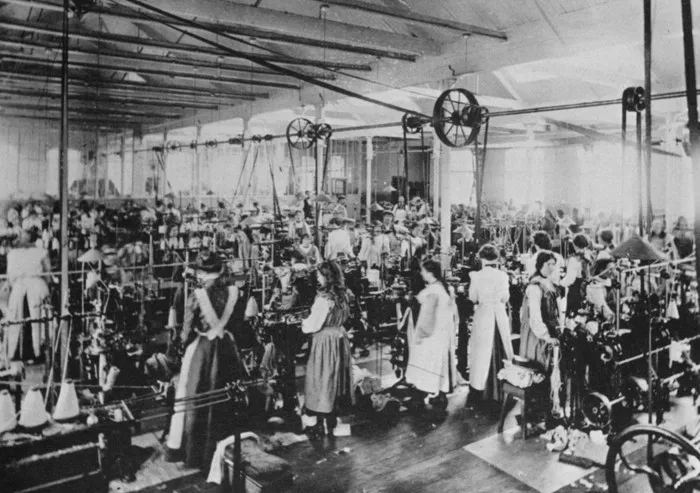
Roslyn woollen mills. During the Labour Party’s formative years, one New Zealand worker in five was female. Paul and Breen were prominent in the organization of women clothing workers
After the strenuous days of the early nineties we got along too comfortably. We lost the spirit of divine discontent; we grew careless and then apathetic. We left our politics mainly to dear old Seddon. We deserve all that has befallen us, and worse. I am ready to make confession, and, old man as I am, to begin all over again. We shall build on a surer foundation next time and shall see that the structure is secure. The lessons we have had will not be lost. It is childish to talk about finality in politics. There is no finality. Rest is rust, and the bulk of us have been resting.6
Manning was less reflective and more succinct: ‘During the life of our late lamented friend, R. J. Seddon, as Prime Minister, unionists slept because they trusted him … during the thirteen years he held office our organizations were allowed to sleep and become disunited.’7
It was, of course, one thing to complain about the state of contemporary politics after 1900; quite another to seek or to effect change by the creation of a new political party based on the trade-union movement. The discontent which finally generated an open breach between the Liberal Government and the Trades and Labour Councils grew out of the workers’ realization that their share of the national income had not increased relative to increases in production and profits during Liberal’s tenure of office. Some union leaders blamed this primarily on the way in which the Arbitration Court had interpreted and operate...
Table of contents
- Labour’s Path to Political Independence
- Preface
- Contents
- Illustrations
- Abbreviations used in text
- 1 Liberal or Labour: the IPLL and the first NZLP, 1890–1909
- 2 The militants: ‘Red Feds’ and socialists, 1909–11
- 3 The thin end of the wedge: the 1911 election
- 4 Fraternity or fratricide: the ULP, 1911–12
- 5 Strikes or ballot box: the Waihi Strike, 1912
- 6 A form of unity: the SDP and the General Strike, 1913
- 7 A taste of victory: the Grey and Lyttelton by-elections, 1913, and the 1914 general election
- 8 The real opposition: the formation of the second NZLP, 1915–17
- 9 Prices, profiteering, and politics: the cost of living and the rise of Labour
- 10 Conscription and conscience: the 1914-18 war and the rise of Labour
- 11 Wowsers and papists: religion and the rise of Labour
- 12 Great expectations: the 1918 by-elections and and the 1919 local body elections
- 13 ‘Dreams shall come true’: the 1919 election
- Biographical appendix
- References
- Bibliography
- Index
- Copyright
Trusted by 375,005 students
Access to over 1.5 million titles for a fair monthly price.
Study more efficiently using our study tools.
Frequently asked questions
Yes, you can cancel anytime from the Subscription tab in your account settings on the Perlego website. Your subscription will stay active until the end of your current billing period. Learn how to cancel your subscription
No, books cannot be downloaded as external files, such as PDFs, for use outside of Perlego. However, you can download books within the Perlego app for offline reading on mobile or tablet. Learn how to download books offline
Perlego offers two plans: Essential and Complete
- Essential is ideal for learners and professionals who enjoy exploring a wide range of subjects. Access the Essential Library with 800,000+ trusted titles and best-sellers across business, personal growth, and the humanities. Includes unlimited reading time and Standard Read Aloud voice.
- Complete: Perfect for advanced learners and researchers needing full, unrestricted access. Unlock 1.5M+ books across hundreds of subjects, including academic and specialized titles. The Complete Plan also includes advanced features like Premium Read Aloud and Research Assistant.
We are an online textbook subscription service, where you can get access to an entire online library for less than the price of a single book per month. With over 1.5 million books across 990+ topics, we’ve got you covered! Learn about our mission
Look out for the read-aloud symbol on your next book to see if you can listen to it. The read-aloud tool reads text aloud for you, highlighting the text as it is being read. You can pause it, speed it up and slow it down. Learn more about Read Aloud
Yes! You can use the Perlego app on both iOS and Android devices to read anytime, anywhere — even offline. Perfect for commutes or when you’re on the go.
Please note we cannot support devices running on iOS 13 and Android 7 or earlier. Learn more about using the app
Please note we cannot support devices running on iOS 13 and Android 7 or earlier. Learn more about using the app
Yes, you can access Labour's Path to Political Independence by Barry Gustafson in PDF and/or ePUB format, as well as other popular books in Politics & International Relations & Political Campaigns & Elections. We have over 1.5 million books available in our catalogue for you to explore.