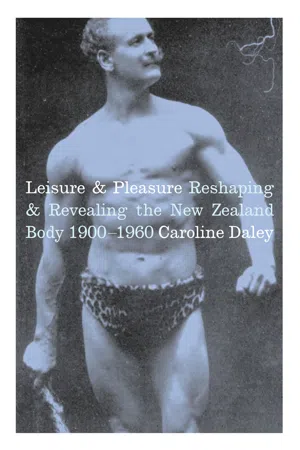
eBook - ePub
Leisure and Pleasure
Reshaping and Revealing the New Zealand Body 1900-1960
- 320 pages
- English
- ePUB (mobile friendly)
- Available on iOS & Android
eBook - ePub
About this book
This exploration of an unexpected aspect of New Zealand social history examines the human body at leisure in the years 1900–1960. This book studies bodybuilding, especially the famous strongman Eugen Sandow; growing ideas about fitness, health, and exercise; the rise of beauty contests; the culture of the beach and the pool; nudism; and children's play and the appearance of playgrounds. The central aim is to explore how bodies—men's, women's and children's—were shaped and displayed through various leisure pursuits in 20th-century New Zealand.
Information
Five Indecent Exposure?1
Around the same time that Roslyn’s new backless swimsuits were making waves, another story about the body at leisure hit the headlines. ‘New Zealand Does Not Want Cult of Nakedness: Nudism Invades New Zealand’ proclaimed the weekly, Truth.2 The newspaper was responding to stories that a group of hardy southerners had formed the Dunedin Gymnosophy Club, modelled on the ‘best’ clubs in England and the United States. Its founders were looking for land so that those who wanted to sunbathe, swim and do their physical exercises in the nude would have a place to go. The founding committee sent a circular outlining their intentions to various swimming clubs in Dunedin. They felt that swimmers would be especially interested in nudism, and hoped that a large number of women would join. Perhaps not surprisingly, this opened them up to a fair amount of ‘ridicule and criticism’, with some club members taking offence at the suggestion that swimmers were inclined to nudism. Many advocated rational swimming costumes, but they had no intention of taking their togs off. The nudists may have been hiding behind the ‘euphemistic’ name of gymnosophy, but the Dunedin swimmers intended to keep themselves nice by swimming with their costumes on.3
The very idea that organised nudism should arise in such a cold part of the country gave Truth plenty of opportunity for jibes about frostbite and chilblains, but the newspaper also declared that ‘This extraordinary cult should be banned in New Zealand’. Noting that nudism had ‘definite potentialities for evil’, Truth interviewed clergymen to bolster its claim. Eric Flint, the honorary secretary of the Dunedin Gymnosophy Club, was also interviewed. Admitting that Dunedin was a little cool to be an ideal nudist retreat, Flint set out the club’s aims and rules. Truth was impressed with Flint’s sincerity but remained unconvinced about nudism’s benefits – except when it came to selling newspapers. Over the years it published many stories about nudists in New Zealand and elsewhere, happy to award them front-page status if the story generated sales.4 Nudism should be banned, but stories about nudists could be banner headlines.
Nudism has not sparked the curiosity of many New Zealand historians. Like so many aspects of the story of the body at leisure, it barely rates a mention. Yet, like beauty contests and changing swimwear fashions, nudism raises many questions about when, how and why New Zealand bodies were revealed for display. To its advocates, nudism was as legitimate a leisure activity as physical culture and swimming. It shared their quest for health; it, too, was a form of corporeal control. To its opponents, though, nudism was the antithesis of bodily constraint. The health claims of nudists were clearly a front for pure, illegitimate pleasure. But many New Zealanders believed that, as a form of leisure and pleasure, nudism had much to recommend it. To find out why we have to leave the beach and enter the bush, the home of New Zealand’s nudist camps.
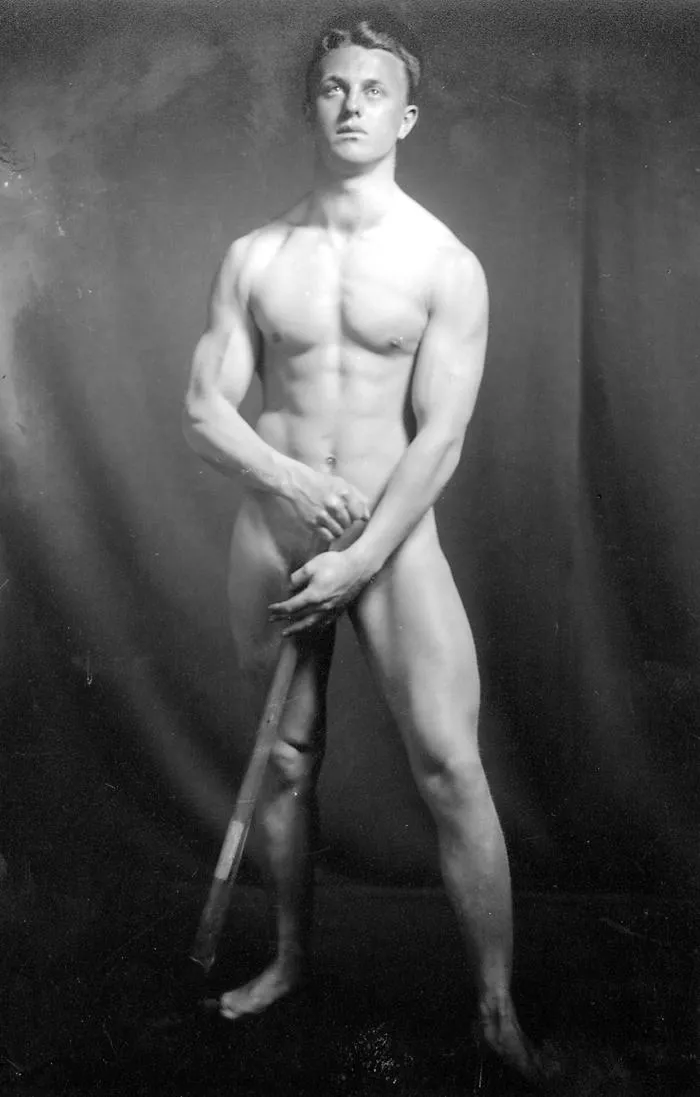
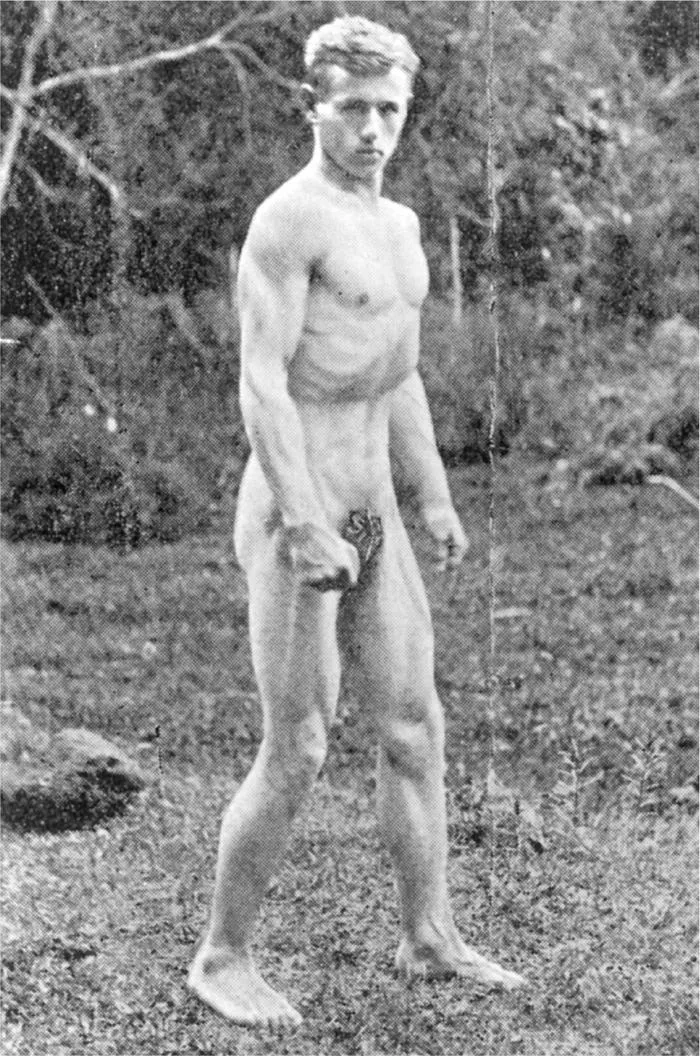
Long before the formation of the Dunedin Gymnosophy Club there were nudists in New Zealand. One, Francis B. Hutchinson, had been a physician at Wellington Hospital in the late nineteenth century. In a guest editorial in Sandow’s Magazine, Hutchinson recommended exercising in the nude, and also making the nude body ‘honourable’ again, as it had been in the time of the ancients. Like Dudley Sargent at Harvard, Hutchinson had been photographing and measuring the bodies of his pupils. He illustrated his article with two of these photographs, both showing young naked men in classical poses. Hutchinson suggested that all gymnasia proudly display nude pictures of their most beautiful and symmetrical members and that books of honour, Libri d’oro, be made containing pictures of the most beautiful naked, male bodies.5
Hutchinson’s nude young men were there to be enjoyed but also to educate. Just as statues of David and the Discobolus in art galleries gave pleasure and instruction, so his photographs showed the public physical perfection and gave them something to strive towards. It was the same logic Sandow used to justify his stage show: the Sandow Season entertained, but it also gave him the opportunity to preach the benefits of the Sandow System. Sandow, though, did not appear on stage in the nude.
By holding up the classical ideal, Hutchinson dampened claims that there was anything coarse or tawdry about his celebration of the naked body, although his next contribution to Sandow’s magazine might have raised some eyebrows. Recommending that the publication should include more photographs of young, naked men, he noted that it would give him ‘pleasure’ to exchange copies of such photographs with others.6 Whether he managed to set up an international trade in photographs of naked men is unknown. Francis B. Hutchinson was not the sort of advocate New Zealand nudists wanted.
One of the two young men photographed to illustrate Hutchinson’s first article. He was naked when the shot was taken: his fig leaf was added for this public showing. Sandow’s Magazine, June 1899. David Chapman Collection.
There was little public advocacy of nudism in early twentieth-century New Zealand. Occasionally stories about nudists made it into the newspapers, but these were about ‘cranky … religious maniacs’ like the Doukhobors in Canada who used nudity as a form of religious expression – returning to the simplicity of Adam and Eve – and as a way to protest against civic authority. Mass public nudity had strategic potential. When a group of Doukhobors went on a nude march in the winter of 1907, they probably did not anticipate that they would become objects of ridicule in the New Zealand press.7 Besides religious fanatics, the public read about people in the nude being charged with indecent exposure and about the trade in indecent pictures.8 There was, for example, the nude cyclist in Christchurch, who sped through North Park and the golf links. Startled players at first thought he was dressed in white, until he got a little closer.9 But before the Great War there was little public discussion that spelt out the case for and against the practice of nudism.
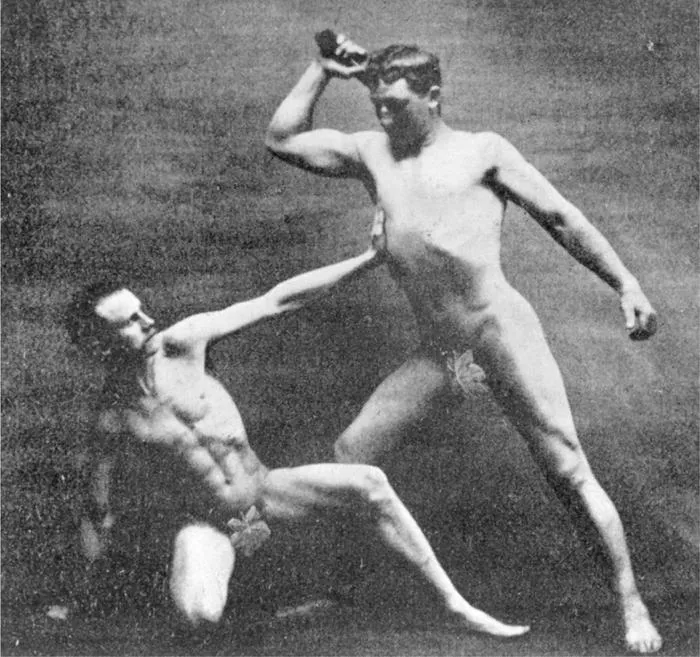
Illustrating Hutchinson’s second article, this ‘Beautiful Study’ was entitled ‘After a Portion of the Frieze of the Temple of Apollo’. The classical references abounded, but Hutchinson was also keen to point out that the two men in the photograph were both ‘eminent athletes, the elder a representative footballer, the youth ha[ving] carried off a shopful of prizes’. He claimed that he valued this photograph above all others that he had taken. Whether he valued it more highly before the fig leaves were added is not stated. Sandow’s Magazine, May 1901. David Chapman Collection.
By the 1920s, though, ...
Table of contents
- Cover
- Half-title
- Title Page
- Dedication
- Table of Contents
- Acknowledgements
- Introduction
- One The Strongman Cometh
- Two Sandow’s Legacy
- Three Beautiful Bodies1
- Four In the Swim
- Five Indecent Exposure?1
- Six Swings and Roundabouts
- Seven State Experiments
- Conclusion
- Bibliography
- Index
- ALSO BY CAROLINE DALEY
- Copyright
Trusted by 375,005 students
Access to over 1.5 million titles for a fair monthly price.
Study more efficiently using our study tools.
Frequently asked questions
Yes, you can cancel anytime from the Subscription tab in your account settings on the Perlego website. Your subscription will stay active until the end of your current billing period. Learn how to cancel your subscription
No, books cannot be downloaded as external files, such as PDFs, for use outside of Perlego. However, you can download books within the Perlego app for offline reading on mobile or tablet. Learn how to download books offline
Perlego offers two plans: Essential and Complete
- Essential is ideal for learners and professionals who enjoy exploring a wide range of subjects. Access the Essential Library with 800,000+ trusted titles and best-sellers across business, personal growth, and the humanities. Includes unlimited reading time and Standard Read Aloud voice.
- Complete: Perfect for advanced learners and researchers needing full, unrestricted access. Unlock 1.5M+ books across hundreds of subjects, including academic and specialized titles. The Complete Plan also includes advanced features like Premium Read Aloud and Research Assistant.
We are an online textbook subscription service, where you can get access to an entire online library for less than the price of a single book per month. With over 1.5 million books across 990+ topics, we’ve got you covered! Learn about our mission
Look out for the read-aloud symbol on your next book to see if you can listen to it. The read-aloud tool reads text aloud for you, highlighting the text as it is being read. You can pause it, speed it up and slow it down. Learn more about Read Aloud
Yes! You can use the Perlego app on both iOS and Android devices to read anytime, anywhere — even offline. Perfect for commutes or when you’re on the go.
Please note we cannot support devices running on iOS 13 and Android 7 or earlier. Learn more about using the app
Please note we cannot support devices running on iOS 13 and Android 7 or earlier. Learn more about using the app
Yes, you can access Leisure and Pleasure by Caroline Daley in PDF and/or ePUB format, as well as other popular books in Social Sciences & Popular Culture. We have over 1.5 million books available in our catalogue for you to explore.