- 312 pages
- English
- ePUB (mobile friendly)
- Available on iOS & Android
eBook - ePub
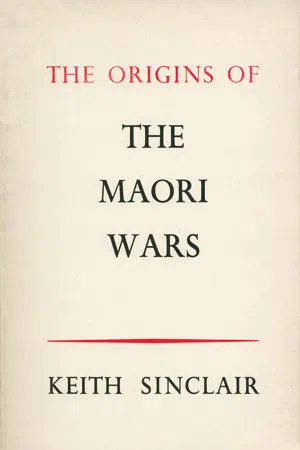
Origins of the Maori Wars
About this book
Keith Sinclair's
The Origins of the Maori Wars is a fascinating account of the Waitara purchase and the cause of war in Taranaki in 1860. The seeds of conflict were sown in the earliest days of European settlement in New Zealand, when colonists arrived to take up land for which they had paid before it had been procured. The King party, one of the earliest national movements among M?ori, reacted against this imperial expansion. The story of the developing crisis features good intentions, self-interest, obstinacy and miscalculations – elements involved in the origins of many wars. Written over ten years, The Origins of the Maori Wars is a pioneering study that comes complete with scholarly apparatus, including maps, appendices, notes and an index. First published in 1957, The Origins of the Maori Wars quickly established itself as a classic of New Zealand historical scholarship. This is the second edition.
Information
Subtopic
Australian & Oceanian HistoryIndex
HistoryPart Three
THE WAITARA PURCHASE
Let not the Pakehas be thought the originators of the disturbance; it was the land, that was the origin of it.
—MATENE TE WHIWHI
New Zealand Spectator and Cook’s
Strait Guardian, 14 April 1860.
New Zealand Spectator and Cook’s
Strait Guardian, 14 April 1860.
VIII
TARANAKI, 1840–1858
TARANAKI, THE SMALLEST OF THE ORIGINAL PROVINCES, POSED the most difficult problems facing the Government. As William Fox, the local New Zealand Company agent, noted in 1850, there were many persons who thought that Taranaki would be the scene of any further outbreak among the Maoris.1 Five years later the Superintendent of the Province considered ‘a collision between the races as inevitable’, and was asking for gunpowder.2
The problems of Taranaki taxed the ingenuity and imagination of so many people that when the war began a large proportion of the public men in New Zealand had intimate acquaintance with the situation from which it arose, a fact which is responsible for our wealth of knowledge about it. Governor Gore Browne had visited Taranaki twice and been continually worried by its dangers. McLean had long experience there in several capacities. The Native Minister, C. W. Richmond, was a Taranaki settler and representative. The leader of the parliamentary opposition was Fox. Other important politicians besides the local members knew the district well. But the problems of Taranaki were so complicated as to defy the intelligence and goodwill of them all. When Richmond introduced his 1858 legislation he said that it was not intended for Taranaki, where it would have been like a health diet applied to cure a disease. The only hope there, he thought, lay in asserting British authority.3 His brother, J. C. Richmond, wrote to him saying, ‘“Taranaki is exceptional” but is an exception more pressing in its importance than all the normal cases. It involves in their fullest complexity the hardest riddles of the question [of] the contact of races & intestine quarrels. Vigorous handling of it ought to precede anything else.’4 This was a fair estimate of the position, but the solutions offered by both brothers were less sound than their understanding of the problem. ‘Vigorous handling’ and ‘British authority’ were to prove too crude responses to this delicate situation.
The source of the difficulties of the Taranaki Province is to be found in the activities of the New Zealand Company and the condition of the local Maoris. In November 1839, Colonel Wakefield ‘purchased’ from some exiled Atiawa in Queen Charlotte Sound, for a few pounds’ worth of blankets, guns, tobacco, spades, pipes, razors, flints, pocket knives, and soap, all the land in New Zealand between the 38th and 43rd parallels of latitude, which included Taranaki. In his negotiations he was greatly assisted by the young chief, Wiremu Kingi Te Rangitake, whose signature was the first on this deed of sale.5 As Bishop Selwyn put it in 1858, ‘A transaction which was supposed to give to two or three thousand Englishmen an absolute right to dispossess seven thousand armed New Zealanders, was concluded within a space of time, in which no honest conveyancer would undertake to draw a marriage settlement upon an encumbered estate’.6
Feeling that this procedure was inadequate, Colonel Wakefield sent two of his party to Taranaki, and in February 1840 Taranaki was purchased again from a handful of Maoris then living near New Plymouth. Thus, as Ernst Dieffenbach, the New Zealand Company surgeon and naturalist, wrote shortly afterwards, ‘the New Zealand Company became proprietors of the finest district in New Zealand, which offers to the colonist, besides its natural resources, the advantage of there being no natives on the land, with the exception of the small remnant of the Ngatiawa tribe at Ngamotu’.7
This optimism was short-lived. Indeed, Wakefield himself considered that the Atiawa wanted him to buy Taranaki only so that they could return there without fear of their Waikato enemies.8 A large section of the tribe—or confederation, as Sir Peter Buck preferred to call the Atiawa9—had migrated to Otaki and Cook Strait about 1824.10 Their motives are obscure, but probably the desire to share in the lucrative trade with the whalers who visited those parts—there being no good harbours in Taranaki11—was important as well as the desire for conquest. In their absence the Waikato tribe avenged previous defeats by overrunning most of the Atiawa lands and taking the great pa Pukerangiora on the Waitara. They ate large numbers of its occupants, and those who were not killed were enslaved, except for about fifty who maintained a precarious existence at Ngamotu.
Late in 1841, the settlers of the Plymouth Company, an offshoot of the New Zealand Company, arrived, sure that ‘the whole district of Taranaki … rivals any in the world in fertility, beauty, and fitness for becoming the dwelling-place of civilized European communities’.12 Their optimism, too, was soon dissipated. First, Te Wherowhero, the great Waikato chief, later to become the Maori King, put in his claim to Taranaki by right of conquest, asserting that the Atiawa had no right to sell without his consent.13 The local agent met the threat of a Waikato occupation by assuring the Maoris of the Company’s protection,14 and by marking the boundaries of its possessions,15 both of which actions lacked substance. In December 1841, a party of Waikato came south to back up their claims,16 and Governor Hobson was obliged to purchase the Waikato rights for £150 and some goods. Taranaki was proving a difficult place to buy.
The settlers were still not securely in possession, for their arrival coincided with the return of Atiawa who had been freed by converted Waikato. Trouble with these ex-slaves, who had not received any payment for their lands, became a daily event in 1842 and 1843. Timber was destroyed, out-settlers were intimidated, and surveyors obstructed.17 Within a year of their arrival, an armed band of colonists took possession of land north of the Waitara. Furthermore, the British Government had sent Spain to investigate the early land purchases. It was difficult to know whether the Maoris or evangelical officialdom would prove the greater threat to the settlers. In the event they looked to Spain to rescue them from the Atiawa, only to have his decision overruled by FitzRoy.
Spain came to the surprising conclusion that, though most of Colonel Wakefield’s purchases had been exceedingly careless, the Taranaki purchase was not open to this objection. He said he knew of no land which could be so easily spared without damage to native interests, and awarded the Company 60,000 acres.18 The returned slaves responded to this award, which specifically denied their claims, by a series of ‘outrages’. The settlers felt that they occupied their land on the poor tenure of native sufferance, and applied for military aid.19 Other voices, however, were speaking to the Governor with more effect, chief among them that of the Clarke family, who constituted the important part of the Protectorate Department. George Clarke junior wrote from Taranaki to his father, urging him to ‘get the Governor to look over the evidence before he confirms Mr S’ report’.20 He argued strongly that the result of enforcing the award would be war, for it could only be done at the point of the bayonet.21 This was not mere prejudice, for the local New Zealand Company agent himself admitted that if the aid of the military were refused, Spain’s award could not be upheld,22 and Colonel Wakefield also looked for some ‘demonstration of force’.23 Right from the beginning, the Taranaki settlers were willing, indeed, eager, to gain their ends by force. The whole pattern for the next twenty years had been laid, and the rest was mere repetition, with subtle variation.
FitzRoy came to New Plymouth and ordered McLean and Forsaith, both Sub-Protectors, to investigate further the Atiawa claims. Eventually the Governor decided to limit the size of the settlement, to secure a clear title to part of the Company’s claims, and confine the settlers to this area.24 For £350 he managed to buy 3,500 acres round New Plymouth from the Maoris living at Ngamotu.25 As a sop to the Company, he waived the Crown right of pre-emption in its favour within the 60,000-acre area claimed.
Short of using troops against the ex-slaves, and relying on the Waikato to keep the main body of the Atiawa quiet, it is difficult to see how FitzR...
Table of contents
- Cover
- Half-title
- Title Page
- Dedication
- Epigraph
- Table of Contents
- ILLUSTRATIONS
- Preface
- ABBREVIATIONS
- Part One : A SETTING FOR A WAR
- Part Two : THE FAILURE OF POLICY
- Part Three : THE WAITARA PURCHASE
- Part Four : THE EXTENSION OF THE WAR
- APPENDIX A : THE MAPS OF THE MAORI OWNERSHIP OF THE PEKAPEKA BLOCK
- APPENDIX B : THE OFFICIAL APOLOGIA FOR THE WAITARA PURCHASE
- APPENDIX C : COMPARISON OF LAND AND STOCK OWNED BY SETTLERS IN SEVERAL PROVINCES, 1854–55
- BIBLIOGRAPHY
- Index
- Copyright
Trusted by 375,005 students
Access to over 1.5 million titles for a fair monthly price.
Study more efficiently using our study tools.
Frequently asked questions
Yes, you can cancel anytime from the Subscription tab in your account settings on the Perlego website. Your subscription will stay active until the end of your current billing period. Learn how to cancel your subscription
No, books cannot be downloaded as external files, such as PDFs, for use outside of Perlego. However, you can download books within the Perlego app for offline reading on mobile or tablet. Learn how to download books offline
Perlego offers two plans: Essential and Complete
- Essential is ideal for learners and professionals who enjoy exploring a wide range of subjects. Access the Essential Library with 800,000+ trusted titles and best-sellers across business, personal growth, and the humanities. Includes unlimited reading time and Standard Read Aloud voice.
- Complete: Perfect for advanced learners and researchers needing full, unrestricted access. Unlock 1.5M+ books across hundreds of subjects, including academic and specialized titles. The Complete Plan also includes advanced features like Premium Read Aloud and Research Assistant.
We are an online textbook subscription service, where you can get access to an entire online library for less than the price of a single book per month. With over 1.5 million books across 990+ topics, we’ve got you covered! Learn about our mission
Look out for the read-aloud symbol on your next book to see if you can listen to it. The read-aloud tool reads text aloud for you, highlighting the text as it is being read. You can pause it, speed it up and slow it down. Learn more about Read Aloud
Yes! You can use the Perlego app on both iOS and Android devices to read anytime, anywhere — even offline. Perfect for commutes or when you’re on the go.
Please note we cannot support devices running on iOS 13 and Android 7 or earlier. Learn more about using the app
Please note we cannot support devices running on iOS 13 and Android 7 or earlier. Learn more about using the app
Yes, you can access Origins of the Maori Wars by Keith Sinclair in PDF and/or ePUB format, as well as other popular books in History & Australian & Oceanian History. We have over 1.5 million books available in our catalogue for you to explore.