eBook - ePub
Songs of Kaumatua
Traditional Songs of the Maori as Sung by Kino Hughes
- 288 pages
- English
- ePUB (mobile friendly)
- Available on iOS & Android
eBook - ePub
Songs of Kaumatua
Traditional Songs of the Maori as Sung by Kino Hughes
About this book
Sixty traditional Maori songs of Tuhoe sung by Kino Hughes are presented in this book and CD collection. The text of each song is given in both English and Maori along with a musical transcription. Kino Hughes was an outstanding singer, orator, and respected Kaumatua who, determined to preserve for future generations all the songs he knew, asked these authors to compile this magnificent record. The introduction includes information on Kino Hughes, on the people of the Tuhoe Maori tribe, on the song categories used, and on the music. This important record of Maori music includes photographs, a glossary, notes on the texts, transcriptions, and an index of song types. Includes 2 CD-ROMs.
Information
Subtopic
MusicSONGS ASSOCIATED WITH TE KOOTI
SONG 43
Ka tū au, ka korikori (I stood up and I acted)
After the iwi of Taranaki had been defeated by the government in the early 1860s, a man named Te Ua Haumene experienced a vision in which the archangel Gabriel revealed to him the true form of Christianity, known as Hauhau, and told him that a god named Tama Rura (Son Ruler) would grant the Māori people victory over the Pākehā and come to rule the world. Te Ua’s prophecies were received with great enthusiasm throughout the west coast of the North Island. As well, his emissaries carried the message to distant iwi.
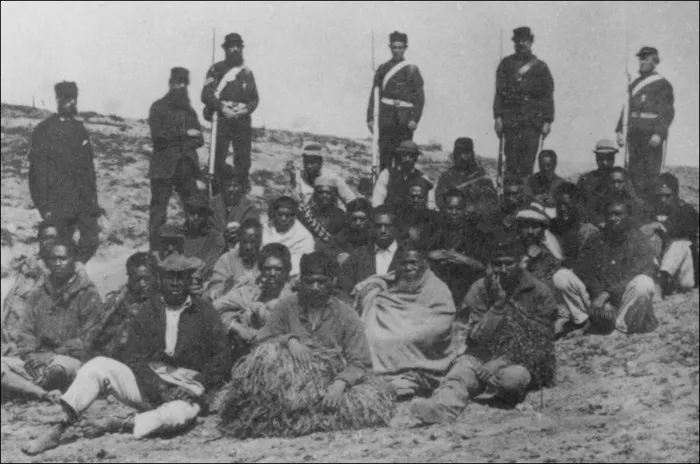
Guarded by soldiers, Hauhau men captured in the fighting on the East Coast await their fate at Ahuriri. Many were banished to Wharekāuri (the Chatham Islands).
In the Tūranga (Gisborne) region, on the other side of the island, many people became Hauhau, and a strong pā was built and occupied at Waerenga-a-Hika. In November 1865, government forces laid siege to the pā. The men inside spent several days praying, then charged out with their right hands uplifted, as they had been taught, to turn aside the bullets. But their faith did not prevail. More than a hundred men were killed, many more were wounded, and some four hundred were taken prisoner. Valuable land at Tūranga was seized by the government in retaliation for this act of rebellion.
Many of the prisoners were sent by ship to Ahuriri (the Napier district), where the superintendent of the province of Hawke’s Bay, Donald McLean, decreed that they should be banished to Wharekāuri (the Chatham Islands). The song published below mourns the defeat at Waerenga-a-Hika and the deportation of the prisoners to Wharekāuri.
There are two conflicting accounts as to the circumstances of its composition. Elsdon Best names the poet as Tawapiko, and apparently regards him (or her) as Tūhoe. In his book Tuhoe: children of the mist (published in 1925 but completed in 1907), Best remarks that ‘a few of the Tuhoe people seem to have been among those deported to [Wharekāuri] … possibly they were taharua, related to [the people of] the East Coast. The … song was composed by Tawapiko as a lament for relatives so deported.’
If we accept this attribution, which probably comes from Tūhoe authorities, we have Tawapiko, in Aotearoa, identifying himself with the captives’ situation and speaking as if he were one of them. He traces their journey to Wharekāuri, describes their unhappiness, and ends with a plea for peace.
Another account, recorded in 1883 in a region far to the west, attributes the song to Te Kooti, who had been among the prisoners sent to Wharekāuri. In 1868 Te Kooti escaped from Wharekāuri with his followers and eventually, after fighting on the East Coast and in the Urewera mountains, accepted an invitation to live with Ngāti Maniapoto and Tāwhiao’s people in Te Rohe Pōtae (the King Country). There he remained until the government, for political reasons, pardoned him in 1883.
Poets and singers reinterpreted and modified existing songs with much freedom, and in this instance it is impossible to be certain of the original composer. Possibly Tawapiko sang, and even adapted, a song originally composed by Te Kooti.
But if the song were composed at Wharekāuri by Te Kooti, it is surprising that at that time he should have been urging his people to obey the government and the law; such admonitions seem generally to occur in songs sung much later in Te Kooti’s life. And it seems improbable that prisoners on distant islands would describe themselves as ‘lying low (kūpapa) now under the shelter of the Queen’; this is more likely to have come from the people back home, who were at least free, and had a choice in the matter. The same can be said for the expressed desire for ‘prosperity’ (te oranga tonutanga).
However that may be, the song is now generally believed to have been composed by Te Kooti.
Ka tū au, ka korikori
Ka tū au, ka korikori.
Ka puta te rongo o Taranaki e hau mai nei,
Ka toro te ringa ki te atua e tū iho nei, ko Tama Rura.
Ka mate i te riri ki Waerenga-a-Hika.
I te toru o Maehe ka whiua atu au ki runga i te kaipuke,
Ka tere moana nui au, ngā whakaihu ki Waikawa rā,
Ka huri tēnei te riu ki Ahuriri, hei a Te Mākarini,
I whiua atu au ki runga ki a Te Kīra. Au e noho nei,
Ka tahuri whakamuri, he wai kei aku kamo e riringi nei.
Whanganui, Whangaroa, ngā ngaru whakapuke kei Wharekāuri!
E noho, e te iwi, tū ake ki runga rā, tiro iho ki raro rā.
Āwangawanga ana te rere mai a te ao nā runga i Hangaroa,
I ahu mai i Tūranga, i te wā kāinga kua wehea nei.
Nō konei te aroha, e te iwi! Koua haere nei
Kūpapa, e te iwi, ki raro ki te maru o te Kuīni
Hei kawe mō tātou ki runga ki te oranga tonutanga.
Kāti rā ngā kupu e makā i te wā i mua rā.
Tēnā ko tēnei, e te iwi, whakarongo ki te ture Kāwana
Hei whakapai ake mō te mahi a Rura, nāna nei i raru ai ē.
I stood up and I acted
I stood up and I acted,
Taranaki’s news came resounding to me here
And my hand went out to the god that stands above, Tama Rura.
He was defeated in the fighting at Waerenga-a-Hika.
On the third of March I was flung on board ship
And sailed the broad ocean – the headlands of Waikawa,
Then I turned to ...
Table of contents
- Cover
- Title Page
- Table of Contents
- ACKNOWLEDGEMENTS
- FOREWORD
- KINO HUGHES
- PEOPLE OF TŪHOE
- THE MUSIC
- SONG CATEGORIES
- THE SONGS
- RITUAL CHANTS BEFORE SPEAKING
- TĀNGATA WHENUA AND MANUHIRI
- SONGS RELATING TO EARLY EVENTS
- SUNG LAMENTS
- RECITED LAMENTS
- SONGS OF LOVE AND LONGING
- SONGS ADDRESSED TO YOUNG PEOPLE
- SONGS ASSOCIATED WITH TE KOOTI
- POI SONGS
- BIRDS’ SONGS
- PAO
- THE SECOND WORLD WAR
- TE KAPO-O-TE-RANGI’S PĀTERE
- NOTES ON THE TEXTS
- NOTES ON THE SONGS AND TRANSCRIPTIONS
- REFERENCES
- ILLUSTRATION CREDITS
- GLOSSARY
- INDEX OF SONG TYPES
- INDEX OF MĀORI FIRST LINES
- INDEX OF ENGLISH FIRST LINES
- THE CDs
- Copyright
Trusted by 375,005 students
Access to over 1.5 million titles for a fair monthly price.
Study more efficiently using our study tools.
Frequently asked questions
Yes, you can cancel anytime from the Subscription tab in your account settings on the Perlego website. Your subscription will stay active until the end of your current billing period. Learn how to cancel your subscription
No, books cannot be downloaded as external files, such as PDFs, for use outside of Perlego. However, you can download books within the Perlego app for offline reading on mobile or tablet. Learn how to download books offline
Perlego offers two plans: Essential and Complete
- Essential is ideal for learners and professionals who enjoy exploring a wide range of subjects. Access the Essential Library with 800,000+ trusted titles and best-sellers across business, personal growth, and the humanities. Includes unlimited reading time and Standard Read Aloud voice.
- Complete: Perfect for advanced learners and researchers needing full, unrestricted access. Unlock 1.5M+ books across hundreds of subjects, including academic and specialized titles. The Complete Plan also includes advanced features like Premium Read Aloud and Research Assistant.
We are an online textbook subscription service, where you can get access to an entire online library for less than the price of a single book per month. With over 1.5 million books across 990+ topics, we’ve got you covered! Learn about our mission
Look out for the read-aloud symbol on your next book to see if you can listen to it. The read-aloud tool reads text aloud for you, highlighting the text as it is being read. You can pause it, speed it up and slow it down. Learn more about Read Aloud
Yes! You can use the Perlego app on both iOS and Android devices to read anytime, anywhere — even offline. Perfect for commutes or when you’re on the go.
Please note we cannot support devices running on iOS 13 and Android 7 or earlier. Learn more about using the app
Please note we cannot support devices running on iOS 13 and Android 7 or earlier. Learn more about using the app
Yes, you can access Songs of Kaumatua by Dr. Mervyn McLean,Dr. Margaret Orbell, Dr. Margaret Orbell in PDF and/or ePUB format, as well as other popular books in Media & Performing Arts & Music. We have over 1.5 million books available in our catalogue for you to explore.