eBook - ePub
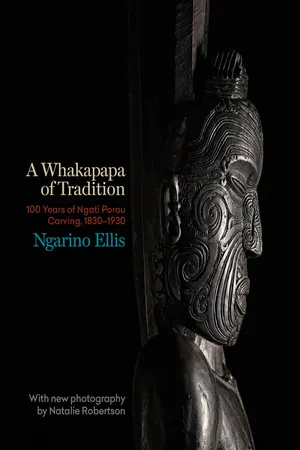
A Whakapapa of Tradition
One Hundred Years of Ngato Porou Carving, 1830-1930
- 304 pages
- English
- ePUB (mobile friendly)
- Available on iOS & Android
eBook - ePub
A Whakapapa of Tradition
One Hundred Years of Ngato Porou Carving, 1830-1930
About this book
From the emergence of the chapel and the wharenui in the nineteenth century to the rejuvenation of carving by Apirana Ngata in the 1920s, Maori carving went through a rapid evolution from 1830 to 1930. Focusing on thirty meeting houses, Ngarino Ellis tells the story of Ngati Porou carving and a profound transformation in Maori art. Beginning around 1830, three previously dominant art traditions – waka taua (war canoes), pataka (decorated storehouses) and whare rangatira (chief's houses) – declined and were replaced by whare karakia (churches), whare whakairo (decorated meeting houses) and wharekai (dining halls). Ellis examines how and why that fundamental transformation took place by exploring the Iwirakau School of carving, based in the Waiapu Valley on the East Coast of the North Island. An ancestor who lived around the year 1700, Iwirakau is credited for reinvigorating the art of carving in the Waiapu region. The six major carvers of his school went on to create more than thirty important meeting houses and other structures. During this transformational period, carvers and patrons re-negotiated key concepts such as tikanga (tradition), tapu (sacredness) and mana (power, authority) – embedding them within the new architectural forms whilst preserving rituals surrounding the creation and use of buildings.
A Whakapapa of Tradition tells us much about the art forms themselves but also analyzes the environment that made carving and building possible: the patrons who were the enablers and transmitters of culture; the carvers who engaged with modern tools and ideas; and the communities as a whole who created the new forms of art and architecture. This book is both a major study of Ngati Porou carving and an attempt to make sense of Maori art history. What makes a tradition in Maori art? Ellis asks. How do traditions begin? Who decides this? Conversely, how and why do traditions cease? And what forces are at play which make some buildings acceptable and others not? Beautifully illustrated with new photography by Natalie Robertson, and drawing on the work of key scholars to make a new synthetic whole, this book will be a landmark volume in the history of writing about Maori art.
Information
Topic
ArtSubtopic
Art GeneralIndex
Adsett, Sandy 6, 244
amo 11, 18, 32, 60, 71–72, 79–80, 109, 112–113, 117, 124, 130, 134–135, 142, 146–147, 155–156, 158, 162, 163, 167, 173–174, 179, 204, 247, 253–254, 259, 272, 274
Anaura Bay 12–13, 54, 70, 86–87, 248; see also Hinetamatea
Anglican Māori boarding schools 26, 185; see also Hukarere Maori Girls’ College; Te Aute College
animal imagery 78, 114
kurī (indigenous dogs) 78–81, 91, 142, 146–147, 260
European dogs 79; see also fish; pigs; whales
Arihia Memorial Dining Hall 3, 231, 240–243, 248, 276
Arikirangi Te Turuki, Te Kooti 82–83, 90, 92, 98, 148, 150–152, 215–216, 219, 227, 239, 256
patronage 192–193; see also Ringatū; Hauhau
Arikirua 38
ātea 2, 32, 65, 259
Aukuri see Okuri
authenticity 7, 10, 85, 93, 95, 97, 115, 196, 209, 216, 217, 221, 228
Baker, J. G. 54–55
Baker, Rev. Charles 44, 53–56, 58, 140
Ballantyne, Ted 243
battens see kaho paetara; kakaho
Best, Elsdon 29, 252
bone-scraping ceremony see hahunga
Buller, Walter 203, 223, 227; see also O Hine Waiapu
carving: training and education 100–104, 183–185, 220, 244
study carvings in museums 204
use of steel/metal tools 24, 28, 34, 158, 209
reusing older carvings 33, 202, 204, 219
as mnemonic device 95
forms 29–38
styles 27–28...
Table of contents
- Cover Page
- Title Page
- Dedication
- Contents
- Introduction: Te Ao Hurihuri o Iwirākau
- One: Iwirākau Visual Culture to 1830
- Two: He Tikanga Hoū: Chapels in the Waiapu, 1838–1860
- Three: Tradition and the Meeting House
- Four: Ngā Tohunga Whakairo o Iwirākau
- Five: Patronage
- Six: ‘Ka pū te ruha, ka hao te rangatahi’: Apirana Ngata, Hone Ngatoto and the End of the Iwirākau Carving School?
- Select List of Iwirākau Meeting Houses
- Occasional Carvers of the Iwirākau School
- Glossary
- Notes
- Bibliography
- Acknowledgements
- Index
- Copyright Page
- Footnotes
Trusted by 375,005 students
Access to over 1.5 million titles for a fair monthly price.
Study more efficiently using our study tools.
Frequently asked questions
Yes, you can cancel anytime from the Subscription tab in your account settings on the Perlego website. Your subscription will stay active until the end of your current billing period. Learn how to cancel your subscription
No, books cannot be downloaded as external files, such as PDFs, for use outside of Perlego. However, you can download books within the Perlego app for offline reading on mobile or tablet. Learn how to download books offline
Perlego offers two plans: Essential and Complete
- Essential is ideal for learners and professionals who enjoy exploring a wide range of subjects. Access the Essential Library with 800,000+ trusted titles and best-sellers across business, personal growth, and the humanities. Includes unlimited reading time and Standard Read Aloud voice.
- Complete: Perfect for advanced learners and researchers needing full, unrestricted access. Unlock 1.5M+ books across hundreds of subjects, including academic and specialized titles. The Complete Plan also includes advanced features like Premium Read Aloud and Research Assistant.
We are an online textbook subscription service, where you can get access to an entire online library for less than the price of a single book per month. With over 1.5 million books across 990+ topics, we’ve got you covered! Learn about our mission
Look out for the read-aloud symbol on your next book to see if you can listen to it. The read-aloud tool reads text aloud for you, highlighting the text as it is being read. You can pause it, speed it up and slow it down. Learn more about Read Aloud
Yes! You can use the Perlego app on both iOS and Android devices to read anytime, anywhere — even offline. Perfect for commutes or when you’re on the go.
Please note we cannot support devices running on iOS 13 and Android 7 or earlier. Learn more about using the app
Please note we cannot support devices running on iOS 13 and Android 7 or earlier. Learn more about using the app
Yes, you can access A Whakapapa of Tradition by Ngarino Ellis,Natalie Robertson in PDF and/or ePUB format, as well as other popular books in Art & Art General. We have over 1.5 million books available in our catalogue for you to explore.