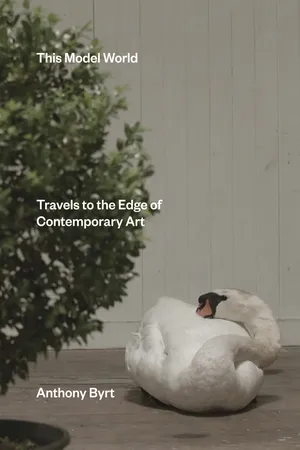
- 252 pages
- English
- ePUB (mobile friendly)
- Available on iOS & Android
eBook - ePub
About this book
In April 2011, Anthony Byrt was living in Berlin and building a career as a critic, writing about the world of contemporary art for magazines like frieze and Artforum International. Then one day his world turned upside down and Byrt, his wife and their new-born son suddenly found themselves booked on a one-way trip home to New Zealand. This Model World is a portrait of what Byrt found when he came back. Built around hundreds of hours spent in galleries, artists' studios and on the road from Brisbane to Detroit to Venice, this is a deeply personal journey into the contemporary New Zealand art world and the global world it inhabits. It's a book about major figures like Yvonne Todd, Shane Cotton, Billy Apple, Peter Robinson, Judy Millar and Simon Denny, and emerging artists such as Luke Willis Thompson, Shannon Te Ao and Ruth Buchanan. It's about severed heads and failed cities; about bright young stars and old men with a final point to prove; about looking for God and finding Edward Snowden; and about what it means to investigate the boundary where our bodies hit the world.
This Model World – a riveting first-person account of one author's travels to the edge of contemporary art.
Information
Topic
ArtSubtopic
Art General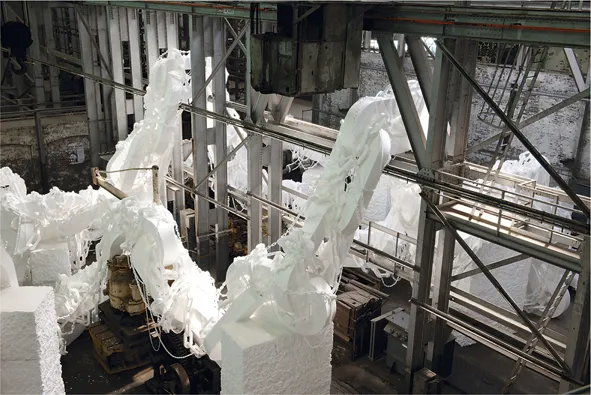
Gravitas Lite, 2012
Scattered Pieces
The first time I met Peter Robinson, he made me sing Sam Cooke’s ‘Chain Gang’ with a group of strangers. Robinson handed out sheets of A4 with the lyrics printed on them, hit play on his iPhone, and after a few tinny opening bars, set us to work. We mumbled along and avoided each other’s eyes, while he took the lead.
This happened in June 2012 on Cockatoo Island, in the middle of Sydney’s harbour. Robinson was part of that year’s Biennale of Sydney, his contribution a work called Gravitas Lite: a massive installation of polystyrene plinths and chains of varying sizes, which wrapped around and through the island’s defunct machinery.
As well as being a home of Sydney’s Biennale, Cockatoo is one of the city’s most haunted sites. In its early days it had been a prison – a place where inmates cracked rocks from the sandstone cliffs, material that helped build Sydney’s signature stone buildings. Later, it was a shipbuilding yard. ‘Chain Gang’, then, was Robinson’s waiata for his installation and for the place: a musical parallel for the material transformation he’d performed in turning a space of forced labour into a Lilliput of restraint and entanglement. Cooke’s tribute to the toughness of prison life during America’s civil rights era had found another life half a world, and half a century, away.
Most of my fellow mumblers were Robinson’s patrons, a group of New Zealanders who’d helped fund his massive installation. They shuffled off quickly after the song was done.
‘That seemed to go pretty well, didn’t it?’ Robinson asked me.
I muttered something in reply. In Robinson’s world, everything is a question. Everything is always something else. And everything is about hard work.
ROBINSON’S STUDIO is in a 1970s office block in central Auckland, which he’s about to be kicked out of because the building is being converted into luxury apartments – another victim of Auckland’s gentrification. Although he shares the space with a few other artists, he takes up the most real estate, working out his large-scale installations and scatter pieces on its concrete floor.
Robinson himself is a big guy too: six foot, with a white-streaked mop of black hair. There’s a shambling delicacy to him. Catch him when he doesn’t know you’re watching and he’ll be stooped with a kind of depressive thoughtfulness. But once he starts moving his materials around, any physical clumsiness disappears. He is capable of shifting a single metal rod or lifting the edge of a piece of felt, and making the entire room change.
He’s also his own harshest critic; when we meet, he’s going through a kind of existential crisis.
‘I want to change some stuff, rethink things,’ he says. ‘Do a lot of reading. I might go underground for a while. I’m trying to work out where I’m going, what I’m doing, what things could be. I’m starting to lose faith in what I do a bit. Which is probably a good moment. It’s not a very comfortable moment. I’ll either regroup and charge straight back into it or it’ll be a change of direction.’
I ask him what he’s losing faith in.
‘It might be the process. Sitting around playing with material, kicking it around. It’s not just the work, it’s the whole enterprise of being an artist: spending so much energy, so much money on production, with very little return. I’m a reasonably lucky artist, but I’ve just spent so much over so many years, and I’m really going backwards rather than forwards, financially. I need to think about that. It’s probably a strange way to have this conversation. But it’s a reality.’
It’s easy to look at Robinson’s recent career – shows in Istanbul, Sydney, Melbourne, Paris, Jakarta, feted by major curators and included in prestigious biennales around the world – and assume he’s living his dream. But it’s a tough grind, especially for an artist for whom political questions have always been essential. He now finds himself part of an art world system whose own political and economic motivations – not to mention questions of social and cultural equality – are increasingly hard to negotiate.
‘We get caught in wanting to resist that system,’ Robinson says, ‘but at the same time wanting to be successful within it. It’s connected to capitalism, and the split that it causes within the subject. That’s interesting in terms of how to perform as an artist. That’s not something my work really examines at the moment, and probably can never do on its current course.’
Robinson and I have planned to meet at Artspace on K Road, where he has a solo exhibition. But at the last minute he changes the appointment to his studio, because there’s something new he wants to show me. When I arrive, the space is rammed full of stuff, like he’s pulled everything he’s made in the past few years out of storage and thrown it together. Felt is the dominant material: coloured squares on the floor; circles that slump where the floor and walls meet; poles wrapped in it; different coloured squares arranged in grids or stacks; tiny discs like washers; linear pieces that, from a distance, look more like drawings on the floor or the wall; and the sheets they’ve all been cut from – squares of fabric that might otherwise have ended up in the bin.
As well as felt, there are bent and malformed steel pipes, either industrial grey or neon-gold. Coke cans hang from thin wire or lie crushed on the floor. Finished bog rolls are propped among traditional Māori gourds. Tiny pinched pieces of aluminium pipe are scattered on the floor, like miniature versions of Warhol’s Clouds. And everywhere, there are little figurines and statues: kitschy geishas, samurai warriors, coconut heads, African fertility sculptures, dinky Aborigines leaning on didgeridoos. There’s a gold Buddha and a Pinocchio with his nose half-extended. There’s even a perfect little wharenui perched on the edge of a black felt square, like it’s about to tumble into a sinkhole.
‘I haven’t quite come to terms with them yet,’ he says of the figurines. ‘They’ve been in my work before. They go back to what I was doing around the turn of the century. But the polemic isn’t as nasty as it was in those days. They shift the scale of things. They also set up the idea of being lost in language. A sculptural language is a language on its own terms. We recognise it as such, but we can’t understand it as we usually understand language. Here, that’s exploded. It’s as though these figures are trying to make their way through a code. But the code is scrambled in some way, and their gazes seem to be lost in something. The colour of them also seems to key into the colour of the felt. There’s a relationship – a vividness.’
It’s impossible to take it all in at once. It’s also a welcome shift from what I’d seen as a certain politeness emerging in his recent work. Since abandoning polystyrene after the Sydney project, Robinson has used felt again and again. In it, he’d found a material with amazing optical effects – something that slips between object and image and between flatness and form, so that as we enter his installations, we feel as though we’re entering a picture and a sculpture. At the same time, the felt experiments had started to feel like formal exercises, like Robinson was developing a visual vocabulary with no obvious grist or politic – just a satisfaction with its own cleverness.
Robinson has also taken the step of letting audiences interact directly with the installations, as a way of democratising making, of breaking down relational hierarchies between artist and viewer. The most substantial example of this was his contribution to the 2013 Auckland Triennial. In the Auckland Art Gallery’s mezzanine, he lined up dozens of coloured felt rods, each one around 2 metres long. A team of volunteers picked these up and carried them through the city to the Auckland War Memorial Museum (more on this project soon). Later that year, at The Dowse Art Museum, he let people build their own rods from small discs of felt scattered across the floor. And at Centre Georges Pompidou in Paris and Artspace in Auckland, audiences were given permission to rearrange his forms in whatever configurations they liked.
It’s a perfectly noble and inclusive act, but one fraught with risk. In the hands of amateur enthusiasts, Robinson’s subtle, delicate arrangements are easily turned into stick figures, smiley faces and emojis.
‘I’m surprised with what people do,’ he says. ‘I really do feel like a viewer of the audience’s work. There are so many things I’d never have done myself – the way people have tied things for example, or gone around the rules. I was also surprised at how free they were – they weren’t intimidated by the role or the space whatsoever.
‘In some instances [at Artspace], I found myself being disappointed by the results because they didn’t subscribe to my preconception of how things should look, which was as an all-over composition in the space. They became more territorial and isolated as gestures. Then I realised there was something interesting in that. So I learned a lot about my sense of trying to be open but actually being very controlling, or having a propensity to be very controlling.’
Which is all good and well. But it doesn’t change my feeling that Robinson is a sculptor who should take control, should dictate terms to us forcefully, just as he’d done in Sydney. That’s why his latest jumble was such a relief. It had a bossiness. It seemed to me that with it, he was back to his best – in a space where his formal games and his deeply felt politics become inextricably tangled with each other.
ON THANKSGIVING NIGHT at the Lost Horse Saloon, beer is a dollar and a turkey dinner costs whatever you want to pay. An absurdly good-looking Texan barman, tall and blond with a tattoo crawling up his neck, looks at me like I’m an idiot when I ask him to repeat the price. ‘It’s Thursday,’ he says, like that explains everything. He pulls the beer. When I ask him about food, he points to the smoking lounge at the back of the room.
On the other side of the smokers’ door, a black woman in her fifties stands beside a makeshift buffet. She smiles, and assembles an enormous plate of food for me: biscuits and mashed potato and gravy and turkey thigh. I ask her how much I owe, and she points at a jar filled with scrunched dollar bills. I put some notes in it and carry my plate back into the bar, sit down, and watch two girls as pretty as the barman shoot pool, lining up trick shots against a wall covered in animal skulls. The towering proprietor, wearing an eye-patch and a Stetson, moves through the room chatting to patrons and pauses, long enough to give me a nod.
I’d set out from El Paso a few hours earlier, on a 300-kilometre trip southeast along the Mexican border. As I turned off the interstate, the sun started its slide behind the mountains. Lucky Luke outcrops of prehistoric rock turned into cartoon silhouettes as the sky glowed red, then orange, then purple. Each time the colour shifted the hills scooping up the light were surrounded by a slightly different haze, a kind of graded blue fog; colours I’d never seen before, and yet the entire horizon was lit up with them as though, here, they were the only logical possibility – the only way the world could be.
Up ahead, I saw a low, flat building, standing alone at the edge of the road. I pulled up opposite. It was, of all desert possibilities, a Prada showroom: a bizarre thing in a bizarre place, hunkering on the side of US90 and showing signs of its age; windows grimy, awnings torn. As the last of the light faded, bulbs inside illuminated stiletto-lined shelves – weird late capitalist relics inside a structure well on its way to ruin; another scar in a landscape full of beauty and glory and death and art.
The sky fades to black. I get back in the car and drive to the city limit of Marfa, Texas, and realise I’m completely alone and nothing is open, until I see a neon-red sign flashing ‘BEER’ from the far end of town and go in, hoping I’ll maybe find something to eat and drink.
MARFA IS A DREAM. It is also a place of pilgrimage; an art world rite of passage. Despite being in the middle of nowhere, the town and its surrounds are full of contemporary art. The Prada showroom, for example, is a permanent artwork by the Scandinavian duo Elmgreen and Dragset, made in 2005.
Their project is certainly a draw, but art worlders mainly come to Marfa because of one man: Donald Judd. Judd was arguably minimalism’s greatest hero, his cantilevered rectangular boxes among postwar art’s most defining forms. He was also an art critic. In the endless hours he spent during the 1960s and early ’70s looking at and making art in New York’s stark, well-lit galleries, he decided something wasn’t right; that the experience of art was far more complicated than simply using your eyes to look at an object inside a neutral, and neutralising, white box. In Judd’s view, it should be about the wholeness of an encounter, in which the surrounding context – the light, the architecture, the landscape – and the way it impacts our bodies is as important as the form itself.
He set out to prove his point. He hit the road and washed up in Marfa: the place where he would try to change everything.
Judd bought up properties all through the run-down town, driven by the idea that its buildings would eventually house massive installations by himself and his famous friends – Dan Flavin, John Chamberlain and others. With support from the Dia Art Foundation (which was set up by Philippa de Menil, the daughter of John and Dominique), he eventually turned his focus to an ex-military barracks on Marfa’s outskirts, which is now called the Chinati Foundation; a massive complex only accessible to the public on an official tour.
I arrive early and walk through the one project by Judd that is open all the time: 15 untitled works in concrete, built between 1980 and 1984 – a kilometre of concrete boxes set out in a field of wheat-coloured grass. What matters isn’t so much the boxes’ solidity as the spaces they articulate, and not even the spaces inside them, but the space you’re standing in just beyond their limits. As you walk the kilometre, you notice everything but the boxes themselves; the dry morning light casting shadows harder than the concrete; the crickets and giant ants at your feet; the piles of dirt thrown up by moles or whatever their desert equivalents are. Judd’s boxes suspend you in a confrontation with the edges of yourself.
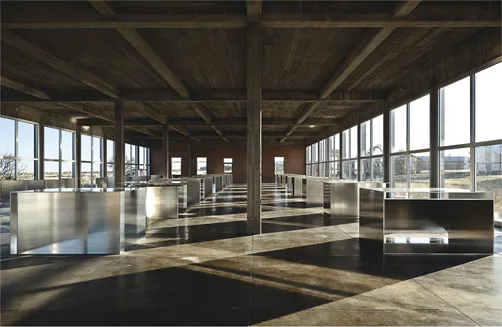
Donald Judd 100 untitled works in mill aluminum, 1982–86
As soon as the Foundation opens, I join a tour group and the day unfolds slowly. It’s like a retreat: a semi-slumberous movement through the heat and the dust. It’s silent. You are constantly aware of your own breath. Your guide only speaks when she absolutely needs to. The rest of the time, you’re left to deal with the facts of the things in front of you. Facts like Judd’s 100 untitled works in mill aluminum, 1982–86, inside two former artillery sheds. At first the steel boxes seem uniform – identical units in neat rows. But each is subtly different from the rest, their internal spaces carved up in different ways. Over time, some of them have moved as the desert’s heat and cold makes their metal ping and contract. Some, our guide tells us, have wandered well away from their original marks. Massive windows flood the room with constantly shifting lines of Texan light. In the distance, you can make out Judd’s concrete boxes, resting in their field of gold.
You move on to text works by Carl Andre: sheets of typewriter paper on which the artist has tapped out words not just for their meaning but for their shape – units of sculpture as w...
Table of contents
- Cover Page
- Title Page
- Dedication
- Contents
- Prologue: The First of May
- Clammy Pipes, and Other Monsters: Yvonne Todd
- Luke Willis Thompson/Kalisolaite ‘Uhila, The Walters Prize 2014
- Death in Palmerston North: Shane Cotton
- Fiona Pardington, Moonlight de Sade
- Live Forever: Billy Apple
- Steve Carr, Transpiration
- Scattered Pieces: Peter Robinson
- Shannon Te Ao, two shoots that stretch far out
- Parallel Worlds: Judy Millar
- Ruth Buchanan, The weather, a building
- No Place to Hide: Simon Denny
- Postscript: 4 January 2016
- List of Illustrations
- Sources and Further Reading
- Acknowledgements
- Copyright Page
Trusted by 375,005 students
Access to over 1.5 million titles for a fair monthly price.
Study more efficiently using our study tools.
Frequently asked questions
Yes, you can cancel anytime from the Subscription tab in your account settings on the Perlego website. Your subscription will stay active until the end of your current billing period. Learn how to cancel your subscription
No, books cannot be downloaded as external files, such as PDFs, for use outside of Perlego. However, you can download books within the Perlego app for offline reading on mobile or tablet. Learn how to download books offline
Perlego offers two plans: Essential and Complete
- Essential is ideal for learners and professionals who enjoy exploring a wide range of subjects. Access the Essential Library with 800,000+ trusted titles and best-sellers across business, personal growth, and the humanities. Includes unlimited reading time and Standard Read Aloud voice.
- Complete: Perfect for advanced learners and researchers needing full, unrestricted access. Unlock 1.5M+ books across hundreds of subjects, including academic and specialized titles. The Complete Plan also includes advanced features like Premium Read Aloud and Research Assistant.
We are an online textbook subscription service, where you can get access to an entire online library for less than the price of a single book per month. With over 1.5 million books across 990+ topics, we’ve got you covered! Learn about our mission
Look out for the read-aloud symbol on your next book to see if you can listen to it. The read-aloud tool reads text aloud for you, highlighting the text as it is being read. You can pause it, speed it up and slow it down. Learn more about Read Aloud
Yes! You can use the Perlego app on both iOS and Android devices to read anytime, anywhere — even offline. Perfect for commutes or when you’re on the go.
Please note we cannot support devices running on iOS 13 and Android 7 or earlier. Learn more about using the app
Please note we cannot support devices running on iOS 13 and Android 7 or earlier. Learn more about using the app
Yes, you can access This Model World by Anthony Byrt in PDF and/or ePUB format, as well as other popular books in Art & Art General. We have over 1.5 million books available in our catalogue for you to explore.