eBook - ePub
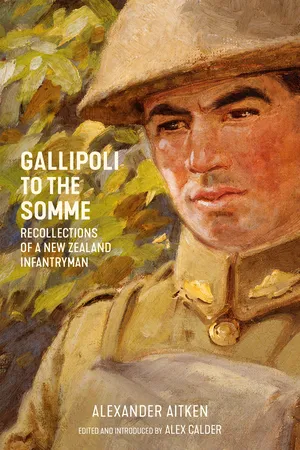
Gallipoli to the Somme
Recollections of a New Zealand Infantryman
- 264 pages
- English
- ePUB (mobile friendly)
- Available on iOS & Android
eBook - ePub
About this book
Alexander Aitken was an ordinary soldier with an extraordinary mind. The student who enlisted in 1915 was a mathematical genius who could multiply nine-digit numbers in his head. He took a violin with him to Gallipoli (where field telephone wire substituted for an E-string) and practiced Bach on the Western Front. Aitken also loved poetry and knew the Aeneid and Paradise Lost by heart. His powers of memory were dazzling. When a vital roll-book was lost with the dead, he was able to dictate the full name, regimental number, next of kin and address of next of kin for every member of his former platoon—a total of fifty-six men. Everything he saw, he could remember. Aitken began to write about his experiences in 1917 as a wounded out-patient in Dunedin Hospital. Every few years, when the war trauma caught up with him, he revisited the manuscript, which was eventually published as Gallipoli to the Somme in 1963. Aitken writes with a unique combination of restraint, subtlety, and an almost photographic vividness. He was elected fellow of the Royal Society of Literature on the strength of this single work—a book recognised by its first reviewers as a literary memoir of the Great War to put alongside those by Graves, Blunden and Sassoon. Long out of print, this is by some distance the most perceptive memoir of the First World War by a New Zealand soldier. For this edition, Alex Calder has written a new introduction, annotated the text, compiled a selection of images, and added a commemorative index identifying the soldiers with whom Aitken served.
Information
1 Egypt to Lemnos
MY ACTIVE SERVICE IN THE WAR OF 1914–18 BEGAN OFFICIALLY ON 14th August 1915. This was the date on which our draft, the 6th Infantry Reinforcements of the N.Z.E.F., finished its four months of training at Trentham, near Wellington, made the usual march of ceremony and farewell through the capital, and embarked for Egypt on the troopships S.S. Willochra and Tofua. But the first six weeks, the long voyage broken only by a day of shore leave at Albany, Western Australia, and a day without leave standing a mile or two off Aden, as well as the six days in the sand at Zeitoun on the north-eastern outskirts of Cairo, seem in retrospect mere prelude. I could recover them with little trouble, and they were interesting to me then, but now that authors have visited every part of the world and described every sensation of travel, nothing is left for an unskilled pen.1
We had come to Zeitoun on 19th September by the usual route, from Suez north to Ismailia, west to Zagazig, south-west to Cairo. At Zeitoun we lived in long, wooden huts, tectis bipatentibus as in Virgil, two walls with a roof across, open at both ends and floorless, planted on the sand.2 The hottest months, July and August, were past, but the September equinox still had heat enough to put parades between 9 a.m. and 5 p.m. out of the question; or rather, to come to terms at once with the twenty-four-hour clock of the Mediterranean zone, between 09.00 and 17.00. There was exercise in the desert in the cool of early morning, 05.30 to 07.30; by 09.00 we were under cover in the huts except for limited leave to visit Zeitoun village, perhaps to watch, under an awning, some conjurer or contortionist; cautioned also, for our own safety, not to look too curiously into any eyes behind a yashmak,3 lest a jealous dagger should come our way in a back street.
From 17.00 to 19.00 there was a route march, usually to Heliopolis and back, then general leave until the last suburban train from Cairo, arriving at Zeitoun after 23.00. I have nothing to say of certain demoralizing, and in some cases permanently ruinous, effects of the night-life of Cairo. For completeness and full understanding something should be said of this, but not by me, incompetent to deal with an aspect of life in barracks more than adequately described by others.4
Cairo at night held no attraction for me. I preferred to practise on the violin in the almost empty hut, the few who might otherwise have been attentive listeners being engaged on other things. Like almost all the occupants of the hut, these few were fated to death or injury: Singleton, who now was writing his interminable letters by candlelight, destined to lose both legs in a railway accident next year at Ismailia;5 Paisley and Robertson farther up, now engaged in reading the Bible together (as they always did at this hour), to die in France—Robertson at Armentières in 1916, Paisley at Passchendaele on that bad day for New Zealand, 12th October 1917.6 But now they were kneeling in the sand before turning back their blankets; and later there will be the train whistle, the influx in the dark, and more than a rumour of disorderly adventure—and yet, tomorrow, at drill in the early morning, all of this washed away as the tide washes detritus from a beach. So the six days passed. One afternoon I visited the Pyramids and Sphinx with my good friend Frank Tucker of the Wellingtons, but, again, I have nothing to describe; from Kinglake onwards, everything has been said about the Pyramids.7 They should be seen, however, like Melrose Abbey, by moonlight.8
We left Zeitoun for Alexandria at noon on 26th September, marching in unbearable heat two or three miles towards the centre of Cairo. The village of Ezbet-el-Zeitoun was in a drowse; only the great ravens above the camp gates watched us departing. We spread ourselves with relief in the airy wide-gauge carriages. My temperature—from a touch of the sun or sand colic—was rising.9 For this reason, though I was unaware of it, all impressions were unnaturally heightened. Mechanically I absorbed them; the stately Nile barges, gracefully deliberate, their tall masts like bent bows; the sudden clatterings through crowded junctions, Benha, Tantah, the equally sudden returns to Biblical scenes, here a kneeling peasant turning an irrigating rill down a furrow, there an ox driven round and round the primitive Archimedean water-screw; at last, but by this time through a film, a glaze of rising nausea, Lake Mareotis on the left, with curious fishing craft moored in its rushy edge, and mud huts on the right, eyes peering through the window-slits.10 At the quay I staggered up the gangway, paraded sick, and was summarily sent below to lie under a blanket and digest that military cure-all, a ‘Number Nine’ pill.11
The Osmanieh appeared to be a cargo steamer of the Levant, perhaps captured and pressed into transport service, for which, with her limited deck space and lack of cabins, she was entirely unsuited. She was later torpedoed in the Mediterranean. Company quarters were away down in the forehold, on a grimy iron floor reached from the hatch by a long ladder. In the dim light of two portholes high above, one could just make out heaps of onion skins, remnants of a previous cargo, swept into corners. The crew of Levantines, seldom seen in the day-time, prowled abroad on that first night and stole socks and shirts that we had washed and put to dry on steam-pipes. As for rations, there was a sudden decline from the relative luxury of the Willochra east of Suez; the hot stew, the New Zealand butter and cheese, the bread, were at one stroke exchanged for the regular military fare of the Mediterranean zone, the hard biscuits and the small tins of Fray Bentos bully beef.
All day on the 27th I lay below, much recovered but unfit for drill, with nothing to do but order my impressions of the previous six weeks. The violin lay in its case beside me; not originally mine, but won in a raffle on board ship, some days after we had left Albany in Western Australia, by my cabin-mate and old schoolfellow R. J. Maunsell, and handed by him to me. Mediocre in tone and cheap, it was wonderful to have in such a place. Sooner or later I would have to part with it; it was excess luggage, contrary to regulations, and could not be expected to survive the strict kit inspections that would precede our disembarking on Gallipoli. I was determined in spite of this to smuggle it along as far as I could, and had begun to print a hopeful list of names on the baize lining of the case. I added one now, so that the list showed: Indian Ocean, Aden, Suez, Cairo (Zeitoun), Alexandria. The violin was by this time almost a platoon mascot, while the piece most in demand, Dvořák’s Humoresque in Wilhelmj’s arrangement in G major, was becoming what in later years would be called the ‘signature tune’.12
On the 28th, recovered though still shaky, I sat above with the platoon about the deck-housing on the port side, looking west. Mr. Johnston, the platoon commander, whose orders had clearly been to use his inventive discretion and keep us occupied, was refurbishing from memory old lectures heard more than once in Trentham. Our course was north with a touch of west; we must have passed during the night between Rhodes and Karpathos and were now in the southern Aegean. I listened with half my mind; we were skirting the eastern fringe of the Cyclades, small, beautiful islands, some too small to be inhabited, rising from the north-western horizon, gliding abeam and vanishing in the south-west. In the late morning a much larger one, dark and mountainous and steep along its eastern coast, came opposite to within fifteen miles. I realized, not then, but in retrospect, that this must be Naxos, the Naxos of Theseus and Ariadne, largest of the Cyclades; this eastern side seemed too precipitous for harbour or beach, which must be round to the west. I began to think of several of those ancient legends. But it was useless; mythology had lost its meaning, the names had no conviction. Gallipoli and Anzac were everything; we were bound for there, perhaps to be actually there within another night and day; meanwhile we were sitting on this deck, listening as before to those trite themes of musketry, of judging distance, of locating objects by a clock-and-finger method, or of carrying out imagined attacks by short skirmishing rushes, as understood and last practised in the Boer War. So the magnificent island faded southward with the rest, a protecting destroyer came from the north at high speed and circled us three times, the last of the Cyclades thinned away, and in the afternoon we were in the blank waters of the northern Aegean.
All this time, and in Egypt, Gallipoli had been uppermost in our minds, yet hardly ever mentioned. Not from fear, but because it was pointless to speculate concerning a place none of us had seen, being without exception volunteer recruits none of whom had yet been in action. No one doubted that Gallipoli was our immediate destination, though rumours, which among soldiers will seize at any fortuitous possibility, did sometimes suggest Salonika. In those days Gallipoli was hidden under a cloud of official silence. Sir John Maxwell, commander of the Egyptian garrison,13 briefly reviewing us one morning in the sand at Zeitoun, had barely mentioned it. We knew of the Landing on 25th April, which had taken place soon after our entry as recruits into Trentham, and we also knew vaguely of some of the later operations; but not of the August advance, which was too recent to be definite, and which had been moving towards its collapse when we embarked for Egypt.14 It was true that at Suez, about to disembark, we had met some wounded and invalided men, brought on board the Willochra to be taken home; but inert in stretchers or lying back exhausted in deck-chairs, they were so evidently reluctant to revive painful experiences that we had left them alone. None the less, a few words had passed, an outline had emerged, and on the main points my own mental picture was exact enough; a narrow, ridgy, barren peninsula, the tail-end of Europe, probably a magnified edition of my own Otago Peninsula, sun-baked and unhealthy of late; Cape Helles on the south tip, Anzac on the west side, Suvla Bay farther up; Anzac itself, our own sector, a semicircle with centre at the beach and of radius no more than two miles, dominated by the range Sari Bair (highest point Hill 971, Koja Chemen Tepe) and its southern spur Chunuk Bair, still uncaptured. Of how far the August advance from Suvla and Anzac had failed we had no idea. Therein lay the cloud of silence.
On the morning of the 29th, much recovered, I was on deck early. Due north was Lemnos, with the great harbour of Mudros already visible, opening on the south coast and almost dividing the island into halves. We passed east of the two sentinel islets that guard the fairway, and were soon merged in an enormous fleet of vessels of every kind, close-packed for miles along both converging shores; cruisers, monitors, transports, hospital ships, trawlers, paddle-steamers, surfaced submarines, tugs, pinnaces, motor-launches, down to cockle-boats and local Aegean fishing craft moored idle against the pier. We were carefully piloted and fitted into an interstice in the pattern, close to the quay of Mudros East. Opposite us, on the other side, the towering masts, four funnels, and great hull of the Cunarder, S.S. Aquitania, rose Brobdingnagian, dwarfing the Lilliputian tongue of Mudros West protruding behind it.15 For the usual and expected several hours we waited on deck with packs up, watching the ceaseless water-beetle skimming of pinnaces and motor-launches up and down the long harbour. At 17.30 a paddle-steamer, the Water Witch, ferried us over and landed us on the tip of Mudros West. It was almost dark when Mr. L. S. Jennings (a well-known university lawn-tennis player, killed at Flers, 15 September 1916), senior platoon commander and acting O.C., led the four platoons along the ridge.16
It was fully dark when we descended the farther neck of the three-mile long Peninsula, guessing at an unseen inlet on the right and striking north-west across salt marsh. The western hills were no longer visible. A cold north wind blew down the divide; for the first time on my active service I felt depression and the sense of exile in the wrong hemisphere. About 20.30 we made out a few muffled lights on a slope ahead, our apparent destination. They were marquees, candle-lit. We formed up and dismissed to quarters in them.
I felt then, as everyone else must have, an obscure disquiet. Last Post had not yet sounded, it could not be as late as 21.00; yet the marquees were almost silent, voices were subdued, men could be seen through the flaps already under their blankets. There was not a trace of the animation usual in a camp until Last Post. Only one man had had the curiosity to walk out a short distance and see us arrive; yet our arrival had been no surprise, for dixies of tea stood waiting for us. No one had asked for news of New Zealand or Egypt. There was a mystery somewhere, perhaps even a disaster; whatever it was I was content to leave it unsolved until daylight. My section was already installed in a marquee, with little room left. I wound myself in my blanket and slept half inside, half outside, my feet among the guy-ropes.
In daylight the explanation was drastically simple. The casual proceedings of the night before had been that long anticipated event, the ‘joining up with the Main Body’; but this camp of a few marquees held all that was left of that Main Body or, more precisely, of the New Zealand Infantry Brigade and its successive reinforcements up to the 5th.17 After almost five months on Gallipoli without relief, from the Landing of 25th April until the dying spasms of the August advance, never out of range of bullet or shell, tormented by flies, weakened by dysentery, these survivors had been taken off for a rest, less than a fortnight before our arrival, to the Lemnian hill-side near the village of Sarpi. The remainder, the large majority, had been killed or wounded, had died of sickness, or been invalided. Half a mile farther west, under the foot-hills, was an even smaller camp with a few horse lines. This similarly held all that remained of the New Zealand Mounted Brigade. The sixteen companies in the four infantry battalions—Auckland, Wellington, Canterbury, and Otago—had each been reduced in almost the same proportion. For example, the 10th North Otago Company had numbered before our arrival eighteen men, with no officers, no senior N.C.O.s, in fact only two lance-corporals, J. Daly and R. Day.18 Augmented by our platoon, the 20th of the draft, it still stood at less than one-third full strength. In the whole Otago Battalion only one officer was left, Major White, of the New Zealand Territorials, an almost grandfatherly figure, seldom seen outside his tent at the top of the slope. Such was our realization of the state of affairs on the morning of 30th September 1915.
These men, who had gone to bed so early the night before, were seen by daylight to be listless, weak, emaciated by dysentery, prematurely aged. They had suffered also in nerves. The pastoral silence of the ancient island was felt to be deceptive and sinister; it was unnatural to walk abroad at large without the fear of sudden death. They were suffering, one might say, from an induced agoraphobia; it was this, quite as much as bodily and nervous exhaustion, that kept them within the marquees. They resembled in some respects the survivors of an earthquake, except that those have the compulsive urge to sit outside, not inside. I noted the startling transformation of old friends. There was Paine, known at school only a few years before, last seen among the 5th Reinforcements, as they marched out of Trentham on 12th June to the music of regimental bands; now hardly recognizable, his hollow face matching in colour his sun-faded tunic and forage cap; yet he was among the least debilitated, being in fact the one who had had the curiosity to walk out two hundred yards and see us arrive. In brief, this camp at Sarpi had been, in all but name, a hospital camp. It was significant that the prime cause, Gallipoli, was under a taboo and barely mentioned.
There were a few men who had kept physique and nerves intact; two in particular, well known to me from school or student days, Sergeants E. G. Pilling and E. M. Ryburn. Ewen George Pilling, fellow prefect and sixth-former less than three years before, was at this time in the 4th Otago Company. He had been in every action since the Landing of 25th April. That evening in his marquee some others and myself listened to an account, as free from bitterness as it was from false heroics, of such part as he himself had seen of the events of the previous five months. There would be no point in detailing it; it simply gave an individual view of what anyone is free to read in the dispatches of Sir Ian Hamilton, supplemented by the official history of Brigadier-General Aspinall-O...
Table of contents
- Cover
- Title Page
- Contents
- Editor’s Introduction
- A Note on the Text
- Acknowledgements
- Chronology
- Introduction
- Author’s Note
- 1 Egypt to Lemnos
- 2 Lemnos: Sarpi, Kastro
- 3 Lemnos to Gallipoli
- 4 Gallipoli to Lemnos
- 5 Lemnos to Egypt
- 6 Egypt: Ismailia
- 7 Ismailia and the Suez Canal
- 8 Egypt to France: Hazebrouck
- 9 Hazebrouck to Estaires
- 10 Estaires to Armentières
- 11 Armentières Salient: The Front Line
- 12 Armentières: The Cresendo
- 13 Terdeghem: A Grenade School
- 14 Armentières: The Raids Begin
- 15 Armentières: The Raid of the 4th Otagos
- 16 Armentières: After the Raid
- 17 Flanders to Picardy: Citernes
- 18 Citernes to Fricourt
- 19 Fricourt to Flers: 15th September 1916
- 20 Delville Wood: Longueval
- 21 Goose Alley: 25th September 1916
- 22 Goose Alley: 26th September 1916
- 23 Goose Alley: 27th September 1916
- Epilogue
- Appendix: Scraps from a Diary, 1915–1916
- Editor’s Notes
- Bibliography
- Commemorative Index of Names
- Plates
- Copyright
- Footnotes
Trusted by 375,005 students
Access to over 1.5 million titles for a fair monthly price.
Study more efficiently using our study tools.
Frequently asked questions
Yes, you can cancel anytime from the Subscription tab in your account settings on the Perlego website. Your subscription will stay active until the end of your current billing period. Learn how to cancel your subscription
No, books cannot be downloaded as external files, such as PDFs, for use outside of Perlego. However, you can download books within the Perlego app for offline reading on mobile or tablet. Learn how to download books offline
Perlego offers two plans: Essential and Complete
- Essential is ideal for learners and professionals who enjoy exploring a wide range of subjects. Access the Essential Library with 800,000+ trusted titles and best-sellers across business, personal growth, and the humanities. Includes unlimited reading time and Standard Read Aloud voice.
- Complete: Perfect for advanced learners and researchers needing full, unrestricted access. Unlock 1.5M+ books across hundreds of subjects, including academic and specialized titles. The Complete Plan also includes advanced features like Premium Read Aloud and Research Assistant.
We are an online textbook subscription service, where you can get access to an entire online library for less than the price of a single book per month. With over 1.5 million books across 990+ topics, we’ve got you covered! Learn about our mission
Look out for the read-aloud symbol on your next book to see if you can listen to it. The read-aloud tool reads text aloud for you, highlighting the text as it is being read. You can pause it, speed it up and slow it down. Learn more about Read Aloud
Yes! You can use the Perlego app on both iOS and Android devices to read anytime, anywhere — even offline. Perfect for commutes or when you’re on the go.
Please note we cannot support devices running on iOS 13 and Android 7 or earlier. Learn more about using the app
Please note we cannot support devices running on iOS 13 and Android 7 or earlier. Learn more about using the app
Yes, you can access Gallipoli to the Somme by Alexander Aitken, Alex Calder in PDF and/or ePUB format, as well as other popular books in History & Historical Biographies. We have over 1.5 million books available in our catalogue for you to explore.