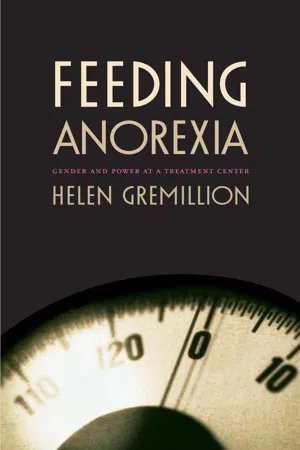
Feeding Anorexia is based on fourteen months of ethnographic research in a small inpatient unit located in a major teaching and research hospital in the western United States. Gremillion attended group, family, and individual therapy sessions and medical staff meetings; ate meals with patients; and took part in outings and recreational activities. She also conducted over one hundred interviews-with patients, parents, staff, and clinicians. Among the issues she explores are the relationship between calorie-counting and the management of consumer desire; why the "typical" anorexic patient is middle-class and white; the extent to which power differentials among clinicians, staff, and patients model "anorexic families"; and the potential of narrative therapy to constructively reframe some of the problematic assumptions underlying more mainstream treatments.
eBook - PDF
Feeding Anorexia
Gender and Power at a Treatment Center
- 301 pages
- English
- PDF
- Available on iOS & Android
eBook - PDF
Feeding Anorexia
Gender and Power at a Treatment Center
About this book
Feeding Anorexia challenges prevailing assumptions regarding the notorious difficulty of curing anorexia nervosa. Through a vivid chronicle of treatments at a state-of-the-art hospital program, Helen Gremillion reveals how the therapies participate unwittingly in culturally dominant ideals of gender, individualism, physical fitness, and family life that have contributed to the dramatic increase in the incidence of anorexia in the United States since the 1970s. She describes how strategies including the meticulous measurement of patients' progress in terms of body weight and calories consumed ultimately feed the problem, not only reinforcing ideas about the regulation of women's bodies, but also fostering in many girls and women greater expertise in the formidable constellation of skills anorexia requires. At the same time, Gremillion shows how contradictions and struggles in treatment can help open up spaces for change.
Trusted by 375,005 students
Access to over 1.5 million titles for a fair monthly price.
Study more efficiently using our study tools.
Information
Publisher
Duke University Press BooksYear
2003Print ISBN
9780822331209
9780822331339
eBook ISBN
9780822385011
Table of contents
- CONTENTS
- Acknowledgments
- Prologue
- Introduction: In Fitness and in Health
- ONE Crafting Resourceful Bodies and Achieving Identities
- TWO Minimal Mothers and Psychiatric Discourse about the Family
- THREE Hierarchy, Power, and Gender in the ‘‘Therapeutic Family’’
- FOUR ‘‘Typical Patients Are Not ‘Borderline’ ’’: Embedded Constructs of Race, Ethnicity, and Class
- Epilogue: A Narrative Approach to Anorexia
- Notes
- Bibliography
- Index
Frequently asked questions
Yes, you can cancel anytime from the Subscription tab in your account settings on the Perlego website. Your subscription will stay active until the end of your current billing period. Learn how to cancel your subscription
No, books cannot be downloaded as external files, such as PDFs, for use outside of Perlego. However, you can download books within the Perlego app for offline reading on mobile or tablet. Learn how to download books offline
Perlego offers two plans: Essential and Complete
- Essential is ideal for learners and professionals who enjoy exploring a wide range of subjects. Access the Essential Library with 800,000+ trusted titles and best-sellers across business, personal growth, and the humanities. Includes unlimited reading time and Standard Read Aloud voice.
- Complete: Perfect for advanced learners and researchers needing full, unrestricted access. Unlock 1.5M+ books across hundreds of subjects, including academic and specialized titles. The Complete Plan also includes advanced features like Premium Read Aloud and Research Assistant.
We are an online textbook subscription service, where you can get access to an entire online library for less than the price of a single book per month. With over 1.5 million books across 990+ topics, we’ve got you covered! Learn about our mission
Look out for the read-aloud symbol on your next book to see if you can listen to it. The read-aloud tool reads text aloud for you, highlighting the text as it is being read. You can pause it, speed it up and slow it down. Learn more about Read Aloud
Yes! You can use the Perlego app on both iOS and Android devices to read anytime, anywhere — even offline. Perfect for commutes or when you’re on the go.
Please note we cannot support devices running on iOS 13 and Android 7 or earlier. Learn more about using the app
Please note we cannot support devices running on iOS 13 and Android 7 or earlier. Learn more about using the app
Yes, you can access Feeding Anorexia by Helen Gremillion, Arjun Appadurai, John L. Comaroff, Judith Farquhar, Arjun Appadurai,John L. Comaroff,Judith Farquhar in PDF and/or ePUB format, as well as other popular books in Psychology & Abnormal Psychology. We have over 1.5 million books available in our catalogue for you to explore.