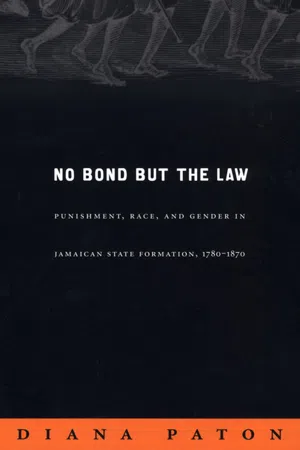
No Bond but the Law reveals the longstanding and intimate relationship between state formation and private punishment. The construction of a dense, state-organized system of prisons began not with emancipation but at the peak of slave-based wealth in Jamaica, in the 1780s. Jamaica provided the paradigmatic case for British observers imagining and evaluating the emancipation process. Paton's analysis moves between imperial processes on the one hand and Jamaican specificities on the other, within a framework comparing developments regarding punishment in Jamaica with those in the U.S. South and elsewhere. Emphasizing the gendered nature of penal policy and practice throughout the emancipation period, Paton is attentive to the ways in which the actions of ordinary Jamaicans and, in particular, of women prisoners, shaped state decisions.
eBook - PDF
No Bond but the Law
Punishment, Race, and Gender in Jamaican State Formation, 1780–1870
- 309 pages
- English
- PDF
- Available on iOS & Android
eBook - PDF
No Bond but the Law
Punishment, Race, and Gender in Jamaican State Formation, 1780–1870
About this book
Investigating the cultural, social, and political histories of punishment during ninety years surrounding the 1838 abolition of slavery in Jamaica, Diana Paton challenges standard historiographies of slavery and discipline. The abolition of slavery in Jamaica, as elsewhere, entailed the termination of slaveholders' legal right to use violence—which they defined as "punishment"—against those they had held as slaves. Paton argues that, while slave emancipation involved major changes in the organization and representation of punishment, there was no straightforward transition from corporal punishment to the prison or from privately inflicted to state-controlled punishment. Contesting the dichotomous understanding of pre-modern and modern modes of power that currently dominates the historiography of punishment, she offers critical readings of influential theories of power and resistance, including those of Michel Foucault, Pierre Bourdieu, and Ranajit Guha.
Information
Publisher
Duke University Press BooksYear
2004Print ISBN
9780822333982
9780822334019
eBook ISBN
9780822386148
Topic
StoriaTable of contents
- Contents
- Illustrations
- Acknowledgments
- Introduction
- ONE Prison and Plantation
- TWO Planters, Magistrates, and Apprentices
- THREE The Treadmill and the Whip
- FOUR Penality and Politics in a "Free" Society
- FIVE Justice and the Jamaican People
- Conclusion
- Notes
- Bibliography
- Index
Trusted by 375,005 students
Access to over 1.5 million titles for a fair monthly price.
Study more efficiently using our study tools.
Frequently asked questions
Yes, you can cancel anytime from the Subscription tab in your account settings on the Perlego website. Your subscription will stay active until the end of your current billing period. Learn how to cancel your subscription
No, books cannot be downloaded as external files, such as PDFs, for use outside of Perlego. However, you can download books within the Perlego app for offline reading on mobile or tablet. Learn how to download books offline
Perlego offers two plans: Essential and Complete
- Essential is ideal for learners and professionals who enjoy exploring a wide range of subjects. Access the Essential Library with 800,000+ trusted titles and best-sellers across business, personal growth, and the humanities. Includes unlimited reading time and Standard Read Aloud voice.
- Complete: Perfect for advanced learners and researchers needing full, unrestricted access. Unlock 1.5M+ books across hundreds of subjects, including academic and specialized titles. The Complete Plan also includes advanced features like Premium Read Aloud and Research Assistant.
We are an online textbook subscription service, where you can get access to an entire online library for less than the price of a single book per month. With over 1.5 million books across 990+ topics, we’ve got you covered! Learn about our mission
Look out for the read-aloud symbol on your next book to see if you can listen to it. The read-aloud tool reads text aloud for you, highlighting the text as it is being read. You can pause it, speed it up and slow it down. Learn more about Read Aloud
Yes! You can use the Perlego app on both iOS and Android devices to read anytime, anywhere — even offline. Perfect for commutes or when you’re on the go.
Please note we cannot support devices running on iOS 13 and Android 7 or earlier. Learn more about using the app
Please note we cannot support devices running on iOS 13 and Android 7 or earlier. Learn more about using the app
Yes, you can access No Bond but the Law by Diana Paton, Inderpal Grewal, Caren Kaplan, Robyn Wiegman, Inderpal Grewal,Caren Kaplan,Robyn Wiegman in PDF and/or ePUB format, as well as other popular books in Storia & Storia dell'America Latina e dei Caraibi. We have over 1.5 million books available in our catalogue for you to explore.