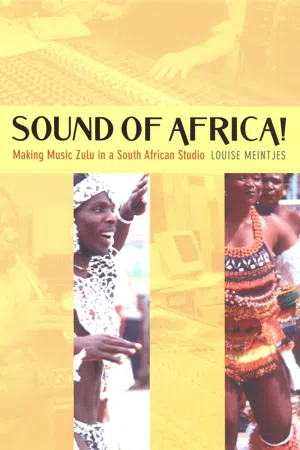
Focusing on the ways artists, producers, and sound engineers collaborate in the studio control room, Meintjes reveals not only how particular mbaqanga sounds are shaped technically, but also how egos and artistic sensibilities and race and ethnicity influence the mix. She analyzes how the turbulent identity politics surrounding Zulu ethnic nationalism impacted mbaqanga artists' decisions in and out of the studio. Conversely, she explores how the global consumption of Afropop and African images fed back into mbaqanga during the recording process. Meintjes is especially attentive to the ways the emotive qualities of timbre (sound quality or tone color) forge complex connections between aesthetic practices and political ideology. Vivid photos by the internationally renowned photographer TJ Lemon further dramatize Meintjes' ethnography.
- 361 pages
- English
- PDF
- Available on iOS & Android
eBook - PDF
About this book
Boosting the bass guitar, blending the vocals, overdubbing percussion while fretting over shoot-outs in the street. Grumbling about a producer, teasing a white engineer, challenging an artist to feel his African beat. Sound of Africa! is a riveting account of the production of a mbaqanga album in a state-of-the-art recording studio in Johannesburg. Made popular internationally by Mahlathini and the Mahotella Queens, mbaqanga's distinctive style features a bass solo voice and soaring harmonies of a female frontline over electric guitar, bass, keyboard, and drumset. Louise Meintjes chronicles the recording and mixing of an album by Izintombi Zesimanje, historically the rival group of the Mahotella Queens. Set in the early 1990s during South Africa's tumultuous transition from apartheid to democratic rule, Sound of Africa! offers a rare portrait of the music recording process. It tracks the nuanced interplay among South African state controls, the music industry's transnational drive, and the mbaqanga artists' struggles for political, professional, and personal voice.
Information
Publisher
Duke University Press BooksYear
2003Print ISBN
9780822330141
9780822330271
eBook ISBN
9780822384632
Subtopic
PopmusikTable of contents
- Contents
- Illustrations
- Notes to the Reader
- Acknowledgments
- Demo Tape: About Sound of Africa!
- Cut 1: Mbaqanga
- Cut 2: The Recording Studio as Fetish
- Cut 3: Producing Liveness
- Cut 4: Sounding Figures
- Cut 5: Performing Zuluness
- Cut 6: Imagining Overseas
- A Final Mix: Mediating Difference
- Print-Through
- Notes
- Glossary
- Bibliography
- Discography
- Index
Trusted by 375,005 students
Access to over 1.5 million titles for a fair monthly price.
Study more efficiently using our study tools.
Frequently asked questions
Yes, you can cancel anytime from the Subscription tab in your account settings on the Perlego website. Your subscription will stay active until the end of your current billing period. Learn how to cancel your subscription
No, books cannot be downloaded as external files, such as PDFs, for use outside of Perlego. However, you can download books within the Perlego app for offline reading on mobile or tablet. Learn how to download books offline
Perlego offers two plans: Essential and Complete
- Essential is ideal for learners and professionals who enjoy exploring a wide range of subjects. Access the Essential Library with 800,000+ trusted titles and best-sellers across business, personal growth, and the humanities. Includes unlimited reading time and Standard Read Aloud voice.
- Complete: Perfect for advanced learners and researchers needing full, unrestricted access. Unlock 1.5M+ books across hundreds of subjects, including academic and specialized titles. The Complete Plan also includes advanced features like Premium Read Aloud and Research Assistant.
We are an online textbook subscription service, where you can get access to an entire online library for less than the price of a single book per month. With over 1.5 million books across 990+ topics, we’ve got you covered! Learn about our mission
Look out for the read-aloud symbol on your next book to see if you can listen to it. The read-aloud tool reads text aloud for you, highlighting the text as it is being read. You can pause it, speed it up and slow it down. Learn more about Read Aloud
Yes! You can use the Perlego app on both iOS and Android devices to read anytime, anywhere — even offline. Perfect for commutes or when you’re on the go.
Please note we cannot support devices running on iOS 13 and Android 7 or earlier. Learn more about using the app
Please note we cannot support devices running on iOS 13 and Android 7 or earlier. Learn more about using the app
Yes, you can access Sound of Africa! by Louise Meintjes in PDF and/or ePUB format, as well as other popular books in Medien & darstellende Kunst & Popmusik. We have over 1.5 million books available in our catalogue for you to explore.