Incorporating a nuanced understanding of visual culture into his analysis, Overmyer-Velázquez shows how ideas of modernity figured in Oaxacans' ideologies of class, race, gender, sexuality, and religion and how they were expressed in Oaxaca City's streets, plazas, buildings, newspapers, and public rituals. He pays particular attention to the roles of national and regional elites, the Catholic church, and popular groups—such as Oaxaca City's madams and prostitutes—in shaping the discourses and practices of modernity. At the same time, he illuminates the dynamic interplay between these groups. Ultimately, this well-illustrated history provides insight into provincial life in pre-Revolutionary Mexico and challenges any easy distinctions between the center and the periphery or modernity and tradition.
eBook - PDF
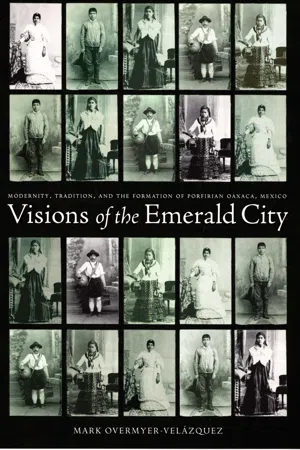
Visions of the Emerald City
Modernity, Tradition, and the Formation of Porfirian Oaxaca, Mexico
- 249 pages
- English
- PDF
- Available on iOS & Android
eBook - PDF
Visions of the Emerald City
Modernity, Tradition, and the Formation of Porfirian Oaxaca, Mexico
About this book
Visions of the Emerald City is an absorbing historical analysis of how Mexicans living in Oaxaca City experienced "modernity" during the lengthy "Order and Progress" dictatorship of Porfirio Díaz (1876–1911). Renowned as the Emerald City (for its many buildings made of green cantera stone), Oaxaca City was not only the economic, political, and cultural capital of the state of Oaxaca but also a vital commercial hub for all of southern Mexico. As such, it was a showcase for many of Díaz's modernizing and state-building projects. Drawing on in-depth research in archives in Oaxaca, Mexico City, and the United States, Mark Overmyer-Velázquez describes how Oaxacans, both elites and commoners, crafted and manipulated practices of tradition and modernity to define themselves and their city as integral parts of a modern Mexico.
Information
Publisher
Duke University Press BooksYear
2006Print ISBN
9780822337904
9780822337775
eBook ISBN
9780822387886
Table of contents
- Contents
- Illustrations and Tables
- Preface
- Introduction: Writing the Emerald City
- 1. La Vallistocracia: The Formation of Oaxaca’s Ruling Class
- 2. The Legible City: Constructed, Symbolic, and Disciplined Spaces
- 3. ‘‘A New Political Religious Order’’: Church, State, and Workers
- 4. ‘‘A Necessary Evil’’: Regulating Public Space and Public Women
- 5. Portraits of a Lady: Visions of Modernity
- Conclusions: The Consequences of Modernity
- Appendix Articles Cited from the 1857 Constitution
- Notes
- Bibliography
- Index
Trusted by 375,005 students
Access to over 1.5 million titles for a fair monthly price.
Study more efficiently using our study tools.
Frequently asked questions
Yes, you can cancel anytime from the Subscription tab in your account settings on the Perlego website. Your subscription will stay active until the end of your current billing period. Learn how to cancel your subscription
No, books cannot be downloaded as external files, such as PDFs, for use outside of Perlego. However, you can download books within the Perlego app for offline reading on mobile or tablet. Learn how to download books offline
Perlego offers two plans: Essential and Complete
- Essential is ideal for learners and professionals who enjoy exploring a wide range of subjects. Access the Essential Library with 800,000+ trusted titles and best-sellers across business, personal growth, and the humanities. Includes unlimited reading time and Standard Read Aloud voice.
- Complete: Perfect for advanced learners and researchers needing full, unrestricted access. Unlock 1.5M+ books across hundreds of subjects, including academic and specialized titles. The Complete Plan also includes advanced features like Premium Read Aloud and Research Assistant.
We are an online textbook subscription service, where you can get access to an entire online library for less than the price of a single book per month. With over 1.5 million books across 990+ topics, we’ve got you covered! Learn about our mission
Look out for the read-aloud symbol on your next book to see if you can listen to it. The read-aloud tool reads text aloud for you, highlighting the text as it is being read. You can pause it, speed it up and slow it down. Learn more about Read Aloud
Yes! You can use the Perlego app on both iOS and Android devices to read anytime, anywhere — even offline. Perfect for commutes or when you’re on the go.
Please note we cannot support devices running on iOS 13 and Android 7 or earlier. Learn more about using the app
Please note we cannot support devices running on iOS 13 and Android 7 or earlier. Learn more about using the app
Yes, you can access Visions of the Emerald City by Mark Overmyer-Velazquez in PDF and/or ePUB format, as well as other popular books in History & Mexican History. We have over 1.5 million books available in our catalogue for you to explore.