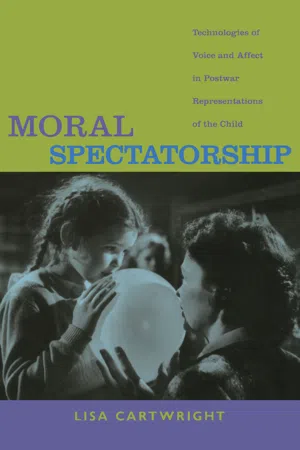
Moral Spectatorship
eBook - PDF

Moral Spectatorship

Technologies of Voice and Affect in Postwar Representations of the Child

  1. English
  2. PDF
  3. Available on iOS & Android
eBook - PDF

Moral Spectatorship

Technologies of Voice and Affect in Postwar Representations of the Child

About this book

Why were theories of affect, intersubjectivity, and object relations bypassed in favor of a Lacanian linguistically oriented psychoanalysis in feminist film theory in the 1980s and 1990s? In Moral Spectatorship, Lisa Cartwright rethinks the politics of spectatorship in film studies. Returning to impasses reached in late-twentieth-century psychoanalytic film theory, she focuses attention on theories of affect and object relations seldom addressed during that period. Cartwright offers a new theory of spectatorship and the human subject that takes into account intersubjective and affective relationships and technologies facilitating human agency. Seeking to expand concepts of representation beyond the visual, she develops her theory through interpretations of two contexts in which adult caregivers help bring children to voice. She considers several social-problem melodramas about deaf and nonverbal girls and young women, including Johnny Belinda, The Miracle Worker, and Children of a Lesser God. Cartwright also analyzes the controversies surrounding facilitated communication, a technological practice in which caregivers help children with communication disorders achieve "voice" through writing facilitated by computers. This practice has inspired contempt among professionals and lay people who charge that the facilitator can manipulate the child's speech.

For more than two decades, film theory has been dominated by a model of identification tacitly based on the idea of feeling what the other feels or of imagining oneself to be the other. Building on the theories of affect and identification developed by André Green, Melanie Klein, Donald W. Winnicott, and Silvan Tomkins, Cartwright develops a model of spectatorship that takes into account and provides a way of critically analyzing the dynamics of a different kind of identification, one that is empathetic and highly intersubjective.

Frequently asked questions

Yes, you can cancel anytime from the Subscription tab in your account settings on the Perlego website. Your subscription will stay active until the end of your current billing period. Learn how to cancel your subscription.
No, books cannot be downloaded as external files, such as PDFs, for use outside of Perlego. However, you can download books within the Perlego app for offline reading on mobile or tablet. Learn more here.
Perlego offers two plans: Essential and Complete
  • Essential is ideal for learners and professionals who enjoy exploring a wide range of subjects. Access the Essential Library with 800,000+ trusted titles and best-sellers across business, personal growth, and the humanities. Includes unlimited reading time and Standard Read Aloud voice.
  • Complete: Perfect for advanced learners and researchers needing full, unrestricted access. Unlock 1.4M+ books across hundreds of subjects, including academic and specialized titles. The Complete Plan also includes advanced features like Premium Read Aloud and Research Assistant.
Both plans are available with monthly, semester, or annual billing cycles.
We are an online textbook subscription service, where you can get access to an entire online library for less than the price of a single book per month. With over 1 million books across 1000+ topics, we’ve got you covered! Learn more here.
Look out for the read-aloud symbol on your next book to see if you can listen to it. The read-aloud tool reads text aloud for you, highlighting the text as it is being read. You can pause it, speed it up and slow it down. Learn more here.
Yes! You can use the Perlego app on both iOS or Android devices to read anytime, anywhere — even offline. Perfect for commutes or when you’re on the go.
Please note we cannot support devices running on iOS 13 and Android 7 or earlier. Learn more about using the app.
Yes, you can access Moral Spectatorship by Lisa Cartwright in PDF and/or ePUB format, as well as other popular books in Media & Performing Arts & Film History & Criticism. We have over one million books available in our catalogue for you to explore.

Table of contents

  1. Contents
  2. Acknowledgments
  3. Introduction: Spectatorship, Affect, and Representation
  4. Chapter 1: Moral Spectatorship: Rethinking Identification in Film Theory
  5. Chapter 2: The (Deaf) Woman’s Film and the Quiet Revolution in Film Sound: On Projection, Incorporation, and Voice
  6. Chapter 3: “A Child Is Being Beaten”: Disorders of Authorship, Agency, and Affect in Facilitated Communication
  7. Conclusion: On Empathy and Moral Spectatorship
  8. Notes
  9. References
  10. Index