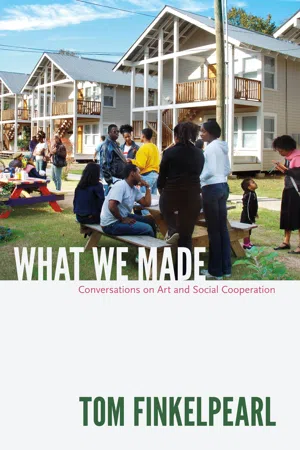
What We Made
eBook - PDF

What We Made

Conversations on Art and Social Cooperation

  1. English
  2. PDF
  3. Available on iOS & Android
eBook - PDF

What We Made

Conversations on Art and Social Cooperation

About this book

In What We Made, Tom Finkelpearl examines the activist, participatory, coauthored aesthetic experiences being created in contemporary art. He suggests social cooperation as a meaningful way to think about this work and provides a framework for understanding its emergence and acceptance. In a series of fifteen conversations, artists comment on their experiences working cooperatively, joined at times by colleagues from related fields, including social policy, architecture, art history, urban planning, and new media. Issues discussed include the experiences of working in public and of working with museums and libraries, opportunities for social change, the lines between education and art, spirituality, collaborative opportunities made available by new media, and the elusive criteria for evaluating cooperative art. Finkelpearl engages the art historians Grant Kester and Claire Bishop in conversation on the challenges of writing critically about this work and the aesthetic status of the dialogical encounter. He also interviews the often overlooked co-creators of cooperative art, "expert participants" who have worked with artists. In his conclusion, Finkelpearl argues that pragmatism offers a useful critical platform for understanding the experiential nature of social cooperation, and he brings pragmatism to bear in a discussion of Houston's Project Row Houses.

Interviewees. Naomi Beckwith, Claire Bishop, Tania Bruguera, Brett Cook, Teddy Cruz, Jay Dykeman, Wendy Ewald, Sondra Farganis, Harrell Fletcher, David Henry, Gregg Horowitz, Grant Kester, Mierle Laderman Ukeles, Pedro Lasch, Rick Lowe, Daniel Martinez, Lee Mingwei, Jonah Peretti, Ernesto Pujol, Evan Roth, Ethan Seltzer, and Mark Stern

Frequently asked questions

Yes, you can cancel anytime from the Subscription tab in your account settings on the Perlego website. Your subscription will stay active until the end of your current billing period. Learn how to cancel your subscription.
No, books cannot be downloaded as external files, such as PDFs, for use outside of Perlego. However, you can download books within the Perlego app for offline reading on mobile or tablet. Learn more here.
Perlego offers two plans: Essential and Complete
  • Essential is ideal for learners and professionals who enjoy exploring a wide range of subjects. Access the Essential Library with 800,000+ trusted titles and best-sellers across business, personal growth, and the humanities. Includes unlimited reading time and Standard Read Aloud voice.
  • Complete: Perfect for advanced learners and researchers needing full, unrestricted access. Unlock 1.4M+ books across hundreds of subjects, including academic and specialized titles. The Complete Plan also includes advanced features like Premium Read Aloud and Research Assistant.
Both plans are available with monthly, semester, or annual billing cycles.
We are an online textbook subscription service, where you can get access to an entire online library for less than the price of a single book per month. With over 1 million books across 1000+ topics, we’ve got you covered! Learn more here.
Look out for the read-aloud symbol on your next book to see if you can listen to it. The read-aloud tool reads text aloud for you, highlighting the text as it is being read. You can pause it, speed it up and slow it down. Learn more here.
Yes! You can use the Perlego app on both iOS or Android devices to read anytime, anywhere — even offline. Perfect for commutes or when you’re on the go.
Please note we cannot support devices running on iOS 13 and Android 7 or earlier. Learn more about using the app.
Yes, you can access What We Made by Tom Finkelpearl in PDF and/or ePUB format, as well as other popular books in Art & Art General. We have over one million books available in our catalogue for you to explore.

Table of contents

  1. Preface
  2. 1. Introduction: The Art of Social Cooperation: An American Framework
  3. 2. Cooperation Goes Public
  4. 3. Museum, Education, Cooperation
  5. 4. Overview
  6. 5. Social Vision and a Cooperative Community
  7. 6. Participation, Planning, and a Cooperative Film
  8. 7. Education Art
  9. 8. A Political Alphabet
  10. 9. Crossing Borders
  11. 10. Spirituality and Cooperation
  12. 11. Interactive Internet Communication
  13. Conclusion: Pragmatism and Social Cooperation
  14. Notes
  15. Bibliography
  16. Index