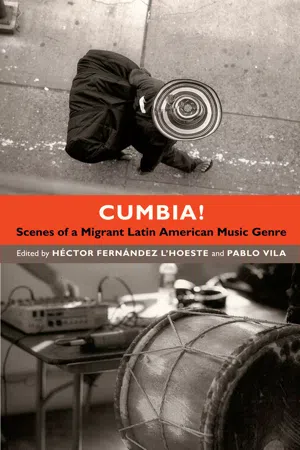
Cumbia!
eBook - PDF

Cumbia!

Scenes of a Migrant Latin American Music Genre

  1. English
  2. PDF
  3. Available on iOS & Android
eBook - PDF

Cumbia!

Scenes of a Migrant Latin American Music Genre

About this book

Cumbia is a musical form that originated in northern Colombia and then spread throughout Latin America and wherever Latin Americans travel and settle. It has become one of the most popular musical genre in the Americas. Its popularity is largely due to its stylistic flexibility. Cumbia absorbs and mixes with the local musical styles it encounters. Known for its appeal to workers, the music takes on different styles and meanings from place to place, and even, as the contributors to this collection show, from person to person. Cumbia is a different music among the working classes of northern Mexico, Latin American immigrants in New York City, Andean migrants to Lima, and upper-class Colombians, who now see the music that they once disdained as a source of national prestige. The contributors to this collection look at particular manifestations of cumbia through their disciplinary lenses of musicology, sociology, history, anthropology, linguistics, and literary criticism. Taken together, their essays highlight how intersecting forms of identity—such as nation, region, class, race, ethnicity, and gender—are negotiated through interaction with the music.

Contributors
. Cristian Alarcón, Jorge Arévalo Mateus, Leonardo D'Amico, Héctor Fernández L'Hoeste, Alejandro L. Madrid, Kathryn Metz, José Juan Olvera Gudiño, Cathy Ragland, Pablo Semán, Joshua Tucker, Matthew J. Van Hoose, Pablo Vila

Frequently asked questions

Yes, you can cancel anytime from the Subscription tab in your account settings on the Perlego website. Your subscription will stay active until the end of your current billing period. Learn how to cancel your subscription.
No, books cannot be downloaded as external files, such as PDFs, for use outside of Perlego. However, you can download books within the Perlego app for offline reading on mobile or tablet. Learn more here.
Perlego offers two plans: Essential and Complete
  • Essential is ideal for learners and professionals who enjoy exploring a wide range of subjects. Access the Essential Library with 800,000+ trusted titles and best-sellers across business, personal growth, and the humanities. Includes unlimited reading time and Standard Read Aloud voice.
  • Complete: Perfect for advanced learners and researchers needing full, unrestricted access. Unlock 1.4M+ books across hundreds of subjects, including academic and specialized titles. The Complete Plan also includes advanced features like Premium Read Aloud and Research Assistant.
Both plans are available with monthly, semester, or annual billing cycles.
We are an online textbook subscription service, where you can get access to an entire online library for less than the price of a single book per month. With over 1 million books across 1000+ topics, we’ve got you covered! Learn more here.
Look out for the read-aloud symbol on your next book to see if you can listen to it. The read-aloud tool reads text aloud for you, highlighting the text as it is being read. You can pause it, speed it up and slow it down. Learn more here.
Yes! You can use the Perlego app on both iOS or Android devices to read anytime, anywhere — even offline. Perfect for commutes or when you’re on the go.
Please note we cannot support devices running on iOS 13 and Android 7 or earlier. Learn more about using the app.
Yes, you can access Cumbia! by Héctor Fernández L'Hoeste, Pablo Vila, Héctor Fernández L'Hoeste,Pablo Vila in PDF and/or ePUB format, as well as other popular books in Media & Performing Arts & Latin American & Caribbean History. We have over one million books available in our catalogue for you to explore.

Table of contents

  1. Contents
  2. Acknowledgments
  3. Introduction, Héctor Fernández L’Hoeste and Pablo Vila
  4. Chapter 1. Cumbia Music in Colombia: Origins, Transformations, and Evolution of a Coastal Music Genre / Leonardo D’Amico
  5. Chapter 2. ¿Pa’ dónde vas Marioneta? ¿Pa’ dónde va la gaita? La Cumbiamba Eneyé Returns to San Jacinto / Jorge Arévalo Mateus with Martín Vejarano
  6. Chapter 3. Cumbia in Mexico’s Northeastern Region / José Juan Olvera Gudiño
  7. Chapter 4. Rigo Tovar, Cumbia, and the Transnational Grupero Boom / Alejandro L. Madrid
  8. Chapter 5. Communicating the Collective Imagination: The Sociospatial World of the Mexican Sonidero in Puebla, New York, and New Jersey / Cathy Ragland
  9. Chapter 6. From The World of the Poor to the Beaches of Eisha: Chicha, Cumbia, and the Search for a Popular Subject in Peru / Joshua Tucker
  10. Chapter 7. Pandillar in the Jungle: Regionalism and Tecno-cumbiain Amazonian Peru / Kathryn Metz
  11. Chapter 8. Gender Tensions in Cumbia Villera’s Lyrics / Pablo Semán and Pablo Vila
  12. Chapter 9. Feliz, feliz / Cristian Alarcón
  13. Chapter 10. El “Tú” Tropical, el “Vos” Villero, and Places in Between: Language, Ideology, Music, and the Spatialization of Differencein Uruguayan Tropical Music / Matthew J. Van Hoose
  14. Chapter 11. On Music and Colombianness: Toward a Critique of the History of Cumbia / Héctor Fernández L’Hoeste
  15. References
  16. Contributors
  17. Index