Drawing on these documents as well as immigration case files, legislative materials, and transcripts of interviews and court proceedings, Lau reveals immigration as an interactive process. Chinese immigrants and their U.S. families were subject to regulation and surveillance, but they also manipulated and thwarted those regulations, forcing the U.S. government to adapt its practices and policies. Lau points out that the Exclusion Acts and the pseudo-familial structures that emerged in response have had lasting effects on Chinese American identity. She concludes with a look at exclusion's legacy, including the Confession Program of the 1960s that coerced people into divulging the names of paper family members and efforts made by Chinese American communities to recover their lost family histories.
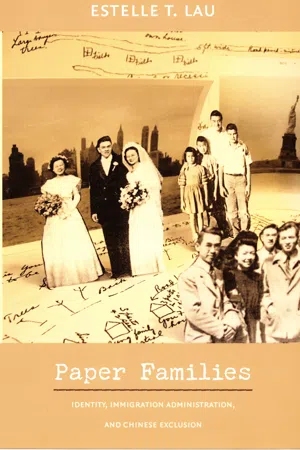
eBook - PDF
Paper Families
Identity, Immigration Administration, and Chinese Exclusion
- 227 pages
- English
- PDF
- Available on iOS & Android
eBook - PDF
Paper Families
Identity, Immigration Administration, and Chinese Exclusion
About this book
The Chinese Exclusion Act of 1882 made the Chinese the first immigrant group officially excluded from the United States. In Paper Families, Estelle T. Lau demonstrates how exclusion affected Chinese American communities and initiated the development of restrictive U.S. immigration policies and practices. Through the enforcement of the Exclusion Act and subsequent legislation, the U.S. immigration service developed new forms of record keeping and identification practices. Meanwhile, Chinese Americans took advantage of the system's loophole: children of U.S. citizens were granted automatic eligibility for immigration. The result was an elaborate system of "paper families," in which U.S. citizens of Chinese descent claimed fictive, or "paper," children who could then use their kinship status as a basis for entry into the United States. This subterfuge necessitated the creation of "crib sheets" outlining genealogies and providing village maps and other information that could be used during immigration processing.
Information
Publisher
Duke University Press BooksYear
2007Print ISBN
9780822337478
9780822337355
eBook ISBN
9780822388319
Table of contents
- Contents
- Acknowledgments
- Introduction: Identity and Exclusion
- 1. Legislating Exclusion
- 2. Challenges to Exclusion
- 3. Entry Despite Exclusion
- 4. Guardians of the Gate
- 5. Legacies
- Notes
- Bibliography
- Index
Trusted by 375,005 students
Access to over 1.5 million titles for a fair monthly price.
Study more efficiently using our study tools.
Frequently asked questions
Yes, you can cancel anytime from the Subscription tab in your account settings on the Perlego website. Your subscription will stay active until the end of your current billing period. Learn how to cancel your subscription
No, books cannot be downloaded as external files, such as PDFs, for use outside of Perlego. However, you can download books within the Perlego app for offline reading on mobile or tablet. Learn how to download books offline
Perlego offers two plans: Essential and Complete
- Essential is ideal for learners and professionals who enjoy exploring a wide range of subjects. Access the Essential Library with 800,000+ trusted titles and best-sellers across business, personal growth, and the humanities. Includes unlimited reading time and Standard Read Aloud voice.
- Complete: Perfect for advanced learners and researchers needing full, unrestricted access. Unlock 1.5M+ books across hundreds of subjects, including academic and specialized titles. The Complete Plan also includes advanced features like Premium Read Aloud and Research Assistant.
We are an online textbook subscription service, where you can get access to an entire online library for less than the price of a single book per month. With over 1.5 million books across 990+ topics, we’ve got you covered! Learn about our mission
Look out for the read-aloud symbol on your next book to see if you can listen to it. The read-aloud tool reads text aloud for you, highlighting the text as it is being read. You can pause it, speed it up and slow it down. Learn more about Read Aloud
Yes! You can use the Perlego app on both iOS and Android devices to read anytime, anywhere — even offline. Perfect for commutes or when you’re on the go.
Please note we cannot support devices running on iOS 13 and Android 7 or earlier. Learn more about using the app
Please note we cannot support devices running on iOS 13 and Android 7 or earlier. Learn more about using the app
Yes, you can access Paper Families by Estelle T. Lau, Julia Adams, George Steinmetz, Julia Adams,George Steinmetz in PDF and/or ePUB format, as well as other popular books in History & World History. We have over 1.5 million books available in our catalogue for you to explore.