More than forty years after the major victories of the civil rights movement, African Americans have a vexed relation to the civic myth of the United States as the land of equal opportunity and justice for all. In Sites of Slavery Salamishah Tillet examines how contemporary African American artists and intellectuals—including Annette Gordon-Reed, Barbara Chase-Riboud, Bill T. Jones, Carrie Mae Weems, and Kara Walker—turn to the subject of slavery in order to understand and challenge the ongoing exclusion of African Americans from the founding narratives of the United States. She explains how they reconstruct "sites of slavery"—contested figures, events, memories, locations, and experiences related to chattel slavery—such as the allegations of a sexual relationship between Thomas Jefferson and Sally Hemings, the characters Uncle Tom and Topsy in Harriet Beecher Stowe's novel Uncle Tom's Cabin, African American tourism to slave forts in Ghana and Senegal, and the legal challenges posed by reparations movements. By claiming and recasting these sites of slavery, contemporary artists and intellectuals provide slaves with an interiority and subjectivity denied them in American history, register the civic estrangement experienced by African Americans in the post–civil rights era, and envision a more fully realized American democracy.
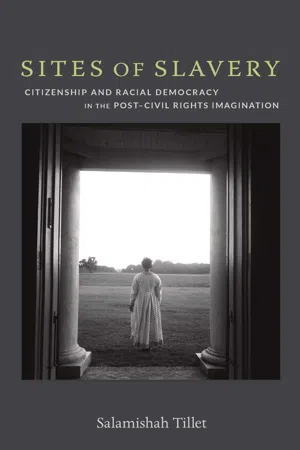
eBook - PDF
Sites of Slavery
Citizenship and Racial Democracy in the Post–Civil Rights Imagination
- 245 pages
- English
- PDF
- Available on iOS & Android
eBook - PDF
Sites of Slavery
Citizenship and Racial Democracy in the Post–Civil Rights Imagination
About this book
Information
Publisher
Duke University Press BooksYear
2012Print ISBN
9780822352617
9780822352426
eBook ISBN
9780822391869
Table of contents
- Contents
- Acknowledgments
- Introduction. Peculiar Citizenships
- One. Freedom in a Bondsmaid’s Arms: Sally Hemings, Thomas Jefferson, and the Persistence of African American Memory
- Two. The Milder and More Amusing Phases of Slavery: Uncle Tom’s Cabin and Black Satire
- Three. A Race of Angels: (Trans)Nationalism, African American Tourism, and the Slave Forts
- Four. What Have We Done to Weigh So Little on Their Scale: Mnemonic Restitution and the Aesthetics of Racial Reparations
- Epilogue. The President’s House, Freedom, and Slavery in the Age of Obama
- Notes
- Bibliography
- Index
Trusted by 375,005 students
Access to over 1.5 million titles for a fair monthly price.
Study more efficiently using our study tools.
Frequently asked questions
Yes, you can cancel anytime from the Subscription tab in your account settings on the Perlego website. Your subscription will stay active until the end of your current billing period. Learn how to cancel your subscription
No, books cannot be downloaded as external files, such as PDFs, for use outside of Perlego. However, you can download books within the Perlego app for offline reading on mobile or tablet. Learn how to download books offline
Perlego offers two plans: Essential and Complete
- Essential is ideal for learners and professionals who enjoy exploring a wide range of subjects. Access the Essential Library with 800,000+ trusted titles and best-sellers across business, personal growth, and the humanities. Includes unlimited reading time and Standard Read Aloud voice.
- Complete: Perfect for advanced learners and researchers needing full, unrestricted access. Unlock 1.5M+ books across hundreds of subjects, including academic and specialized titles. The Complete Plan also includes advanced features like Premium Read Aloud and Research Assistant.
We are an online textbook subscription service, where you can get access to an entire online library for less than the price of a single book per month. With over 1.5 million books across 990+ topics, we’ve got you covered! Learn about our mission
Look out for the read-aloud symbol on your next book to see if you can listen to it. The read-aloud tool reads text aloud for you, highlighting the text as it is being read. You can pause it, speed it up and slow it down. Learn more about Read Aloud
Yes! You can use the Perlego app on both iOS and Android devices to read anytime, anywhere — even offline. Perfect for commutes or when you’re on the go.
Please note we cannot support devices running on iOS 13 and Android 7 or earlier. Learn more about using the app
Please note we cannot support devices running on iOS 13 and Android 7 or earlier. Learn more about using the app
Yes, you can access Sites of Slavery by Salamishah Tillet in PDF and/or ePUB format, as well as other popular books in Sozialwissenschaften & Nordamerikanische Literaturkritik. We have over 1.5 million books available in our catalogue for you to explore.