Combining ethnographic observation derived from her experience as a student and performer of South Indian music with close readings of archival materials, Weidman traces the emergence of this politics of voice through compelling analyses of the relationship between vocal sound and instrumental imitation, conventions of performance and staging, the status of women as performers, debates about language and music, and the relationship between oral tradition and technologies of printing and sound reproduction. Through her sustained exploration of the way "voice" is elaborated as a trope of modern subjectivity, national identity, and cultural authenticity, Weidman provides a model for thinking about the voice in anthropological and historical terms. In so doing, she shows that modernity is characterized as much by particular ideas about orality, aurality, and the voice as it is by regimes of visuality.
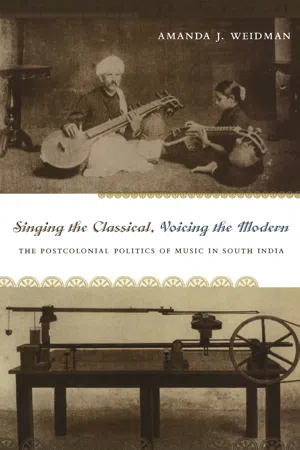
eBook - PDF
Singing the Classical, Voicing the Modern
The Postcolonial Politics of Music in South India
- 367 pages
- English
- PDF
- Available on iOS & Android
eBook - PDF
Singing the Classical, Voicing the Modern
The Postcolonial Politics of Music in South India
About this book
While Karnatic music, a form of Indian music based on the melodic principle of raga and time cycles called tala, is known today as South India's classical music, its status as "classical" is an early-twentieth-century construct, one that emerged in the crucible of colonial modernity, nationalist ideology, and South Indian regional politics. As Amanda J. Weidman demonstrates, in order for Karnatic music to be considered classical music, it needed to be modeled on Western classical music, with its system of notation, composers, compositions, conservatories, and concerts. At the same time, it needed to remain distinctively Indian. Weidman argues that these contradictory imperatives led to the emergence of a particular "politics of voice," in which the voice came to stand for authenticity and Indianness.
Information
Publisher
Duke University Press BooksYear
2006Print ISBN
9780822336204
9780822336310
eBook ISBN
9780822388050
Subtopic
MusicTable of contents
- Contents
- List of Illustrations
- Acknowledgments
- Note on Transliteration and Spelling
- Introduction
- 1. Gone Native?: Travels of the Violin in South India
- 2. From the Palace to the Street: Staging ‘‘Classical’’ Music
- 3. Gender and the Politics of Voice
- 4. Can the Subaltern Sing?: Music, Language, and the Politics of Voice
- 5. A Writing Lesson: Musicology and the Birth of the Composer
- 6. Fantastic Fidelities
- Afterword: Modernity and the Voice
- Notes
- Works Cited
- Index
Trusted by 375,005 students
Access to over 1.5 million titles for a fair monthly price.
Study more efficiently using our study tools.
Frequently asked questions
Yes, you can cancel anytime from the Subscription tab in your account settings on the Perlego website. Your subscription will stay active until the end of your current billing period. Learn how to cancel your subscription
No, books cannot be downloaded as external files, such as PDFs, for use outside of Perlego. However, you can download books within the Perlego app for offline reading on mobile or tablet. Learn how to download books offline
Perlego offers two plans: Essential and Complete
- Essential is ideal for learners and professionals who enjoy exploring a wide range of subjects. Access the Essential Library with 800,000+ trusted titles and best-sellers across business, personal growth, and the humanities. Includes unlimited reading time and Standard Read Aloud voice.
- Complete: Perfect for advanced learners and researchers needing full, unrestricted access. Unlock 1.5M+ books across hundreds of subjects, including academic and specialized titles. The Complete Plan also includes advanced features like Premium Read Aloud and Research Assistant.
We are an online textbook subscription service, where you can get access to an entire online library for less than the price of a single book per month. With over 1.5 million books across 990+ topics, we’ve got you covered! Learn about our mission
Look out for the read-aloud symbol on your next book to see if you can listen to it. The read-aloud tool reads text aloud for you, highlighting the text as it is being read. You can pause it, speed it up and slow it down. Learn more about Read Aloud
Yes! You can use the Perlego app on both iOS and Android devices to read anytime, anywhere — even offline. Perfect for commutes or when you’re on the go.
Please note we cannot support devices running on iOS 13 and Android 7 or earlier. Learn more about using the app
Please note we cannot support devices running on iOS 13 and Android 7 or earlier. Learn more about using the app
Yes, you can access Singing the Classical, Voicing the Modern by Amanda J. Weidman in PDF and/or ePUB format, as well as other popular books in Media & Performing Arts & Music. We have over 1.5 million books available in our catalogue for you to explore.