Adams draws on her observations and interviews conducted with artists, intellectuals, and bureaucrats involved in the production of Uzbekistan's national culture. These elites used globalized cultural forms such as Olympics-style spectacle to showcase local, national, and international aspects of official culture. While these state-sponsored extravaganzas were intended to be displays of Uzbekistan's ethnic and civic national identity, Adams found that cultural renewal in the decade after Uzbekistan's independence was not so much a rejection of Soviet power as it was a re-appropriation of Soviet methods of control and ideas about culture. The public sphere became more restricted than it had been in Soviet times, even as Soviet-era ideas about ethnic and national identity paved the way for Uzbekistan to join a more open global community.
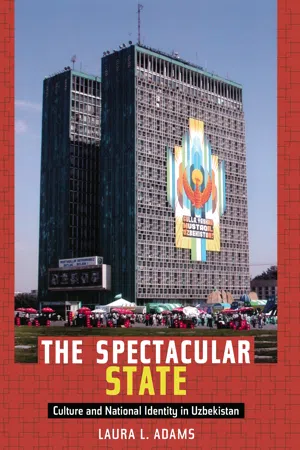
eBook - PDF
The Spectacular State
Culture and National Identity in Uzbekistan
- 255 pages
- English
- PDF
- Available on iOS & Android
eBook - PDF
About this book
Laura L. Adams offers unique insight into nation building in Central Asia during the post-Soviet era through an exploration of Uzbekistan's production of national culture in the 1990s. As she explains, after independence the Uzbek government maintained a monopoly over ideology, exploiting the remaining Soviet institutional and cultural legacies. The state expressed national identity through tightly controlled mass spectacles, including theatrical and musical performances. Adams focuses on these events, particularly the massive outdoor concerts the government staged on the two biggest national holidays, Navro'z, the spring equinox celebration, and Independence Day. Her analysis of the content, form, and production of these ceremonies shows how Uzbekistan's cultural and political elites engaged in a highly directed, largely successful program of nation building through culture.
Information
Publisher
Duke University Press BooksYear
2010Print ISBN
9780822346432
9780822346517
eBook ISBN
9780822392538
Topic
SozialwissenschaftenSubtopic
Zentralasiatische GeschichteTable of contents
- Contents
- Acknowledgments
- Introduction: The Politics of Culture in Uzbekistan 1991–2002
- 1. Mapping the Landscape of National Identity in Uzbekistan
- 2. Cultural Form: Globalization and the Spectacular State
- 3. Cultural Content and Postcolonial Civic Nationalism
- 4. Culture Production and Participation in the Spectacular State
- Conclusion: Spectacle and the Ideology of National Independence
- Notes
- Bibliography
- Index
Trusted by 375,005 students
Access to over 1.5 million titles for a fair monthly price.
Study more efficiently using our study tools.
Frequently asked questions
Yes, you can cancel anytime from the Subscription tab in your account settings on the Perlego website. Your subscription will stay active until the end of your current billing period. Learn how to cancel your subscription
No, books cannot be downloaded as external files, such as PDFs, for use outside of Perlego. However, you can download books within the Perlego app for offline reading on mobile or tablet. Learn how to download books offline
Perlego offers two plans: Essential and Complete
- Essential is ideal for learners and professionals who enjoy exploring a wide range of subjects. Access the Essential Library with 800,000+ trusted titles and best-sellers across business, personal growth, and the humanities. Includes unlimited reading time and Standard Read Aloud voice.
- Complete: Perfect for advanced learners and researchers needing full, unrestricted access. Unlock 1.5M+ books across hundreds of subjects, including academic and specialized titles. The Complete Plan also includes advanced features like Premium Read Aloud and Research Assistant.
We are an online textbook subscription service, where you can get access to an entire online library for less than the price of a single book per month. With over 1.5 million books across 990+ topics, we’ve got you covered! Learn about our mission
Look out for the read-aloud symbol on your next book to see if you can listen to it. The read-aloud tool reads text aloud for you, highlighting the text as it is being read. You can pause it, speed it up and slow it down. Learn more about Read Aloud
Yes! You can use the Perlego app on both iOS and Android devices to read anytime, anywhere — even offline. Perfect for commutes or when you’re on the go.
Please note we cannot support devices running on iOS 13 and Android 7 or earlier. Learn more about using the app
Please note we cannot support devices running on iOS 13 and Android 7 or earlier. Learn more about using the app
Yes, you can access The Spectacular State by Laura L. Adams,Laura L. Adams in PDF and/or ePUB format, as well as other popular books in Sozialwissenschaften & Zentralasiatische Geschichte. We have over 1.5 million books available in our catalogue for you to explore.