Based on extensive research in southern Africa with the Maloti-Drakensberg Transfrontier Conservation and Development Project, Büscher explains how the successful promotion of transfrontier conservation as a "win-win" solution happens not only in spite of troubling contradictions and problems, but indeed because of them. This is what he refers to as the "politics of neoliberal conservation," which receives its strength from effectively combining strategies of consensus, antipolitics, and marketing. Drawing on long-term, multilevel ethnographic research, Büscher argues that transfrontier conservation projects are not as concerned with on-the-ground development as they are purported to be. Instead, they are reframing environmental protection and sustainable development to fit an increasingly contradictory world order.
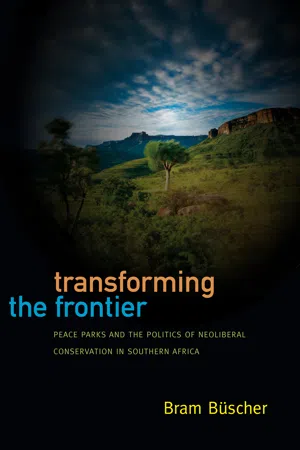
eBook - PDF
Transforming the Frontier
Peace Parks and the Politics of Neoliberal Conservation in Southern Africa
- 311 pages
- English
- PDF
- Available on iOS & Android
eBook - PDF
Transforming the Frontier
Peace Parks and the Politics of Neoliberal Conservation in Southern Africa
About this book
International peace parks—transnational conservation areas established and managed by two or more countries—have become a popular way of protecting biodiversity while promoting international cooperation and regional development. In Transforming the Frontier, Bram Büscher shows how cross-border conservation neatly reflects the neoliberal political economy in which it developed.
Information
Publisher
Duke University Press BooksYear
2013Print ISBN
9780822354208
9780822354048
eBook ISBN
9780822399087
Table of contents
- Contents
- Preface
- Introduction: Frontiers of Conservation
- Chapter One: Forging (Trans)frontier Spaces
- Chapter Two: Neoliberal Amplifications
- Chapter Three: Compressing Reality
- Chapter Four: Divergent Interpretations
- Chapter Five: Processing Politics
- Chapter Six: Images of an Intervention
- Chapter Seven: Neoliberal Alignments
- Conclusions
- Notes
- References
- Index
Trusted by 375,005 students
Access to over 1.5 million titles for a fair monthly price.
Study more efficiently using our study tools.
Frequently asked questions
Yes, you can cancel anytime from the Subscription tab in your account settings on the Perlego website. Your subscription will stay active until the end of your current billing period. Learn how to cancel your subscription
No, books cannot be downloaded as external files, such as PDFs, for use outside of Perlego. However, you can download books within the Perlego app for offline reading on mobile or tablet. Learn how to download books offline
Perlego offers two plans: Essential and Complete
- Essential is ideal for learners and professionals who enjoy exploring a wide range of subjects. Access the Essential Library with 800,000+ trusted titles and best-sellers across business, personal growth, and the humanities. Includes unlimited reading time and Standard Read Aloud voice.
- Complete: Perfect for advanced learners and researchers needing full, unrestricted access. Unlock 1.5M+ books across hundreds of subjects, including academic and specialized titles. The Complete Plan also includes advanced features like Premium Read Aloud and Research Assistant.
We are an online textbook subscription service, where you can get access to an entire online library for less than the price of a single book per month. With over 1.5 million books across 990+ topics, we’ve got you covered! Learn about our mission
Look out for the read-aloud symbol on your next book to see if you can listen to it. The read-aloud tool reads text aloud for you, highlighting the text as it is being read. You can pause it, speed it up and slow it down. Learn more about Read Aloud
Yes! You can use the Perlego app on both iOS and Android devices to read anytime, anywhere — even offline. Perfect for commutes or when you’re on the go.
Please note we cannot support devices running on iOS 13 and Android 7 or earlier. Learn more about using the app
Please note we cannot support devices running on iOS 13 and Android 7 or earlier. Learn more about using the app
Yes, you can access Transforming the Frontier by Bram Büscher in PDF and/or ePUB format, as well as other popular books in Social Sciences & African History. We have over 1.5 million books available in our catalogue for you to explore.