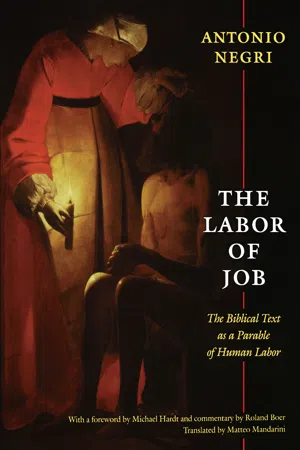
The Labor of Job was first published in Italy in 1990. Negri began writing it in the early 1980s, while he was a political prisoner in Italy, and it was the first book he completed during his exile in France (1983–97). As he writes in the preface, understanding suffering was for him in the early 1980s "an essential element of resistance. . . . It was the problem of liberation, in prison and in exile, from within the absoluteness of Power." Negri presents a Marxist interpretation of Job's story. He describes it as a parable of human labor, one that illustrates the impossibility of systems of measure, whether of divine justice (in Job's case) or the value of labor (in the case of late-twentieth-century Marxism). In the foreword, Michael Hardt elaborates on this interpretation. In his commentary, Roland Boer considers Negri's reading of the book of Job in relation to the Bible and biblical exegesis. The Labor of Job provides an intriguing and accessible entry into the thought of one of today's most important political philosophers.
eBook - PDF
The Labor of Job
The Biblical Text as a Parable of Human Labor
- 166 pages
- English
- PDF
- Available on iOS & Android
eBook - PDF
The Labor of Job
The Biblical Text as a Parable of Human Labor
About this book
In The Labor of Job, the renowned Marxist political philosopher Antonio Negri develops an unorthodox interpretation of the Old Testament book of Job, a canonical text of Judeo-Christian thought. In the biblical narrative, the pious Job is made to suffer for no apparent reason. The story revolves around his quest to understand why he must bear, and why God would allow, such misery. Conventional readings explain the tale as an affirmation of divine transcendence. When God finally speaks to Job, it is to assert his sovereignty and establish that it is not Job's place to question what God allows. In Negri's materialist reading, Job does not recognize God's transcendence. He denies it, and in so doing becomes a co-creator of himself and the world.
Information
Publisher
Duke University Press BooksYear
2009Print ISBN
9780822346340
9780822346227
eBook ISBN
9780822392019
Table of contents
- Contents
- Foreword - Creation beyond Measure
- Preface to the 2002 Edition
- Introduction
- One - The Difference of Job
- Two - Of the Absoluteness of the Contingent
- Three - The Adversary and the Avenger
- Four - The Chaos of Being
- Five - The Dispositif of the Messiah
- Six - The Constitution of Power
- Seven - Ethics as Creation
- Commentary - Negri, Job, and the Bible
- Bibliographical Appendix
- Index
Trusted by 375,005 students
Access to over 1.5 million titles for a fair monthly price.
Study more efficiently using our study tools.
Frequently asked questions
Yes, you can cancel anytime from the Subscription tab in your account settings on the Perlego website. Your subscription will stay active until the end of your current billing period. Learn how to cancel your subscription
No, books cannot be downloaded as external files, such as PDFs, for use outside of Perlego. However, you can download books within the Perlego app for offline reading on mobile or tablet. Learn how to download books offline
Perlego offers two plans: Essential and Complete
- Essential is ideal for learners and professionals who enjoy exploring a wide range of subjects. Access the Essential Library with 800,000+ trusted titles and best-sellers across business, personal growth, and the humanities. Includes unlimited reading time and Standard Read Aloud voice.
- Complete: Perfect for advanced learners and researchers needing full, unrestricted access. Unlock 1.5M+ books across hundreds of subjects, including academic and specialized titles. The Complete Plan also includes advanced features like Premium Read Aloud and Research Assistant.
We are an online textbook subscription service, where you can get access to an entire online library for less than the price of a single book per month. With over 1.5 million books across 990+ topics, we’ve got you covered! Learn about our mission
Look out for the read-aloud symbol on your next book to see if you can listen to it. The read-aloud tool reads text aloud for you, highlighting the text as it is being read. You can pause it, speed it up and slow it down. Learn more about Read Aloud
Yes! You can use the Perlego app on both iOS and Android devices to read anytime, anywhere — even offline. Perfect for commutes or when you’re on the go.
Please note we cannot support devices running on iOS 13 and Android 7 or earlier. Learn more about using the app
Please note we cannot support devices running on iOS 13 and Android 7 or earlier. Learn more about using the app
Yes, you can access The Labor of Job by Antonio Negri, Matteo Mandarini, Creston Davis, Philip Goodchild, Kenneth Surin, Matteo Mandarini,Creston Davis,Philip Goodchild,Kenneth Surin in PDF and/or ePUB format, as well as other popular books in Politics & International Relations & Communism, Post-Communism & Socialism. We have over 1.5 million books available in our catalogue for you to explore.