Turning to film, Mraz compares portrayals of the Mexican Revolution by Fernando de Fuentes to the later movies of Emilio Fernández and Gabriel Figueroa. He considers major stars of Golden Age cinema as gender archetypes for mexicanidad, juxtaposing the charros (hacienda cowboys) embodied by Pedro Infante, Pedro Armendáriz, and Jorge Negrete with the effacing women: the mother, Indian, and shrew as played by Sara García, Dolores del Río, and María Félix. Mraz also analyzes the leading comedians of the Mexican screen, representations of the 1968 student revolt, and depictions of Frida Kahlo in films made by Paul Leduc and Julie Taymor. Filled with more than fifty illustrations, Looking for Mexico is an exuberant plunge into Mexico's national identity, its visual culture, and the connections between the two.
- 360 pages
- English
- PDF
- Available on iOS & Android
eBook - PDF
About this book
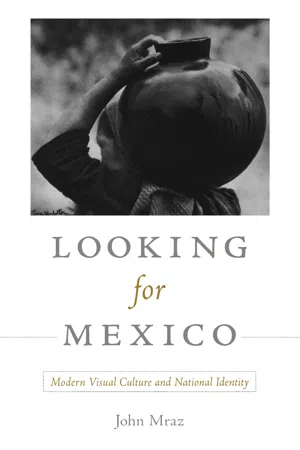
In Looking for Mexico, a leading historian of visual culture, John Mraz, provides a panoramic view of Mexico's modern visual culture from the U.S. invasion of 1847 to the present. Along the way, he illuminates the powerful role of photographs, films, illustrated magazines, and image-filled history books in the construction of national identity, showing how Mexicans have both made themselves and been made with the webs of significance spun by modern media. Central to Mraz's book is photography, which was distributed widely throughout Mexico in the form of cartes-de-visite, postcards, and illustrated magazines. Mraz analyzes the work of a broad range of photographers, including Guillermo Kahlo, Winfield Scott, Hugo Brehme, Agustín Víctor Casasola, Tina Modotti, Manuel Álvarez Bravo, Héctor García, Pedro Meyer, and the New Photojournalists. He also examines representations of Mexico's past in the country's influential picture histories: popular, large-format, multivolume series replete with thousands of photographs and an assortment of texts.
Information
Publisher
Duke University Press BooksYear
2009Print ISBN
9780822344438
9780822344292
eBook ISBN
9780822392200
Topic
HistoireSubtopic
Histoire du MexiqueTable of contents
- Contents
- Author's Note
- Acknowledgments
- Introduction
- One: War, Portraits, Mexican Types, and Porfirian Progress (1847-1910)
- Two: Revolution and Culture (1910-1940)
- Three: Cinema and Celebrities in the Golden Age
- Four: Illustrated Magazines, Photojournalism, and Historia grafica (1940-1968)
- Five: New Ocular Cultures and the Old Battle to Visualize the Past and Present (1968-2007)
- Notes
- Bibliography
- Index
Trusted by 375,005 students
Access to over 1.5 million titles for a fair monthly price.
Study more efficiently using our study tools.
Frequently asked questions
Yes, you can cancel anytime from the Subscription tab in your account settings on the Perlego website. Your subscription will stay active until the end of your current billing period. Learn how to cancel your subscription
No, books cannot be downloaded as external files, such as PDFs, for use outside of Perlego. However, you can download books within the Perlego app for offline reading on mobile or tablet. Learn how to download books offline
Perlego offers two plans: Essential and Complete
- Essential is ideal for learners and professionals who enjoy exploring a wide range of subjects. Access the Essential Library with 800,000+ trusted titles and best-sellers across business, personal growth, and the humanities. Includes unlimited reading time and Standard Read Aloud voice.
- Complete: Perfect for advanced learners and researchers needing full, unrestricted access. Unlock 1.5M+ books across hundreds of subjects, including academic and specialized titles. The Complete Plan also includes advanced features like Premium Read Aloud and Research Assistant.
We are an online textbook subscription service, where you can get access to an entire online library for less than the price of a single book per month. With over 1.5 million books across 990+ topics, we’ve got you covered! Learn about our mission
Look out for the read-aloud symbol on your next book to see if you can listen to it. The read-aloud tool reads text aloud for you, highlighting the text as it is being read. You can pause it, speed it up and slow it down. Learn more about Read Aloud
Yes! You can use the Perlego app on both iOS and Android devices to read anytime, anywhere — even offline. Perfect for commutes or when you’re on the go.
Please note we cannot support devices running on iOS 13 and Android 7 or earlier. Learn more about using the app
Please note we cannot support devices running on iOS 13 and Android 7 or earlier. Learn more about using the app
Yes, you can access Looking for Mexico by John Mraz in PDF and/or ePUB format, as well as other popular books in Histoire & Histoire du Mexique. We have over 1.5 million books available in our catalogue for you to explore.