Jain draws on interviews with artists, printers, publishers, and consumers as well as analyses of the prints themselves to trace the economies—of art, commerce, religion, and desire—within which calendar images and ideas about them are formulated. For Jain, an analysis of the bazaar, or vernacular commercial arena, is crucial to understanding not only the calendar art that circulates within the bazaar but also India's postcolonial modernity and the ways that its mass culture has developed in close connection with a religiously inflected nationalism. The bazaar is characterized by the coexistence of seemingly incompatible elements: bourgeois-liberal and neoliberal modernism on the one hand, and vernacular discourses and practices on the other. Jain argues that from the colonial era to the present, capitalist expansion has depended on the maintenance of these multiple coexisting realms: the sacred, the commercial, and the artistic; the official and the vernacular.
- 449 pages
- English
- PDF
- Available on iOS & Android
eBook - PDF
About this book
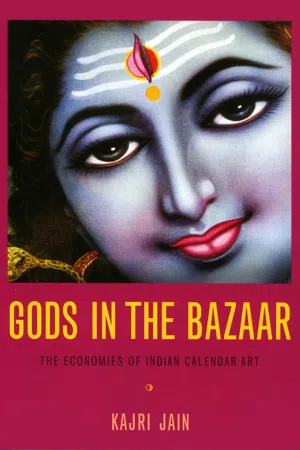
Gods in the Bazaar is a fascinating account of the printed images known in India as "calendar art" or "bazaar art," the color-saturated, mass-produced pictures often used on calendars and in advertisements, featuring deities and other religious themes as well as nationalist leaders, alluring women, movie stars, chubby babies, and landscapes. Calendar art appears in all manner of contexts in India: in chic elite living rooms, middle-class kitchens, urban slums, village huts; hung on walls, stuck on scooters and computers, propped up on machines, affixed to dashboards, tucked into wallets and lockets. In this beautifully illustrated book, Kajri Jain examines the power that calendar art wields in Indian mass culture, arguing that its meanings derive as much from the production and circulation of the images as from their visual features.
Information
Publisher
Duke University Press BooksYear
2007Print ISBN
9780822339267
9780822339069
eBook ISBN
9780822389736
Table of contents
- Contents
- Notes on Style
- Acknowledgments
- Introduction: Calendar Art as an Object of Knowledge
- Part 1: Genealogy
- Part 2: Economy
- Part 3: Efficacy
- Conclusion
- Notes
- Works Cited
- Index
Trusted by 375,005 students
Access to over 1.5 million titles for a fair monthly price.
Study more efficiently using our study tools.
Frequently asked questions
Yes, you can cancel anytime from the Subscription tab in your account settings on the Perlego website. Your subscription will stay active until the end of your current billing period. Learn how to cancel your subscription
No, books cannot be downloaded as external files, such as PDFs, for use outside of Perlego. However, you can download books within the Perlego app for offline reading on mobile or tablet. Learn how to download books offline
Perlego offers two plans: Essential and Complete
- Essential is ideal for learners and professionals who enjoy exploring a wide range of subjects. Access the Essential Library with 800,000+ trusted titles and best-sellers across business, personal growth, and the humanities. Includes unlimited reading time and Standard Read Aloud voice.
- Complete: Perfect for advanced learners and researchers needing full, unrestricted access. Unlock 1.5M+ books across hundreds of subjects, including academic and specialized titles. The Complete Plan also includes advanced features like Premium Read Aloud and Research Assistant.
We are an online textbook subscription service, where you can get access to an entire online library for less than the price of a single book per month. With over 1.5 million books across 990+ topics, we’ve got you covered! Learn about our mission
Look out for the read-aloud symbol on your next book to see if you can listen to it. The read-aloud tool reads text aloud for you, highlighting the text as it is being read. You can pause it, speed it up and slow it down. Learn more about Read Aloud
Yes! You can use the Perlego app on both iOS and Android devices to read anytime, anywhere — even offline. Perfect for commutes or when you’re on the go.
Please note we cannot support devices running on iOS 13 and Android 7 or earlier. Learn more about using the app
Please note we cannot support devices running on iOS 13 and Android 7 or earlier. Learn more about using the app
Yes, you can access Gods in the Bazaar by Kajri Jain, Nicholas Thomas in PDF and/or ePUB format, as well as other popular books in Social Sciences & Asian Art. We have over 1.5 million books available in our catalogue for you to explore.