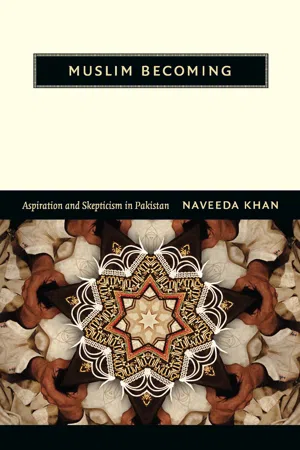
In Muslim Becoming, Naveeda Khan challenges the claim that Pakistan's relation to Islam is fragmented and problematic. Offering a radically different interpretation, Khan contends that Pakistan inherited an aspirational, always-becoming Islam, one with an open future and a tendency toward experimentation. For the individual, this aspirational tendency manifests in a continual striving to be a better Muslim. It is grounded in the thought of Muhammad Iqbal (1877–1938), the poet, philosopher, and politician considered the spiritual founder of Pakistan. Khan finds that Iqbal provided the philosophical basis for recasting Islam as an open religion with possible futures as yet unrealized, which he did in part through his engagement with the French philosopher Henri Bergson. Drawing on ethnographic research in the neighborhoods and mosques of Lahore and on readings of theological polemics, legal history, and Urdu literature, Khan points to striving throughout Pakistani society: in prayers and theological debates and in the building of mosques, readings of the Qur'an, and the undertaking of religious pilgrimages. At the same time, she emphasizes the streak of skepticism toward the practices of others that accompanies aspiration. She asks us to consider what is involved in affirming aspiration while acknowledging its capacity for violence.
- 275 pages
- English
- PDF
- Available on iOS & Android
eBook - PDF
About this book
Information
Publisher
Duke University Press BooksYear
2012Print ISBN
9780822352310
9780822352174
eBook ISBN
9780822395256
Table of contents
- Contents
- Acknowledgments
- Introduction
- One. Scenes of Muslim Aspiration: Neighborhood Mosques and Their Qabza
- Two. A Possible Genealogy of Aspiration: Muhammad Iqbal in His Time
- Three. Inheriting Iqbal: The Law and the Ahmadi Question
- Four. The Singularity of Aspiration: A Father, a Child, and a Jinn
- Five. Skepticism in Public Culture: From the Jahil Maulwi to Mullaism
- Six. Skepticism and Spiritual Diagnostics: Iqbal, the Ulama, and the Literati
- Epilogue. Becoming Present
- Notes
- Bibliography
- Index
Trusted by 375,005 students
Access to over 1.5 million titles for a fair monthly price.
Study more efficiently using our study tools.
Frequently asked questions
Yes, you can cancel anytime from the Subscription tab in your account settings on the Perlego website. Your subscription will stay active until the end of your current billing period. Learn how to cancel your subscription
No, books cannot be downloaded as external files, such as PDFs, for use outside of Perlego. However, you can download books within the Perlego app for offline reading on mobile or tablet. Learn how to download books offline
Perlego offers two plans: Essential and Complete
- Essential is ideal for learners and professionals who enjoy exploring a wide range of subjects. Access the Essential Library with 800,000+ trusted titles and best-sellers across business, personal growth, and the humanities. Includes unlimited reading time and Standard Read Aloud voice.
- Complete: Perfect for advanced learners and researchers needing full, unrestricted access. Unlock 1.5M+ books across hundreds of subjects, including academic and specialized titles. The Complete Plan also includes advanced features like Premium Read Aloud and Research Assistant.
We are an online textbook subscription service, where you can get access to an entire online library for less than the price of a single book per month. With over 1.5 million books across 990+ topics, we’ve got you covered! Learn about our mission
Look out for the read-aloud symbol on your next book to see if you can listen to it. The read-aloud tool reads text aloud for you, highlighting the text as it is being read. You can pause it, speed it up and slow it down. Learn more about Read Aloud
Yes! You can use the Perlego app on both iOS and Android devices to read anytime, anywhere — even offline. Perfect for commutes or when you’re on the go.
Please note we cannot support devices running on iOS 13 and Android 7 or earlier. Learn more about using the app
Please note we cannot support devices running on iOS 13 and Android 7 or earlier. Learn more about using the app
Yes, you can access Muslim Becoming by Naveeda Khan in PDF and/or ePUB format, as well as other popular books in Social Sciences & Indian & South Asian History. We have over 1.5 million books available in our catalogue for you to explore.