eBook - PDF
The Afterlife of Images
Translating the Pathological Body between China and the West
- English
- PDF
- Available on iOS & Android
eBook - PDF
The Afterlife of Images
Translating the Pathological Body between China and the West
About this book
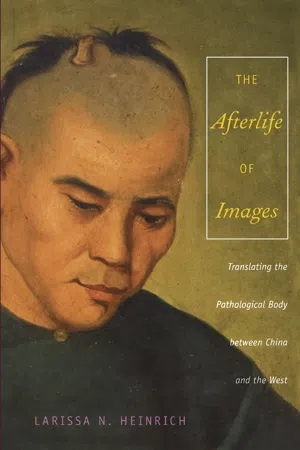
In 1739 China's emperor authorized the publication of a medical text that included images of children with smallpox to aid in the diagnosis and treatment of the disease. Those images made their way to Europe, where they were interpreted as indicative of the ill health and medical backwardness of the Chinese. In the mid-nineteenth century, the celebrated Cantonese painter Lam Qua collaborated with the American medical missionary Peter Parker in the creation of portraits of Chinese patients with disfiguring pathologies, rendered both before and after surgery. Europeans saw those portraits as evidence of Western medical prowess. Within China, the visual idiom that the paintings established influenced the development of medical photography. In The Afterlife of Images, Ari Larissa Heinrich investigates the creation and circulation of Western medical discourses that linked ideas about disease to Chinese identity beginning in the eighteenth century.
Combining literary studies, the history of science, and visual culture studies, Heinrich analyzes the rhetoric and iconography through which medical missionaries transmitted to the West an image of China as "sick" or "diseased." He also examines the absorption of that image back into China through missionary activity, through the earliest translations of Western medical texts into Chinese, and even through the literature of Chinese nationalism. Heinrich argues that over time "scientific" Western representations of the Chinese body and culture accumulated a host of secondary meanings, taking on an afterlife with lasting consequences for conceptions of Chinese identity in China and beyond its borders.
Frequently asked questions
Yes, you can cancel anytime from the Subscription tab in your account settings on the Perlego website. Your subscription will stay active until the end of your current billing period. Learn how to cancel your subscription.
No, books cannot be downloaded as external files, such as PDFs, for use outside of Perlego. However, you can download books within the Perlego app for offline reading on mobile or tablet. Learn more here.
Perlego offers two plans: Essential and Complete
- Essential is ideal for learners and professionals who enjoy exploring a wide range of subjects. Access the Essential Library with 800,000+ trusted titles and best-sellers across business, personal growth, and the humanities. Includes unlimited reading time and Standard Read Aloud voice.
- Complete: Perfect for advanced learners and researchers needing full, unrestricted access. Unlock 1.4M+ books across hundreds of subjects, including academic and specialized titles. The Complete Plan also includes advanced features like Premium Read Aloud and Research Assistant.
We are an online textbook subscription service, where you can get access to an entire online library for less than the price of a single book per month. With over 1 million books across 1000+ topics, we’ve got you covered! Learn more here.
Look out for the read-aloud symbol on your next book to see if you can listen to it. The read-aloud tool reads text aloud for you, highlighting the text as it is being read. You can pause it, speed it up and slow it down. Learn more here.
Yes! You can use the Perlego app on both iOS or Android devices to read anytime, anywhere — even offline. Perfect for commutes or when you’re on the go.
Please note we cannot support devices running on iOS 13 and Android 7 or earlier. Learn more about using the app.
Yes, you can access The Afterlife of Images by Ari Larissa Heinrich, Arjun Appadurai, Judith Farquhar, Arjun Appadurai,Judith Farquhar in PDF and/or ePUB format, as well as other popular books in History & History of Art. We have over one million books available in our catalogue for you to explore.
Information
Publisher
Duke University Press BooksYear
2008Print ISBN
9780822341130, 9780822340935eBook ISBN
9780822388821Table of contents
- Cover
- TABLE OF CONTENTS
- List of Illustrations
- Acknowledgments
- Introduction
- 1. How China Became the “Cradle of Smallpox”: Transformations in Discourse
- 2. The Pathological Body: Lam Qua’s Medical Portraiture
- 3. The Pathological Empire: Early Medical Photography in China
- 4. “What’s Hard for the Eye to See”: Anatomical Aesthetics from Benjamin Hobson to Lu Xun
- Epilogue: Through the Microscope
- Notes
- Bibliography
- Index