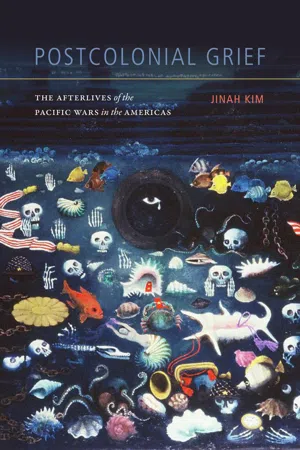
In Postcolonial Grief Jinah Kim explores the relationship of mourning to transpacific subjectivities, aesthetics, and decolonial politics since World War II. Kim argues that Asian diasporic subjectivity exists in relation to afterlives because the deaths of those killed by U.S. imperialism and militarism in the Pacific remain unresolved and unaddressed. Kim shows how primarily U.S.-based Korean and Japanese diasporic writers, artists, and filmmakers negotiate the necropolitics of Asia and how their creative refusal to heal from imperial violence may generate transformative antiracist and decolonial politics. She contests prevalent interpretations of melancholia by engaging with Frantz Fanon's and Hisaye Yamamoto's decolonial writings; uncovering the noir genre's relationship to the U.S. war in Korea; discussing the emergence of silenced colonial histories during the 1992 Los Angeles riots; and analyzing the 1996 hostage takeover of the Japanese ambassador's home in Peru. Kim highlights how the aesthetic and creative work of the Japanese and Korean diasporas offers new insights into twenty-first-century concerns surrounding the state's erasure of military violence and colonialism and the difficult work of remembering histories of war across the transpacific.
- 201 pages
- English
- PDF
- Available on iOS & Android
eBook - PDF
About this book
Information
Publisher
Duke University Press BooksYear
2019Print ISBN
9781478002932
9781478001355
eBook ISBN
9781478002796
Table of contents
- Cover
- Contents
- Acknowledgments
- Introduction. Mourning Empire
- One. Melancholy Violence: Frantz Fanon’s The Wretched of the Earth and Hisaye Yamamato’s “A Fire in Fontana"
- Two. Haunting Absence: Racial Cognitive Mapping, Interregnum, and the Los Angeles Riots of 1992
- Three. Transpacific Noir, Dying Colonialism
- Four. Destined for Death: Antigone along the Pacific Rim
- Epilogue. Watery Graves
- Notes
- Bibliography
- Index
Trusted by 375,005 students
Access to over 1.5 million titles for a fair monthly price.
Study more efficiently using our study tools.
Frequently asked questions
Yes, you can cancel anytime from the Subscription tab in your account settings on the Perlego website. Your subscription will stay active until the end of your current billing period. Learn how to cancel your subscription
No, books cannot be downloaded as external files, such as PDFs, for use outside of Perlego. However, you can download books within the Perlego app for offline reading on mobile or tablet. Learn how to download books offline
Perlego offers two plans: Essential and Complete
- Essential is ideal for learners and professionals who enjoy exploring a wide range of subjects. Access the Essential Library with 800,000+ trusted titles and best-sellers across business, personal growth, and the humanities. Includes unlimited reading time and Standard Read Aloud voice.
- Complete: Perfect for advanced learners and researchers needing full, unrestricted access. Unlock 1.5M+ books across hundreds of subjects, including academic and specialized titles. The Complete Plan also includes advanced features like Premium Read Aloud and Research Assistant.
We are an online textbook subscription service, where you can get access to an entire online library for less than the price of a single book per month. With over 1.5 million books across 990+ topics, we’ve got you covered! Learn about our mission
Look out for the read-aloud symbol on your next book to see if you can listen to it. The read-aloud tool reads text aloud for you, highlighting the text as it is being read. You can pause it, speed it up and slow it down. Learn more about Read Aloud
Yes! You can use the Perlego app on both iOS and Android devices to read anytime, anywhere — even offline. Perfect for commutes or when you’re on the go.
Please note we cannot support devices running on iOS 13 and Android 7 or earlier. Learn more about using the app
Please note we cannot support devices running on iOS 13 and Android 7 or earlier. Learn more about using the app
Yes, you can access Postcolonial Grief by Jinah Kim in PDF and/or ePUB format, as well as other popular books in Social Sciences & North American Literary Criticism. We have over 1.5 million books available in our catalogue for you to explore.