- English
- PDF
- Available on iOS & Android
eBook - PDF
About this book
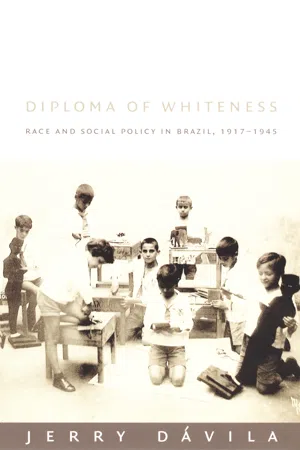
In Brazil, the country with the largest population of African descent in the Americas, the idea of race underwent a dramatic shift in the first half of the twentieth century. Brazilian authorities, who had considered race a biological fact, began to view it as a cultural and environmental condition. Jerry Dávila explores the significance of this transition by looking at the history of the Rio de Janeiro school system between 1917 and 1945. He demonstrates how, in the period between the world wars, the dramatic proliferation of social policy initiatives in Brazil was subtly but powerfully shaped by beliefs that racially mixed and nonwhite Brazilians could be symbolically, if not physically, whitened through changes in culture, habits, and health.
Providing a unique historical perspective on how racial attitudes move from elite discourse into people's lives, Diploma of Whiteness shows how public schools promoted the idea that whites were inherently fit and those of African or mixed ancestry were necessarily in need of remedial attention. Analyzing primary material—including school system records, teacher journals, photographs, private letters, and unpublished documents—Dávila traces the emergence of racially coded hiring practices and student-tracking policies as well as the development of a social and scientific philosophy of eugenics. He contends that the implementation of the various policies intended to "improve" nonwhites institutionalized subtle barriers to their equitable integration into Brazilian society.
Frequently asked questions
Yes, you can cancel anytime from the Subscription tab in your account settings on the Perlego website. Your subscription will stay active until the end of your current billing period. Learn how to cancel your subscription.
At the moment all of our mobile-responsive ePub books are available to download via the app. Most of our PDFs are also available to download and we're working on making the final remaining ones downloadable now. Learn more here.
Perlego offers two plans: Essential and Complete
- Essential is ideal for learners and professionals who enjoy exploring a wide range of subjects. Access the Essential Library with 800,000+ trusted titles and best-sellers across business, personal growth, and the humanities. Includes unlimited reading time and Standard Read Aloud voice.
- Complete: Perfect for advanced learners and researchers needing full, unrestricted access. Unlock 1.4M+ books across hundreds of subjects, including academic and specialized titles. The Complete Plan also includes advanced features like Premium Read Aloud and Research Assistant.
We are an online textbook subscription service, where you can get access to an entire online library for less than the price of a single book per month. With over 1 million books across 1000+ topics, we’ve got you covered! Learn more here.
Look out for the read-aloud symbol on your next book to see if you can listen to it. The read-aloud tool reads text aloud for you, highlighting the text as it is being read. You can pause it, speed it up and slow it down. Learn more here.
Yes! You can use the Perlego app on both iOS or Android devices to read anytime, anywhere — even offline. Perfect for commutes or when you’re on the go.
Please note we cannot support devices running on iOS 13 and Android 7 or earlier. Learn more about using the app.
Yes, you can access Diploma of Whiteness by Jerry Dávila in PDF and/or ePUB format, as well as other popular books in Education & Education Theory & Practice. We have over one million books available in our catalogue for you to explore.
Information
Table of contents
- CONTENTS
- Acknowledgments
- Introduction
- 1. Building the "Brazilian Man"
- 2. Educating Brazil
- 3. What Happened to Rio’s Teachers of Color?
- 4. Elementary Education
- 5. Escola Nova no Estado Novo: The New School in the New State
- 6. Behaving White: Rio’s Secondary Schools
- Epilogue: The Enduring Brazilian Fascination with Race
- List of Abbreviations
- Notes
- Bibliography
- Index